All comparisons
An alternative to SyteAI enrichment tools

Anglera vs Syte

The bottom line

Buy Syte for visual search and on-site discovery in fashion, jewelry, or home decor; its deep tagging is real but lands in Syte's own layer. Buy Anglera if the catalog data itself has to be right in your system of record.

Both claim to enrich product data. This page is about where that claim stops.

The frame for this comparison

Product data is a practice, not a project.

Every tool in this market sells you one act and calls it the whole play. The useful question isn't whether Syte is good at its act — it's what happens to the other two.

01

Ground it

Mine every spec from every source.

Every value traced to a document you can open. The catalog is only as honest as what it was built from.

02

Align it

Aim the catalog at the buyer who actually buys.

Grounded data still loses if it answers questions nobody asked. Alignment is what turns specs into conversion.

03

Keep it alive

Product data is a practice, not a project.

Markets move, suppliers reissue, buyers change what they ask for. A catalog that is right in March is wrong by August unless something is watching.
Capability by capability

Where Syte stops.

Scored against public documentation. Grouped by the three acts — so you can see which ones Syte leaves on your desk.

01

Ground it

Mine every spec from every source.
Source mining
Where does it get specs from?
SyteLimited

Product images and text; no supplier PDFs or manuals

AngleraYes

PDFs, spec tables, drawings, manuals, images, sites

Schema discovery
Does it find attributes that aren't in your schema yet?
SyteLimited

Applies prebuilt 15k lexicon; does not discover new attributes

AngleraYes

Proposes fields your schema never had

Governed vocabulary
Does it turn messy free-text into a governed pick list?
SyteYes

Lexicon Manager normalizes tags into controlled, mappable value set

AngleraYes

Normalizes and governs allowed values, versioned

Taxonomy & classification
Can it classify every SKU into your hierarchy?
SyteLimited

Auto-categorizes and maps to your taxonomy; on-site, not marketplaces

AngleraYes

Auto-classifies; channel and marketplace mapping

Citations & provenance
Can you see where any given value came from?
SyteNo

Tags Editor allows review; no per-value source citation found

AngleraYes

Every value cites its source doc and page

02

Align it

Aim the catalog at the buyer who actually buys.
Buyer personas
Is the content written for your buyer, or generically?
SyteNo

Personalizes recommendations per shopper, not the enrichment output

AngleraYes

B2B specifier and B2C shopper enriched differently

Review, search & social signals
Does it learn what buyers ask from the live market?
SyteLimited

Deep Tag Analytics reports trending attributes to merchandisers

AngleraYes

Reviews, search, competitor rails, social — fed back

Copy & SEO
Does it write original, channel-ready copy?
SyteLimited

Generates product descriptions; no bullets or FAQs found

AngleraYes

Original copy per persona and channel

Product imagery
Can it produce usable images for SKUs that lack them?
SyteNo

Visual search and tagging only; no image generation

AngleraYes

Generates studio-grade imagery for photoless SKUs

03

Keep it alive

Product data is a practice, not a project.
Continuous re-enrichment
What happens when the market moves after go-live?
SyteLimited

Auto-tags new SKUs on feed refresh; no autonomous re-enrichment

AngleraYes

Re-enriches on its own after go-live

Quality scoring
Does it score its own output and track catalog health?
SyteNo

Analytics track tag and search performance, not data completeness

AngleraYes

Scored against your standards; nothing publishes below bar

Write-back
Does enriched data land back in your system of record?
SyteLimited

Tags retrievable via API; no PIM connector found

AngleraYes

Writes back to PIM, ERP, warehouse, commerce

API, MCP & webhooks
Can your own tools and agents drive it headlessly?
SyteYes

REST API, webhooks, and SDKs; no MCP server

AngleraYes

API, webhooks, and MCP servers

Who does the work
Does it do the work, or help your team do it?
SyteYour team

Software; your merchandisers review tags and own rules

AngleraYes

Anglera owns the work; review is a guardrail

KeyYesships itLimitedlimited or gatedYour teamyour team still does itNodoesn't do itAnglera differentiator
The part nobody else does

Syte fills the fields you defined.
Anglera finds the ones you didn't.

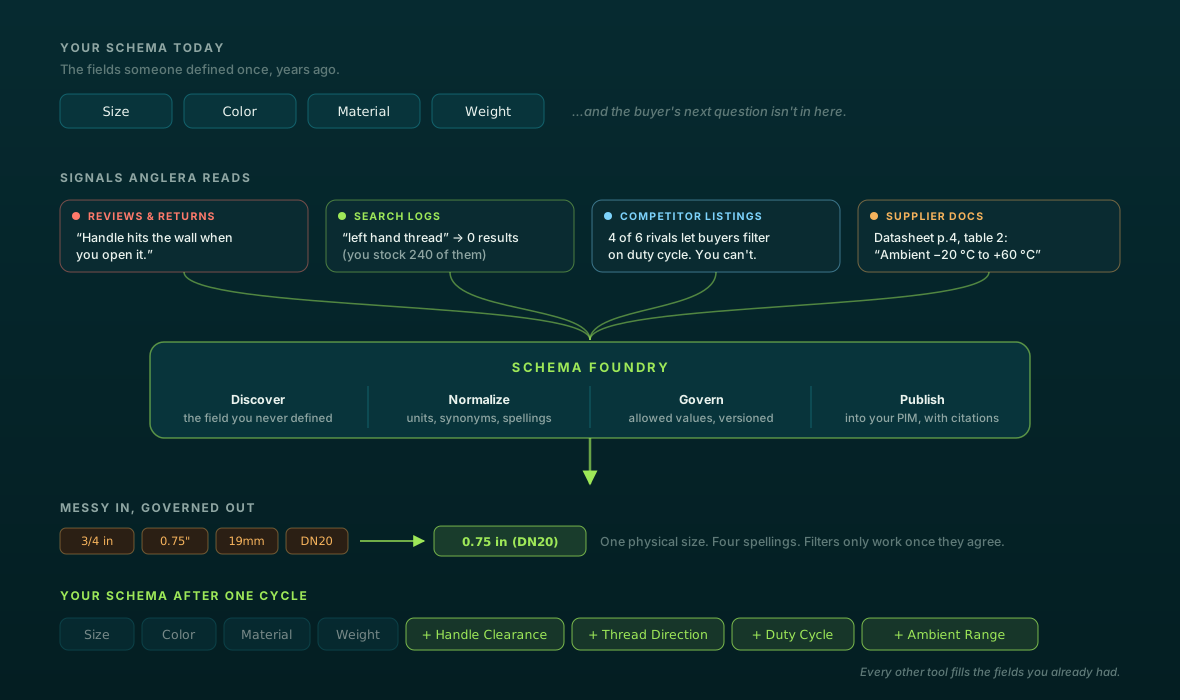
Every enrichment tool on the market takes your schema as a given and fills the blanks in it. That ceiling is invisible: your catalog can hit 100% complete and still be missing the attribute that loses the sale — because completeness is measured against a schema someone drew years ago.

Schema Foundry: signals from reviews, search logs, competitor listings and supplier documents reveal attributes missing from your schema; the Foundry discovers, normalizes and governs them, so your schema ends the cycle with more fields than it started with.
Nominal Size
3/4 in0.75"3/4"19mm3/4 inchDN20
0.75 in (DN20)

Six suppliers, six spellings, one physical size. Filters only work once they agree.

Finish
BlkblackBLACK MATTEMatte BlkRAL 9005
Black — Matte

Free text makes a colour filter useless. A governed value makes it a facet.

Material
SS316316 StainlessStainless Steel 316A4 Stainless
Stainless Steel — 316 / A4

Same alloy, four vocabularies, plus a trade name. Buyers search all of them.

What “buyer signals” actually means

Six signals Syte isn't reading.

“Buyer signals” is the emptiest phrase in this category, so here is the literal thing. Each of these is an observation from a live market, the gap it exposes, and the field that gets created as a result.

Review signal·Product reviews & returns notes

“Handle hits the wall when you open it” shows up across the 2- and 3-star reviews on a brass ball valve — and in the return reasons behind it.

Clearance is why the product came back, and no field anywhere describes it.

Field createdHandle Clearance (fully open)Millimetres, measured from valve centreline
Search signal·On-site & marketplace search logs

“left hand thread” is searched steadily on your own site and returns zero results — while you stock 240 left-hand-threaded SKUs.

You have the products. You do not have the attribute, so search cannot find them.

Field createdThread DirectionRight-hand (RH) · Left-hand (LH)
Social signal·Trade forums, YouTube teardowns, TikTok

Contractors comparing compressors argue about noise in decibels months before any RFQ mentions it.

The dB rating is sitting in the supplier PDF. It is not a field, so it is not a filter.

Field createdSound Level (dB)dB(A) at 1 m, integer
Competitor signal·Competitor listings & filter rails

Four of six competitors let a buyer filter welders by duty cycle. Your category has no such field.

Buyers who filter on duty cycle never see your catalog at all.

Field createdDuty Cycle% at rated amperage (e.g. 60% @ 200 A)
Supplier signal·Supplier PDFs, spec tables & drawings

Page 4 of the datasheet has “Ambient operating range −20 °C to +60 °C” in a table nobody ever mapped.

The data arrived years ago and died in a PDF because no field was waiting for it.

Field createdAmbient Operating RangeMin/max °C pair
Marketplace signal·Channel rejection logs

Listings bounce for a missing Country of Origin that is printed on the packaging and in the customs paperwork.

A required field for the channel that was never required by the PIM.

Field createdCountry of OriginISO 3166-1 alpha-2

What Syte does

Syte sells an AI product discovery platform for ecommerce: camera and visual search, Shop the Look, personalized recommendations, and augmented text search. Underneath sits automated "deep tagging," which uses visual AI plus NLP to tag catalog items against a lexicon of 15,000+ attributes tuned for fashion, jewelry, home decor, furniture, DIY, and eyewear. A Tags Editor and Lexicon Manager let merchandisers moderate tags and map Syte's attributes onto their own taxonomy, while Deep Tag Analytics reports trending attributes for assortment and inventory planning. Syte was acquired by Nayax and is now also marketed as Syte by Nayax.

Pricing: Not publicly disclosed. Syte publishes no pricing page and routes buyers to a demo; G2 reviewers note the lack of transparent pricing complicates evaluation. Marketing cites ROI figures (e.g. 423% average ROI, up to 90% lower tagging costs) rather than rates or tiers. API access requires contacting Syte for verified developer credentials.

Syte website

When Syte is the right call

Fashion, jewelry, and home-decor retailers whose goal is camera search, Shop the Look, and visual recommendations on-site, and who treat attribute tagging as fuel for that experience.

We'd rather tell you here than in month three of an implementation.

Capability verdicts reviewed against Syte's public documentation on July 14, 2026. Vendors ship quickly — if something here is out of date, tell us and we'll correct it.

Find the attributes you're missing.

Bring one category. We'll run Schema Foundry against it and show you the fields your schema doesn't have yet — on your own SKUs, in 30 minutes.

Book a demo