Both, if AI-shopping visibility is the goal. Wildcard tracks ChatGPT and Gemini rankings and enriches from product photos; Anglera goes deeper on the data model — supplier docs, governed vocabulary, provenance. Overlap is narrow.
Both claim to enrich product data. This page is about where that claim stops.
The frame for this comparison
Product data is a practice, not a project.
Wildcard's enrichment is aimed at winning the AI answer; this comparison turns on what happens to those fields after the first pass — when the supplier reissues the spec sheet, a SKU forks into a variant, and a marketplace adds a facet nobody had a field for — because product data is a practice, not a project.
01
Ground it
Mine every spec from every source.
Every value traced to a document you can open. The catalog is only as honest as what it was built from.
02
Align it
Aim the catalog at the buyer who actually buys.
Grounded data still loses if it answers questions nobody asked. Alignment is what turns specs into conversion.
03
Keep it alive
Product data is a practice, not a project.
Markets move, suppliers reissue, buyers change what they ask for. A catalog that is right in March is wrong by August unless something is watching.
Capability by capability
Where Wildcard stops.
Scored against public documentation. Grouped by the three acts — so you can see which ones Wildcard leaves on your desk.
01
Ground it
Mine every spec from every source.
CapabilityWildcardAnglera
Source mining
Where does it get specs from?
WildcardLimited
Product photos and identifiers; no supplier PDFs or manuals
Can it produce usable images for SKUs that lack them?
WildcardNo
Extracts attributes from photos; no image generation
AngleraYes
Generates studio-grade imagery for photoless SKUs
03
Keep it alive
Product data is a practice, not a project.
CapabilityWildcardAnglera
Continuous re-enrichment
What happens when the market moves after go-live?
WildcardLimited
Continuous visibility monitoring; auto re-enrichment claimed, undetailed
AngleraYes
Re-enriches on its own after go-live
Quality scoring
Does it score its own output and track catalog health?
WildcardLimited
Tracks AI visibility rankings; not data-completeness scoring
AngleraYes
Scored against your standards; nothing publishes below bar
Write-back
Does enriched data land back in your system of record?
WildcardYes
Pushes to Shopify metafields, SFCC, Akeneo, Salsify
AngleraYes
Writes back to PIM, ERP, warehouse, commerce
API, MCP & webhooks
Can your own tools and agents drive it headlessly?
WildcardLimited
API for custom platforms; no webhooks or catalog MCP
AngleraYes
API, webhooks, and MCP servers
Who does the work
Does it do the work, or help your team do it?
WildcardLimited
Agent-run enrichment; human review workflow undocumented
AngleraYes
Anglera owns the work; review is a guardrail
KeyYesships itLimitedlimited or gatedYour teamyour team still does itNodoesn't do itAnglera differentiator
What “buyer signals” actually means
Six signals sitting in your market right now.
“Buyer signals” is the emptiest phrase in this category, so here is the literal thing. Each of these is an observation from a live market, the gap it exposes, and the field that gets created as a result.
Review signal·the Q&A tab on the product page, and the two-star reviews under it
Three separate questions in a month asking whether the jogging stroller fits in a Golf hatchback boot with the rear seats up. The thread ends with another shopper saying "just measure it yourself, mine barely went in."
Folded dimensions are on the supplier's drawing and nowhere in the catalog. The copy says "compact fold," which no filter and no assistant can act on.
Field createdfolded_dimensions_l_w_h_cmCentimetres to one decimal, always L x W x H, measured wheels-on with the handlebar collapsed — the state the buyer is actually loading.
Search signal·site-search logs, filtered to zero- and low-result queries
"induction" returns four SKUs out of a sixty-piece cookware range. The carbon-steel skillets and the enamelled cast-iron Dutch ovens are all magnetic-base and none of them say so anywhere machine-readable.
Compatibility sits mid-paragraph in the description on some SKUs and is absent on others, so the facet cannot see it and neither can a shopping answer.
Field createdcooktop_compatibility (multi-select)gas | electric coil | ceramic radiant | induction | halogen | open flame — derived from base material and base-plate construction, not from marketing copy.
Marketplace signal·the marketplace item spec and its "4mm and under" drop filter
A trail runner with heel_stack 32mm and forefoot_stack 28mm populated falls out of the low-drop filter entirely, while the near-identical competitor SKU sits inside it.
A derivable field nobody owns. Both inputs are present and the arithmetic is trivial, but nothing recomputes the drop when the shoe is reissued on a new midsole.
Field createdheel_to_toe_drop_mmInteger millimetres, heel_stack minus forefoot_stack, measured at men's US 9 sample size, rounded to the nearest whole mm.
Why catalogs rot
Why the gaps come back
Wildcard is explicit about a guardrail we'd defend too: enriched fields stay tied to approved product facts and source evidence, and unsupported claims remain gaps instead of becoming catalog data. The catalog question is what happens to that gap list next month. Suppliers reissue spec sheets. A SKU forks into a 240V variant. A marketplace adds a facet — heel-to-toe drop, kcal per cup — that no schema had a field for. Each event reopens a gap the first pass correctly left open, and none of them announce themselves. Wildcard's stated scoreboard is what ranks, plus every order tied back to the AI surface and the work that earned it. That is a real measurement, and the one its buyer is hired to move. Anglera keeps the other one: fill rate against a category schema, held per SKU, per release. Find the evidence, fill the field, show the source.
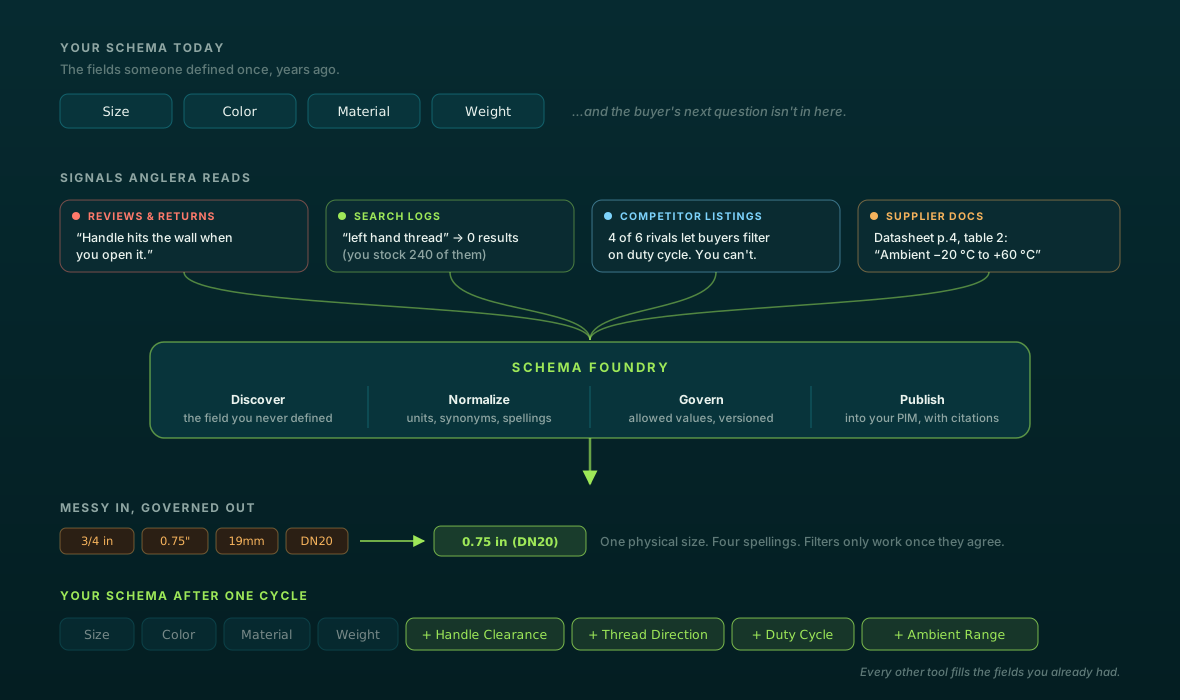
Messy in, governed out.
Values are normalized into a governed, versioned set of allowed values — so a filter works, and keeps working after the next import.
Nominal Size
3/4 in0.75"3/4"19mm3/4 inchDN20
0.75 in (DN20)
Six suppliers, six spellings, one physical size. Filters only work once they agree.
Finish
BlkblackBLACK MATTEMatte BlkRAL 9005
Black — Matte
Free text makes a colour filter useless. A governed value makes it a facet.
Material
SS316316 StainlessStainless Steel 316A4 Stainless
Stainless Steel — 316 / A4
Same alloy, four vocabularies, plus a trade name. Buyers search all of them.
And the part nobody else does
We don't just fill the template you handed us.
Filling the fields you defined has an invisible ceiling: a catalog can hit 100% complete and still miss the attribute that loses the sale, because completeness is measured against a schema someone drew years ago. Schema Foundry reads competitor listings, buyer searches, review complaints and your supplier docs, and proposes the fields you never defined — which is where Wildcard stops.
Wildcard (YC W25) sells AEO/GEO for e-commerce and retail brands. It monitors where products surface across ChatGPT Shopping, Google AI Overviews, Gemini, and Amazon Rufus, tracks competitor rankings and the queries they win, then uses AI agents to close gaps — enriching data and generating brand-voice descriptions, collection pages, blogs, and FAQs. Catalog enrichment works primarily from product photos and universal product identifiers, extracting material, colorway, fit, style, and dimensions. Structured data pushes into Shopify metafields, BigCommerce, Magento, WooCommerce, SFCC, Akeneo, and Salsify; they also implement ACP and UCP instant checkout.
Pricing: Not publicly disclosed. The site states tiered plans based on number of products monitored and platforms covered, from a Startup tier to Enterprise with custom requirements, behind a "contact us / book a demo" CTA. No dollar figures, seat counts, or SKU thresholds are published, and the /pricing URL 404s as of July 2026. ACP/UCP instant checkout appears to be scoped separately.
DTC and Shopify brands whose top priority is getting cited in ChatGPT Shopping and Gemini — especially apparel or vintage catalogs where the product photo is the only reliable data source.
We'd rather tell you here than in month three of an implementation.
Capability verdicts reviewed against Wildcard's public documentation on July 14, 2026. Vendors ship quickly — if something here is out of date, tell us and we'll correct it.
See it on your own SKUs.
Bring one category and your supplier files. In 30 minutes you'll see it enriched — complete, structured, and consistent enough to launch on — plus the attributes your schema didn't have yet.