1WorldSync vs Akeneo: Syndication Pipe or System of Record?
1WorldSync and Akeneo are often mentioned in the same breath because both touch product data — but they solve different problems at different points in the data lifecycle. Buying the wrong one is a common and expensive mistake. Buying both when you only need one is also common. This page breaks down what each does, who genuinely needs it, and how a buyer should think about the decision.
1WorldSync is a GDSN (Global Data Synchronization Network) data pool and syndication platform. Its job is to take your GS1-structured product attributes and distribute them to 900+ retail trading partners — Walmart, Kroger, Target, and thousands of others — in the precise format each requires. It is the de facto standard for CPG brands and manufacturers selling into US grocery and mass-market retail. Akeneo, by contrast, is a PIM (Product Information Management) system. Its job is to be your internal system of record: one place where product teams build, maintain, and distribute content across every channel — ecommerce, wholesale catalogs, print, and marketplaces.
Both platforms share a critical assumption: that the product data coming in is already reasonably complete and accurate. 1WorldSync validates incoming attributes against GS1 schemas and rejects records that fail — it does not fill the gaps. Akeneo shows completeness scores and offers AI-assisted suggestions — but the catalog is still only as good as what gets entered. That gap between raw supplier data and distribution-ready content is where Anglera works, regardless of which platform you choose.
| 1WorldSync | Akeneo | Anglera | |
|---|---|---|---|
| Primary function | Syndicate GS1-structured product attributes to 900+ retail trading partners via the GDSN data pool; compliance and distribution, not content management | Centralize, organize, and distribute product content across channels as the internal system of record; the PIM your product teams work in every day | Enrich and score every SKU against buyer signals before it flows downstream — fills the preparation gap both platforms assume is already handled |
| Who it's built for | CPG brands and manufacturers whose retail partners (Walmart, Kroger, Target, club stores) require GDSN-synchronized data; common in grocery, foodservice, and consumer goods | Mid-market and enterprise retailers, distributors, and brands managing large catalogs across ecommerce, wholesale, marketplaces, and print — especially where localization or variant complexity is high | B2B distributors, retailers, and manufacturers who receive incomplete supplier data; works alongside whichever platform you already run |
| Data enrichment capability | Validates attributes against GS1 schemas and retailer-specific requirements; rejects or flags records that fail format checks — does not research or fill missing data | Completeness scoring and AI-assisted copy suggestions help editorial teams prioritize; AI can extract structured data from supplier PDFs and images, but still depends on human input at catalog scale | Automatically gathers missing attributes from supplier sites and external sources, normalizes values, scores completeness, and writes enriched records back to your system of record |
| Channel and partner reach | 14,000+ brands, 60+ countries, direct GDSN connections to major US grocery chains and global retailers; purpose-built for retail supply chain syndication | 250+ connectors in the Akeneo App Store (Shopify, SAP, Salesforce, Amazon, and more); API-first; connects to 1WorldSync via partner integrations when both are in the stack | Reads from and writes back to your existing PIM, ERP, or data store; enriched data flows into downstream channels automatically through your existing integrations |
| Implementation timeline | Weeks to several months; requires GTIN registration, data pool onboarding, and retailer-specific attribute mapping; specialized consultants commonly needed | 3–12 months for enterprise deployments; involves data modeling, catalog migration, connector setup, and team training | ~30 days; connects to your existing system of record without replacing it — no rip-and-replace, no parallel system to maintain |
| Pricing | Not publicly listed; estimated $500–$2,000/month for mid-market, $25,000–$90,000+/year for enterprise, plus $10,000–$100,000+ implementation fees; large enterprise contracts can reach ~$1M/year | Starts at $45,000/year (Growth package); higher tiers add collaboration workflows, analytics, DAM, and supplier data tools; requires a sales conversation | Priced per SKU enriched, not per seat or annual platform fee; designed to work alongside your existing PIM investment rather than replacing it |
How to choose between 1WorldSync and Akeneo
Choose 1WorldSync if you are a CPG brand or manufacturer whose retail buyers require GDSN-synchronized data. If Walmart, Kroger, Target, or any major grocery or mass-market chain is a customer or prospect, GDSN compliance is a practical non-negotiable — and 1WorldSync is the industry standard for satisfying it. Note that 1WorldSync is a syndication platform, not a PIM: you will still need somewhere to author and maintain product content, which means it typically pairs with a PIM rather than replacing one.
Choose Akeneo if you need a flexible, channel-agnostic system of record for product content. It fits retailers, distributors, and brands managing SKU counts in the thousands across ecommerce, wholesale, and marketplace channels — particularly where localization, complex product variants, or multi-channel publishing are priorities. If you also sell through GDSN-connected grocery retail, Akeneo integrates with 1WorldSync via its App Store.
Consider running both if you are a CPG brand or manufacturer that sells through grocery retail and also manages rich digital content for DTC, B2B, or international channels. In that scenario, Akeneo typically serves as the content hub and 1WorldSync as the compliance syndication layer to grocery trading partners — two tools doing two different jobs in sequence.
Whichever you pick, the data still has to get done
Neither platform fills the data. 1WorldSync validates what you give it — if attributes are missing, wrong, or inconsistent, it returns the record as failed or incomplete, and the manual rework lands back on your team. Akeneo organizes and distributes whatever content you put in — the PIM is only as good as what gets entered. Both tools are built for data that is already distribution-ready.
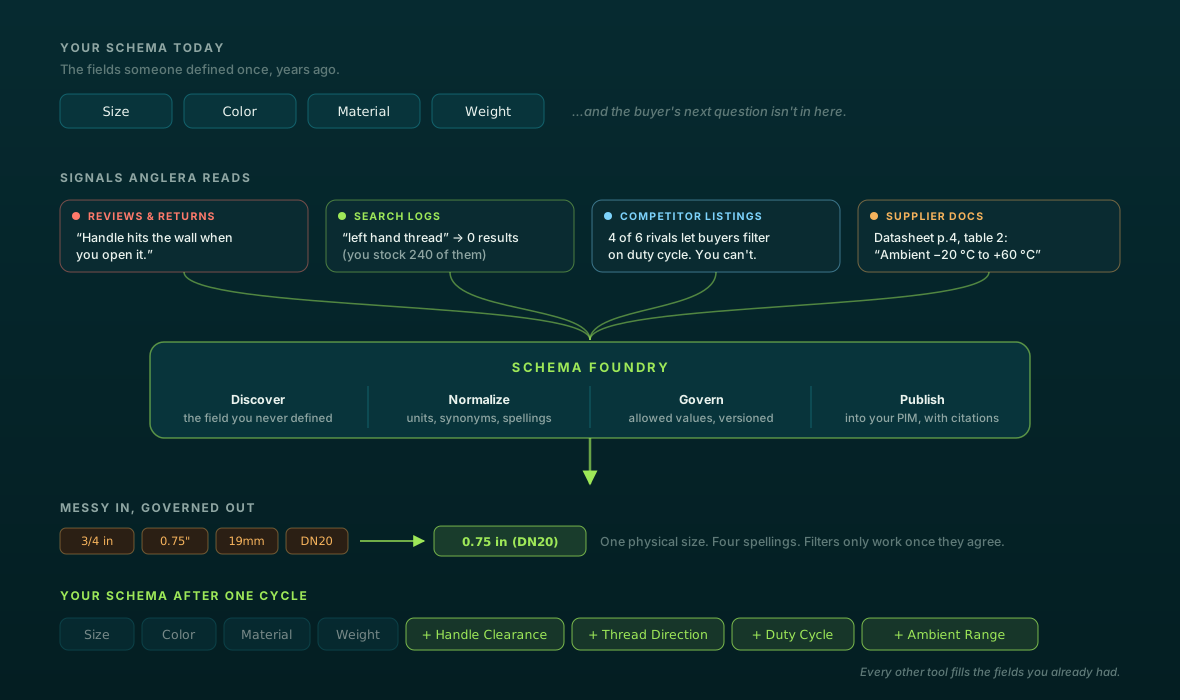
Anglera works upstream of both. It crawls supplier sites, pulls from buyer signals, normalizes units and values, scores every SKU against your attribute model, and writes the enriched record back to wherever you store product data — your Akeneo PIM, your 1WorldSync staging environment, your ERP. By the time your data reaches either platform's validation or distribution layer, it is already complete.
The workflow is additive, not disruptive. Anglera connects to your existing system of record in roughly 30 days and enriches in bulk, then keeps pace as your catalog grows or supplier feeds change. You keep whichever platform you have chosen. The data that flows through it gets better — and stays better.
Frequently asked questions
Can Akeneo replace 1WorldSync for GDSN syndication?
No. Akeneo is a PIM and can integrate with 1WorldSync, but it does not operate a GDSN data pool. If your retail partners require GDSN-synchronized data, you need a certified data pool — 1WorldSync is the most common choice in the US — regardless of which PIM you use.
Can 1WorldSync replace a PIM like Akeneo?
For narrow use cases it is possible — 1WorldSync does let you author and store GS1-structured product content. But it is optimized for trading partner syndication, not for multi-channel publishing, localization, variant management, or rich digital experience content. Most enterprises with complex catalogs use a dedicated PIM alongside it.
Does Akeneo's AI enrichment reduce the need for a separate enrichment tool?
Akeneo's AI features assist editors: they can extract structured data from supplier PDFs and images, suggest copy, and surface completeness gaps. They do not automatically research missing attributes from external sources or score content against real buyer search behavior at catalog scale. High-volume automated enrichment across large supplier catalogs typically still requires a dedicated enrichment layer.
How does Anglera fit if I'm already using both 1WorldSync and Akeneo?
Anglera connects to Akeneo as the source of truth, enriches SKUs with missing or thin attributes, and writes the improved data back. Your existing Akeneo-to-1WorldSync integration then carries clean, complete records into the syndication pipe — reducing 1WorldSync validation failures and the manual rework they cause.
My suppliers send us flat files with missing specs. Does either platform fix that?
Neither platform was designed to. 1WorldSync will reject or flag records with missing required GS1 attributes. Akeneo will store the incomplete record and flag it in completeness scoring — but the gap stays until someone fills it. Anglera is purpose-built for exactly this scenario: it takes incomplete supplier inputs, researches and fills the missing attributes, and writes complete records back to your system of record before they reach either platform.