All comparisons
Works with AkeneoPIM platforms

Anglera + Akeneo

The bottom line

Keep Akeneo as the system of record — it models families, scores quality, and syndicates. Add Anglera to fill the fields: PDF spec mining, buyer-signal-driven values, per-value citations, written back via the API.

Akeneo and Anglera solve different halves of the problem — this page is about the seam between them.

The frame for this comparison

Product data is a practice, not a project.

Akeneo is built to be the governed system of record — families, variants, rules, validation workflows, a data quality dashboard — so a comparison with it was never about where product data lives; it is about who does the daily work of finding the values those fields are waiting for, and who keeps doing it every time a family, a locale, or a channel adds one more.

01

Ground it

Mine every spec from every source.

Every value traced to a document you can open. The catalog is only as honest as what it was built from.

02

Align it

Aim the catalog at the buyer who actually buys.

Grounded data still loses if it answers questions nobody asked. Alignment is what turns specs into conversion.

03

Keep it alive

Product data is a practice, not a project.

Markets move, suppliers reissue, buyers change what they ask for. A catalog that is right in March is wrong by August unless something is watching.
Capability by capability

Where Akeneo stops.

Scored against public documentation. Grouped by the three acts — so you can see which ones Akeneo leaves on your desk.

01

Ground it

Mine every spec from every source.
Source mining
Where does it get specs from?
AkeneoLimited

Mines text fields and media assets; PDFs not input sources

AngleraYes

PDFs, spec tables, drawings, manuals, images, sites

Schema discovery
Does it find attributes that aren't in your schema yet?
AkeneoYes

Suggests new attributes from rejections, search trends; admin approves

AngleraYes

Proposes fields your schema never had

Governed vocabulary
Does it turn messy free-text into a governed pick list?
AkeneoLimited

Generates select options, reference entities; limited free-text normalization

AngleraYes

Normalizes and governs allowed values, versioned

Taxonomy & classification
Can it classify every SKU into your hierarchy?
AkeneoYes

AI classification into families, categories; channel category mapping

AngleraYes

Auto-classifies; channel and marketplace mapping

Citations & provenance
Can you see where any given value came from?
AkeneoLimited

Bot icon flags AI values; no per-value source citation

AngleraYes

Every value cites its source doc and page

02

Align it

Aim the catalog at the buyer who actually buys.
Buyer personas
Is the content written for your buyer, or generically?
AkeneoYour team

Channel/locale scoping holds variants; team configures persona prompts

AngleraYes

B2B specifier and B2C shopper enriched differently

Review, search & social signals
Does it learn what buyers ask from the live market?
AkeneoYes

Marketplace rejections, search and SEO trends feed attribute suggestions

AngleraYes

Reviews, search, competitor rails, social — fed back

Copy & SEO
Does it write original, channel-ready copy?
AkeneoYes

GenAI descriptions, SEO meta, translations; bring-your-own LLM

AngleraYes

Original copy per persona and channel

Product imagery
Can it produce usable images for SKUs that lack them?
AkeneoLimited

Prompt-based DAM edits: color variants, backgrounds, from existing asset

AngleraYes

Generates studio-grade imagery for photoless SKUs

03

Keep it alive

Product data is a practice, not a project.
Continuous re-enrichment
What happens when the market moves after go-live?
AkeneoLimited

Feedback loop surfaces suggestions; admins approve, not autonomous re-enrichment

AngleraYes

Re-enriches on its own after go-live

Quality scoring
Does it score its own output and track catalog health?
AkeneoYes

Data Quality Insights: A-E scores, six-month trend dashboards

AngleraYes

Scored against your standards; nothing publishes below bar

Write-back
Does enriched data land back in your system of record?
AkeneoYes

Is the record; connectors and syndication push to commerce, ERP

AngleraYes

Writes back to PIM, ERP, warehouse, commerce

API, MCP & webhooks
Can your own tools and agents drive it headlessly?
AkeneoYes

Public REST API, Event Platform webhooks, and MCP server

AngleraYes

API, webhooks, and MCP servers

Who does the work
Does it do the work, or help your team do it?
AkeneoYour team

Software with agent assist; customer's team owns the work

AngleraYes

Anglera owns the work; review is a guardrail

KeyYesships itLimitedlimited or gatedYour teamyour team still does itNodoesn't do itAnglera differentiator
What “buyer signals” actually means

Six signals sitting in your market right now.

“Buyer signals” is the emptiest phrase in this category, so here is the literal thing. Each of these is an observation from a live market, the gap it exposes, and the field that gets created as a result.

Review signal·one-star reviews on a marketplace listing for a 1/2 in. cordless impact wrench

Four reviewers in a row make the same complaint in different words: "Takes lug nuts off fine, but the socket came off in the driveway and I lost the pin."

The record carries drive size (1/2 in.) and max torque, because those are what the family models. How the socket is retained on the anvil decides the purchase for a tire shop versus a homeowner, and it is nowhere: not a field, not a facet, not a filter. Buyers infer it from photos and get it wrong.

Field createdanvil_retention_typeFriction ring | Detent pin | Hog ring | Through-hole pin
Search signal·internal site-search logs on a distributor storefront, electrical enclosures category

Repeated zero-result queries of the shape "nema 4x fiberglass 8x6x4" and "4x polycarbonate hinged 10x8". The dimension part matches hundreds of records; adding the material word kills it.

Material exists on the enclosure family as free text, and most records say "Plastic". Polycarbonate, fiberglass-reinforced polyester and ABS behave differently under UV and washdown, and the buyer typing the query already knows which one they need. A governed option list makes the value filterable; free-text "Plastic" fills the field without answering the question.

Field createdenclosure_materialPolycarbonate | Fiberglass-reinforced polyester | ABS | PVC | 304 stainless | 316 stainless | Painted carbon steel | Aluminum
Supplier signal·a manufacturer's cut sheet submitted through the vendor portal for a 2x4 LED troffer

The feed sends CCT: 4000K. Page two of the attached PDF has an ordering-code table with a footnote: DIP switch, 3500K / 4000K / 5000K, set at install.

The record now says the fixture is a fixed 4000K troffer. It is a selectable one, which is the reason a distributor stocks it: one SKU covers three specs. Spec writers filtering for field-selectable never see it, so it loses to a competitor's identical fixture that modeled the attribute, and the rep who knows the truth answers it by phone, one call at a time.

Field createdcct_selectabilityFixed | Field-selectable (3-step) | Field-selectable (5-step) | Tunable white
Why catalogs rot

The model outruns the fill

Akeneo's data quality dashboard monitors completeness, and the catalog model is what the records are measured against. Add `thread_standard` to the Pipe Fittings family because a distributor portal now demands it, and several thousand SKUs have an empty field where a moment ago they had none. Nothing changed on the shelf; a field is waiting for a fact nobody has gone and found. Two habits follow. Teams stop proposing attributes, because every addition creates a backlog they personally own. Or they fill to green: "N/A", "See catalog", the parent's value copied down the variant tree. The record is worse and it reads as complete. Activation does what it is built to do — adapt centralized PIM data to each channel's formatting and validation rules — and "N/A" arrives at Amazon. The structure holds. The supply of facts is the practice.

Messy in, governed out.

Values are normalized into a governed, versioned set of allowed values — so a filter works, and keeps working after the next import.

Nominal Size
3/4 in0.75"3/4"19mm3/4 inchDN20
0.75 in (DN20)

Six suppliers, six spellings, one physical size. Filters only work once they agree.

Finish
BlkblackBLACK MATTEMatte BlkRAL 9005
Black — Matte

Free text makes a colour filter useless. A governed value makes it a facet.

Material
SS316316 StainlessStainless Steel 316A4 Stainless
Stainless Steel — 316 / A4

Same alloy, four vocabularies, plus a trade name. Buyers search all of them.

And the part nobody else does

We don't just fill the template you handed us.

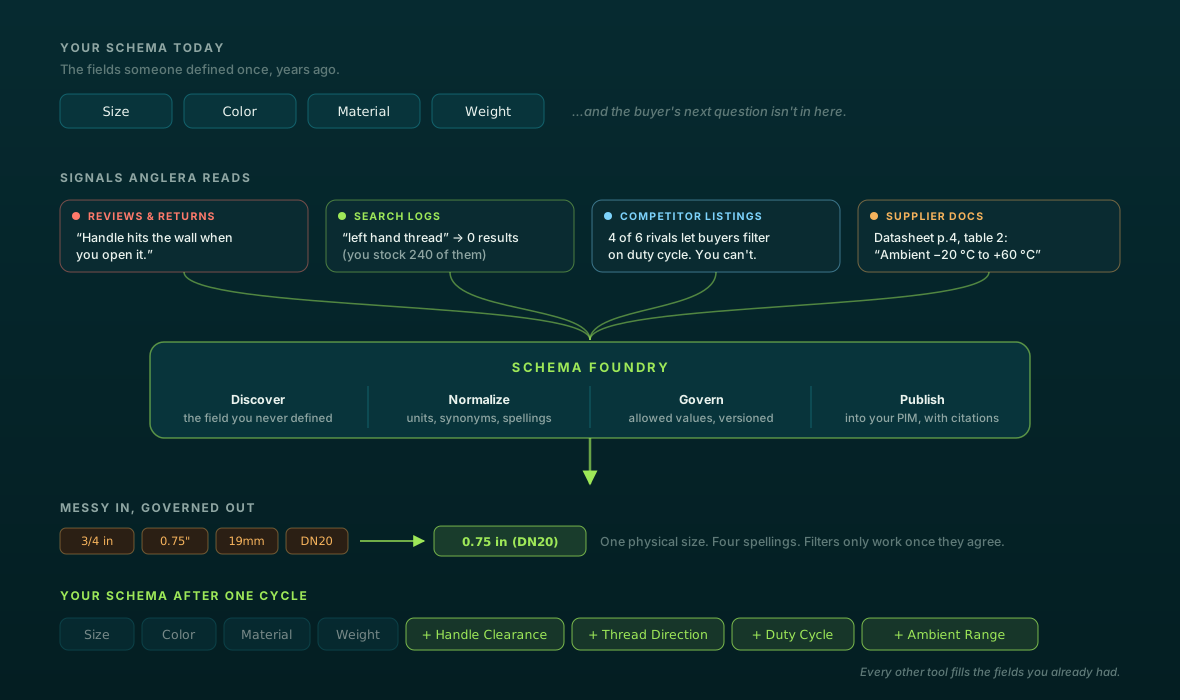
Filling the fields you defined has an invisible ceiling: a catalog can hit 100% complete and still miss the attribute that loses the sale, because completeness is measured against a schema someone drew years ago. Schema Foundry reads competitor listings, buyer searches, review complaints and your supplier docs, and proposes the fields you never defined — which is where Akeneo stops.

How Schema Foundry works
Schema Foundry: signals from reviews, search logs, competitor listings and supplier documents reveal attributes missing from your schema; the Foundry discovers, normalizes and governs them, so your schema ends the cycle with more fields than it started with.

What Akeneo does

Akeneo is a leading Product Information Management (PIM) platform that helps mid-market and enterprise companies centralize, enrich, and distribute product data across channels and locales. It is the system of record for product content, with an app store of 250+ integrations and recent additions of AI-assisted enrichment and PX Insights analytics.

Pricing: Starts at $45,000/year (Growth package). Advanced and Premium tiers add collaboration workflows, analytics, asset management, SSO, and supplier data tools. Pricing is not self-serve; requires a sales conversation.

Akeneo website

When Akeneo is the right call

Teams that need one governed home for product data across channels and locales — strong AI classification into families, A-E quality scoring with trend dashboards, and 250+ integrations.

We'd rather tell you here than in month three of an implementation.

Capability verdicts reviewed against Akeneo's public documentation on July 14, 2026. Vendors ship quickly — if something here is out of date, tell us and we'll correct it.

See it on your own SKUs.

Bring one category and your supplier files. In 30 minutes you'll see it enriched — complete, structured, and consistent enough to launch on — plus the attributes your schema didn't have yet.

Book a demo