Akeneo vs Feedonomics: Different Tools, Different Jobs
Akeneo and Feedonomics solve different problems in the product data supply chain, which makes this comparison both useful and potentially misleading. Akeneo is a Product Information Management platform — the system of record where your team centralizes, governs, and publishes product content across channels and locales. Feedonomics is a feed management and syndication platform — it takes your existing catalog and distributes it across 300+ ad channels and marketplaces, with dedicated specialists managing feed optimization on your behalf. One is upstream; the other is downstream.
If your catalog is incomplete, inconsistently structured, or living in spreadsheets and ERPs, no syndicator can fix that — Akeneo addresses the root problem. If you already have clean, organized product data and need broader channel reach with managed distribution, Feedonomics is the logical next investment. Companies that use both typically run Akeneo as the source of truth and Feedonomics as the distribution engine, though that stack still requires a third layer — enrichment — that neither platform handles automatically.
The real question this comparison surfaces: which layer of your product data problem is most urgent? Governance and organization (Akeneo), or distribution reach (Feedonomics)? Most teams need both eventually, but the sequencing matters.
| Akeneo | Feedonomics | Anglera | |
|---|---|---|---|
| Primary role | PIM — centralizes, governs, and publishes product content as the authoritative system of record across teams, channels, and locales | Feed management and syndication — transforms and distributes your existing product data across 300+ ad channels and marketplaces via managed specialists | Enrichment layer — researches, writes, and scores product content against buyer signals, then writes results back to your PIM; upstream of both |
| Position in the data supply chain | Upstream — the source of truth that downstream tools, including feed syndicators, pull from | Downstream — takes whatever is in your catalog and pushes it to channels; output quality depends entirely on the input it receives | Pre-PIM — enriches raw supplier data before it enters the PIM, ensuring what Akeneo stores and Feedonomics distributes is buyer-ready |
| Content enrichment capability | AI extracts structured data from supplier PDFs and images; PX Insights surfaces channel performance data for teams to act on manually; teams still write and approve final copy | Rule-based field mapping and title rewriting for channel compliance — optimizes feed format for each destination, not the quality of the underlying product content | Generates buyer-signal-driven titles, bullets, specs, and descriptions from scratch; scores every SKU for completeness and conversion readiness; writes results back to the PIM automatically |
| Channel distribution reach | 250+ integrations for multichannel publishing; distribution is available but Akeneo is not a managed distribution platform — your team owns that work | 300+ channels with dedicated feed specialists who manage setup, error resolution, and ongoing optimization on your behalf — no self-serve model | Not a distribution platform; enriches the content that flows through Akeneo's integrations or Feedonomics' feeds, making what goes out worth distributing |
| Service and implementation model | SaaS platform with onboarding support; your team configures and manages the PIM and enrichment workflows; implementation typically 3–12 months | Fully managed service — Feedonomics specialists own feed setup, ongoing optimization, and error resolution; no self-serve option | ~30-day implementation; automated enrichment pipeline runs continuously with minimal team involvement after initial setup |
| Pricing | From $45,000/year (Growth tier); no self-serve; requires a sales conversation | Custom quote only — no public pricing; varies by SKU count, channels, and service tier; no revenue-share model | Contact for pricing; no revenue-share; pairs with existing PIM and feed tools rather than replacing them |
| Best fit | Mid-market and enterprise companies managing complex catalogs across multiple teams, channels, and locales that need governed, structured product data as a foundation | Established retailers and brands with clean, organized product data that need managed, high-performance distribution across major ad platforms and marketplaces | Any company using Akeneo, Feedonomics, or both that needs the enrichment step — buyer-signal-driven content that makes what goes into the PIM and out through the feed actually convert |
How to choose between Akeneo and Feedonomics
Choose Akeneo if your core problem is organizing and governing product data. If product content lives across spreadsheets, ERPs, and supplier portals — inconsistently structured, hard to maintain, and difficult to publish to new channels — Akeneo is the right investment. It fits mid-market and enterprise teams that need workflow, approval, localization, and a single governed system for teams to collaborate around. Budget: $45,000+/year; plan for a multi-month implementation.
Choose Feedonomics if your catalog is already reasonably complete and organized, and your primary bottleneck is reach. If you need managed, high-performance distribution across Google Shopping, Amazon, Walmart, and 300+ other destinations — and you want specialists owning that distribution work rather than managing it in-house — Feedonomics is built for that job. It suits brands and retailers who want to outsource feed ops entirely, not buy software and build a team.
You likely need both if you are at enterprise scale: Akeneo as the source of truth, Feedonomics as the distribution engine. These tools are genuinely complementary rather than competing, and many large retailers and brands run both in sequence. The practical advice: get the PIM right first, then invest in distribution infrastructure. Syndicating weak, incomplete content to 300 channels is worse than syndicating to fewer channels with better data.
If you are unsure which problem is more urgent, ask one question: is our product data actually clean and complete, or are we distributing weak content to more places? If it is the latter, no syndicator fixes that — you need the upstream layer first.
Whichever you pick, the data still has to get done
Neither Akeneo nor Feedonomics solves the enrichment problem automatically. Akeneo gives you an excellent place to store and govern product data, but filling those fields with buyer-signal-driven content is still on your team. Feedonomics distributes whatever catalog data it receives — if your product descriptions are thin or your attributes are incomplete, Feedonomics sends that weak content to 300 channels at once, efficiently.
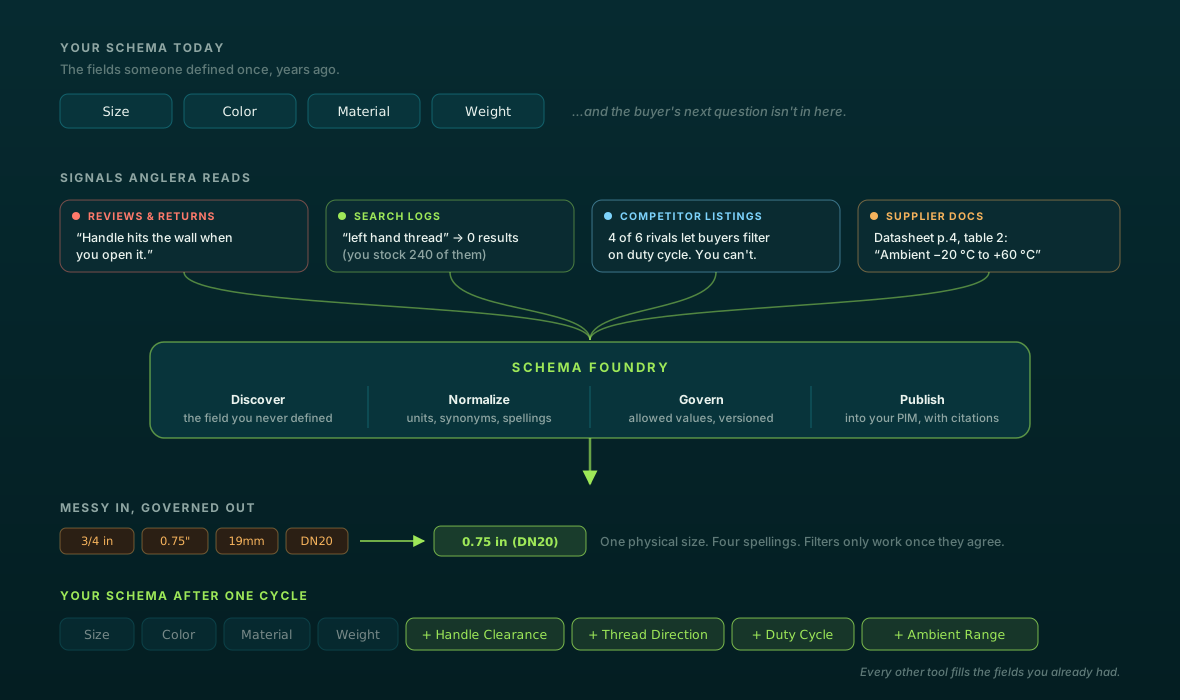
Anglera is the layer that does the work both platforms assume already happened. It reads your existing SKUs from the PIM, gathers external buyer signals — how real shoppers search, filter, and compare in your category — writes enriched titles, bullets, specs, and descriptions, scores every SKU for completeness and buyer readiness, and writes the results back to Akeneo in approximately 30 days. No PIM replacement. No rip-and-replace. The PIM stays the system of record; Anglera makes sure what is in it is worth distributing.
If you are adopting Feedonomics, Anglera ensures the feed going out is built to convert, not just built to validate. If you are on Akeneo, Anglera closes the gap between what your team can manually enrich and what your catalog actually needs to win at the digital shelf.
Frequently asked questions
Are Akeneo and Feedonomics competing tools?
Not exactly. Akeneo is a PIM — it organizes and governs product data upstream. Feedonomics is a feed syndicator — it distributes product data downstream to channels. Many companies use both in sequence: Akeneo as the source of truth, Feedonomics as the distribution layer. The comparison is most relevant for buyers deciding which problem to solve first, or which investment to prioritize when budget is limited.
Can Feedonomics replace a PIM?
No. Feedonomics transforms and distributes your existing product data; it does not serve as a system of record for organizing, governing, or enriching product content. It depends on a clean, complete catalog as its input — from a PIM, an ecommerce platform, or a data feed. Without an organized upstream source, Feedonomics is distributing whatever fragmented data you already have.
Does Akeneo's built-in distribution make Feedonomics redundant?
For some companies, yes. Akeneo's 250+ integrations can push product content to major channels directly. For companies that need Feedonomics' fully managed model — dedicated specialists, deep optimization across 300+ destinations, and hands-on error resolution — Akeneo's native connectors may not deliver equivalent channel coverage or service depth.
Where does enrichment fit in an Akeneo and Feedonomics stack?
Between raw supplier data and Akeneo. Enrichment ensures every SKU entering the PIM has buyer-signal-driven titles, complete attributes, and optimized copy — so when Feedonomics distributes it, the content converts. Anglera handles that layer: it enriches SKUs and writes results back to Akeneo before any downstream distribution, so every channel gets better data.
What does Anglera do that Akeneo's AI enrichment does not?
Akeneo's AI extracts structured data from supplier PDFs and images and automates some reformatting. It works with content the supplier already provided. Anglera starts from external buyer signals — search queries, competitor listings, and purchase patterns in your category — uses those signals to determine what attributes are missing and what language converts, then writes enriched content back to Akeneo. The output reflects buyer intent, not supplier content reformatted.