Akeneo vs Contentserv: PIM Comparison for Enterprise Product Teams
Akeneo and Contentserv (now branded Centric PXM) are both enterprise-grade product information management platforms, but they reflect two different architectural philosophies. Akeneo is a best-of-breed PIM — the system of record for product content that connects to a broader commerce stack through a 250+ partner app store. Contentserv bets on a single-vendor suite, bundling PIM, digital asset management, syndication, and digital shelf analytics into one platform.
The practical question for most buyers is not which has more features, but which model fits your organization. If your IT and operations teams prefer composable architecture and already have a DAM or syndication tool they trust, Akeneo integrates cleanly. If you want to consolidate vendors and your category — fashion, lifestyle, consumer goods, or luxury — demands rich media and localized content workflows, Contentserv is built for exactly that.
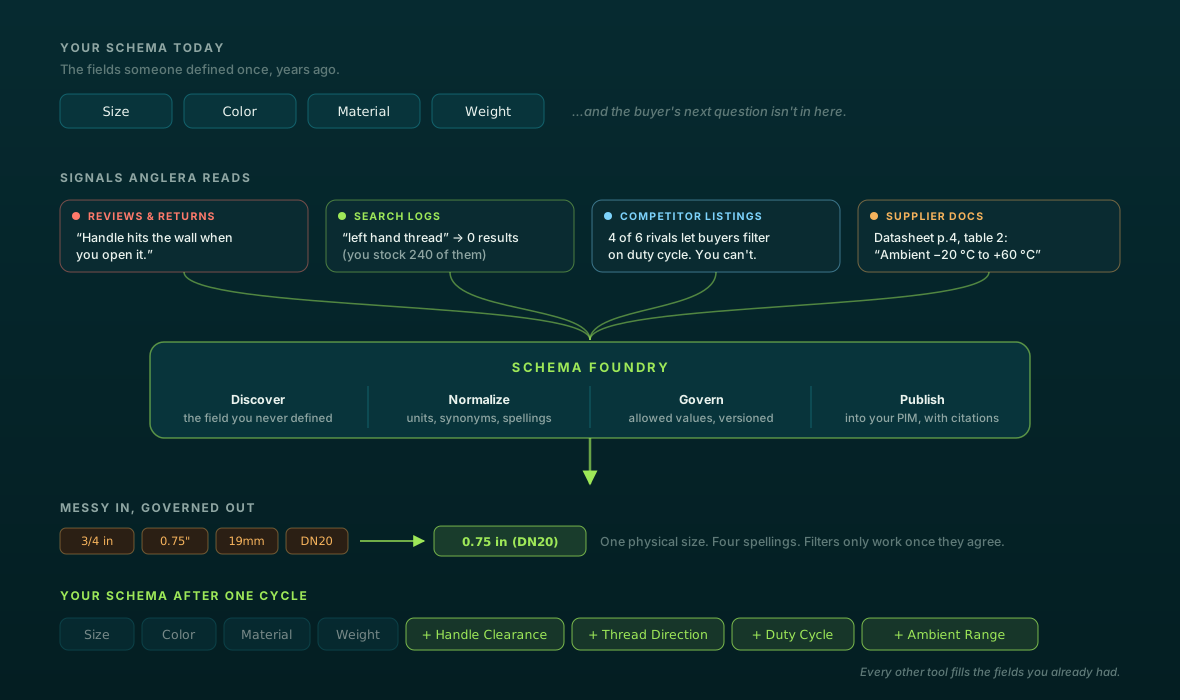
Neither platform, however, solves the upstream problem: getting complete, accurate, buyer-signal-scored product data into the PIM in the first place. Both Akeneo and Contentserv assume clean content arrives at the front door. For most teams it does not. That is where Anglera operates — not as a PIM, but as the enrichment engine that runs alongside whichever platform you choose.
| Akeneo | Contentserv | Anglera | |
|---|---|---|---|
| Platform architecture | Best-of-breed PIM. Akeneo is the system of record for product content and connects to the rest of your stack — DAM, commerce platform, syndication — through a curated app store of 250+ integrations. | All-in-one PXM suite. Contentserv bundles PIM, DAM, syndication, and digital shelf analytics under a single vendor and contract, reducing the number of point solutions to manage. | Sits outside both as a dedicated enrichment engine. Pulls raw or incomplete SKU data from suppliers and the web, cleans and scores it against buyer signals, and writes it back to whichever platform is your source of truth. |
| Digital asset management (DAM) | Available through app-store integrations with DAM partners. Teams that already have a DAM can connect it without replacing it; teams that do not will need to select and integrate a separate tool. | Built-in DAM for rich media and localized content. Fashion and lifestyle brands that need image variants, video, and locale-specific assets managed alongside product data benefit from having it in the same platform. | Focuses on structured product attributes, descriptions, and specifications rather than media files — but ensures the metadata and copy that accompany assets are complete, consistent, and scored for buyer relevance. |
| Channel syndication | Distributes product content through 250+ app-store connectors to retailers, marketplaces, and commerce platforms. Flexibility depends on which connectors exist or can be built. | Built-in syndication to 1,000+ channels, positioned as a core feature rather than an add-on. Broad channel coverage without requiring third-party syndication middleware. | Enriches and scores product content before it enters either platform's distribution layer. Fixing data quality upstream means cleaner, more complete listings on every downstream channel — regardless of which syndication mechanism is used. |
| Best-fit industries | Broad mid-market and enterprise coverage across retail, manufacturing, wholesale distribution, and consumer goods. Strong in organizations that want a flexible PIM without industry-specific lock-in. | Deep specialization in fashion, lifestyle, consumer goods, and luxury — sectors where rich media management, localized content, and high SKU velocity are the norm rather than the exception. | Works across all verticals where SKU-level data quality affects conversion. Whether the catalog is apparel, industrial parts, or consumer electronics, Anglera enriches what the PIM needs to distribute. |
| AI-assisted enrichment | AI-assisted enrichment is included in recent releases, with capabilities to suggest or auto-populate product attributes and content inside the Akeneo platform. | Enrichment capabilities exist within the PXM suite; specific AI feature depth requires direct evaluation against your use case during a vendor demo. | Enrichment is the sole purpose of the product. Anglera gathers data from supplier feeds and the web, cleans inconsistencies, fills attribute gaps, scores every SKU against buyer signals, and writes the result back to the PIM — with a ~30-day time-to-value. |
| Analytics and reporting | PX Insights provides product experience analytics — visibility into how product content performs across channels and where gaps exist. | Built-in digital shelf analytics gives teams a view of how products appear and perform on retail and marketplace shelves, alongside PIM data in the same platform. | Surfaces SKU-level enrichment completeness scores and gap analysis so teams know which attributes are missing or weak before content goes live — a pre-distribution quality layer rather than a post-publish analytics tool. |
| Pricing and contract | Published starting point: $45,000/year for the Growth package. Advanced and Premium tiers add collaboration workflows, asset management, SSO, and supplier data tools. Requires a sales conversation; not self-serve. | Subscription tiers (Starter, Professional, Enterprise) with pricing not publicly disclosed. Final cost depends on modules selected, user count, and data volume. Requires a direct quote. | Priced per SKU volume and complements — not replaces — the existing PIM investment. Typical implementations take approximately 30 days to go live alongside either platform. |
How to choose between Akeneo and Contentserv
Choose Akeneo if your organization values composable architecture and already has (or plans to select) best-of-breed tools for DAM, syndication, and analytics. Akeneo's app-store model means you are not locked into a single vendor's vision for every component. It suits mid-market and enterprise teams across a wide range of industries, and the published $45,000/year starting price gives budget planning a concrete anchor. If your team is strong on system integration and wants the flexibility to swap out components over time, Akeneo is the cleaner fit.
Choose Contentserv if you want a single vendor to cover PIM, DAM, syndication, and digital shelf analytics under one contract and one support relationship. This is particularly compelling in fashion, lifestyle, consumer goods, and luxury — categories where managing rich media alongside product data is not optional, and where the overhead of integrating four separate platforms would be significant. If your priority is vendor consolidation and your team does not want to own the integration work between point solutions, Contentserv's all-in-one model reduces that burden.
The honest caveat for both: enterprise PIM projects are long implementations with meaningful change-management requirements. The right platform is the one your team will actually maintain and adopt — which often means evaluating the vendor's implementation support and customer success track record as seriously as the feature set.
Whichever you pick, the data still has to get done
Whichever platform you select, Anglera addresses the problem that precedes distribution: your product data is probably incomplete, inconsistent, or missing the attributes buyers actually search on. Both Akeneo and Contentserv are distribution and governance systems — they are excellent at storing and routing product content, but they do not go out and gather it, reconcile supplier discrepancies, or score individual SKUs against what buyers are actually looking for.
Anglera connects to your PIM as the enrichment layer. It pulls raw data from supplier portals, PDFs, and the web; resolves conflicts; fills attribute gaps; and scores each SKU against buyer-signal data. The enriched record writes back to Akeneo or Contentserv as the source of truth, so the PIM receives content that is ready to distribute rather than content that needs cleaning after the fact.
Implementation takes approximately 30 days and does not require replacing or reconfiguring the PIM. Teams using Akeneo get richer content flowing into Akeneo's distribution engine. Teams using Contentserv get better-quality input for Contentserv's built-in syndication and analytics. In both cases, Anglera handles the work the PIM assumed had already happened.
Frequently asked questions
What is the main difference between Akeneo and Contentserv?
Akeneo is a best-of-breed PIM that connects to your existing DAM, syndication, and analytics tools through a 250+ integration app store. Contentserv bundles PIM, DAM, syndication, and digital shelf analytics into a single all-in-one PXM suite. The core decision is composable architecture versus vendor consolidation.
Which platform is better for fashion and luxury brands?
Contentserv has deeper specialization in fashion, lifestyle, consumer goods, and luxury — sectors where managing rich media variants and localized content alongside product data is central to daily operations. Akeneo covers these industries but is not positioned specifically around them.
Does Akeneo or Contentserv include channel syndication?
Both do, but differently. Akeneo distributes through a curated app-store of 250+ connectors to retailers, marketplaces, and commerce platforms. Contentserv includes built-in syndication to 1,000+ channels as a core feature of the platform. If avoiding third-party syndication middleware is a priority, Contentserv has a broader built-in network.
How does Anglera fit if I have already chosen Akeneo or Contentserv?
Anglera connects to your PIM as the upstream enrichment layer — it does not replace either platform. It gathers product data from supplier sources and the web, cleans and enriches it, scores each SKU against buyer signals, and writes the result back to Akeneo or Contentserv as the system of record. The PIM then distributes content that is already complete and buyer-ready rather than requiring manual cleanup post-import.
How long does Anglera take to implement alongside a PIM?
Approximately 30 days. Anglera is designed to layer on top of an existing PIM without requiring a platform replacement or a lengthy reconfiguration of your current stack.