All comparisons
Works with ContentservPIM platforms

Anglera + Contentserv

The bottom line

Keep Contentserv as your system of record — taxonomy, governed vocabulary, syndication to 1,000+ channels. Add Anglera for the work it assumes you already did: mining specs from supplier PDFs, discovering attributes, citing every value.

Contentserv and Anglera solve different halves of the problem — this page is about the seam between them.

The frame for this comparison

Product data is a practice, not a project.

Contentserv — acquired by Centric Software in February 2025 and rebranded Centric PXM — gives an attribute like rough-in distance a defined home, a type, a locale and a rule that fires when it is empty or out of range; this comparison is about who does the work between the rule firing and the cell being right, this week and every week after.

01

Ground it

Mine every spec from every source.

Every value traced to a document you can open. The catalog is only as honest as what it was built from.

02

Align it

Aim the catalog at the buyer who actually buys.

Grounded data still loses if it answers questions nobody asked. Alignment is what turns specs into conversion.

03

Keep it alive

Product data is a practice, not a project.

Markets move, suppliers reissue, buyers change what they ask for. A catalog that is right in March is wrong by August unless something is watching.
Capability by capability

Where Contentserv stops.

Scored against public documentation. Grouped by the three acts — so you can see which ones Contentserv leaves on your desk.

01

Ground it

Mine every spec from every source.
Source mining
Where does it get specs from?
ContentservLimited

Supplier catalog onboarding with AI mapping; not unstructured docs

AngleraYes

PDFs, spec tables, drawings, manuals, images, sites

Schema discovery
Does it find attributes that aren't in your schema yet?
ContentservLimited

Auto-creates attributes from classification standards, not buyer signals

AngleraYes

Proposes fields your schema never had

Governed vocabulary
Does it turn messy free-text into a governed pick list?
ContentservYes

Value lists, normalization, de-dup, versioned approval workflows

AngleraYes

Normalizes and governs allowed values, versioned

Taxonomy & classification
Can it classify every SKU into your hierarchy?
ContentservYes

AI classification, ETIM/eCl@ss library, 1,000+ channel mapping

AngleraYes

Auto-classifies; channel and marketplace mapping

Citations & provenance
Can you see where any given value came from?
ContentservLimited

Audit trails and version control; no value-level source citation

AngleraYes

Every value cites its source doc and page

02

Align it

Aim the catalog at the buyer who actually buys.
Buyer personas
Is the content written for your buyer, or generically?
ContentservLimited

Channel and locale content variants; no persona-tailored enrichment found

AngleraYes

B2B specifier and B2C shopper enriched differently

Review, search & social signals
Does it learn what buyers ask from the live market?
ContentservLimited

DSA reads reviews, competitors; flags SKUs for human fixes

AngleraYes

Reviews, search, competitor rails, social — fed back

Copy & SEO
Does it write original, channel-ready copy?
ContentservYes

AI descriptions, titles, translations, channel-constrained copy

AngleraYes

Original copy per persona and channel

Product imagery
Can it produce usable images for SKUs that lack them?
ContentservNo

DAM stores and AI-tags assets; no image generation found

AngleraYes

Generates studio-grade imagery for photoless SKUs

03

Keep it alive

Product data is a practice, not a project.
Continuous re-enrichment
What happens when the market moves after go-live?
ContentservLimited

DSA monitors continuously; re-enrichment stays workflow-driven

AngleraYes

Re-enriches on its own after go-live

Quality scoring
Does it score its own output and track catalog health?
ContentservYes

Quality index dashboards, completeness KPIs, data quality rules

AngleraYes

Scored against your standards; nothing publishes below bar

Write-back
Does enriched data land back in your system of record?
ContentservYes

ERP and ecommerce connectors; syndication to 1,000+ channels

AngleraYes

Writes back to PIM, ERP, warehouse, commerce

API, MCP & webhooks
Can your own tools and agents drive it headlessly?
ContentservLimited

REST API and connectors; no MCP server found

AngleraYes

API, webhooks, and MCP servers

Who does the work
Does it do the work, or help your team do it?
ContentservYour team

Software platform; customer's team owns the enrichment work

AngleraYes

Anglera owns the work; review is a guardrail

KeyYesships itLimitedlimited or gatedYour teamyour team still does itNodoesn't do itAnglera differentiator
What “buyer signals” actually means

Six signals sitting in your market right now.

“Buyer signals” is the emptiest phrase in this category, so here is the literal thing. Each of these is an observation from a live market, the gap it exposes, and the field that gets created as a result.

Review signal·Retailer PDP reviews on the sunscreen listing

"Bought this for a Hawaii trip and had to leave it at the hotel. Nowhere on the page does it say it's a chemical sunscreen — I only found the oxybenzone on the back of the bottle."

Filter chemistry lives in the ingredient blob rather than in a typed field, so there is nothing to facet on, nothing for a reef-safe destination page to filter by, and nothing to validate against a regional ban list.

Field createduv_filter_typeMineral | Chemical | Hybrid — with active_filters[] as a governed multi-select (Zinc Oxide, Titanium Dioxide, Avobenzone, Oxybenzone, Octinoxate, Homosalate)
Search signal·Onsite search logs, bathroom fixtures category

"10 inch rough in toilet" is a standing query in the category and returns the entire two-piece toilet grid, unranked. The most common follow-up is the same query with "actual" typed in front of it.

Rough-in is stated in installation-guide PDFs and in some long descriptions, but it is not a typed, faceted attribute, so search cannot narrow and the returns desk absorbs the miss.

Field createdrough_in_distance_in10 | 12 | 14 (inches, enumerated — not free numeric; measured wall to drain centerline)
Supplier signal·Supplier spec-sheet revision received for an aftermarket brake pad line

The revised sheet lists the compound as "low-met" for eleven part numbers the catalog has carried as "Semi-Metallic" since launch, and as "NAO" for four it calls "Organic".

Compound class arrived as supplier free text and was mapped once, by hand, at onboarding. With no governed value set to map the revision into, both spellings now coexist across the family and the fitment comparison table contradicts itself.

Field createdfriction_material_classNAO | Low-Metallic | Semi-Metallic | Ceramic — supplier synonyms ("low-met", "organic", "LM", "semi-met") resolve to the governed term on ingest
Why catalogs rot

The model holds. The filling is the work.

Contentserv — acquired by Centric Software in February 2025 and rebranded Centric PXM — handles product information through intelligent templates, inheritance logic and validation rules. That is the right machinery for the job a PIM should own: it is where `rough_in_distance_in` gets a home, a type, a locale and a rule. The rot starts one step later, in what people do with the flag. Someone makes the field optional for the DIY family to get a launch out. Someone else inherits a parent default down to nine hundred children that do not share it. A third pastes "see spec sheet" to clear it. None of it reads as an error: the cell is populated, the rule passes, the dashboard is green. Six months on, the model is still correct and the catalog is still wrong. Anglera works alongside the model, on the filling.

Messy in, governed out.

Values are normalized into a governed, versioned set of allowed values — so a filter works, and keeps working after the next import.

Nominal Size
3/4 in0.75"3/4"19mm3/4 inchDN20
0.75 in (DN20)

Six suppliers, six spellings, one physical size. Filters only work once they agree.

Finish
BlkblackBLACK MATTEMatte BlkRAL 9005
Black — Matte

Free text makes a colour filter useless. A governed value makes it a facet.

Material
SS316316 StainlessStainless Steel 316A4 Stainless
Stainless Steel — 316 / A4

Same alloy, four vocabularies, plus a trade name. Buyers search all of them.

And the part nobody else does

We don't just fill the template you handed us.

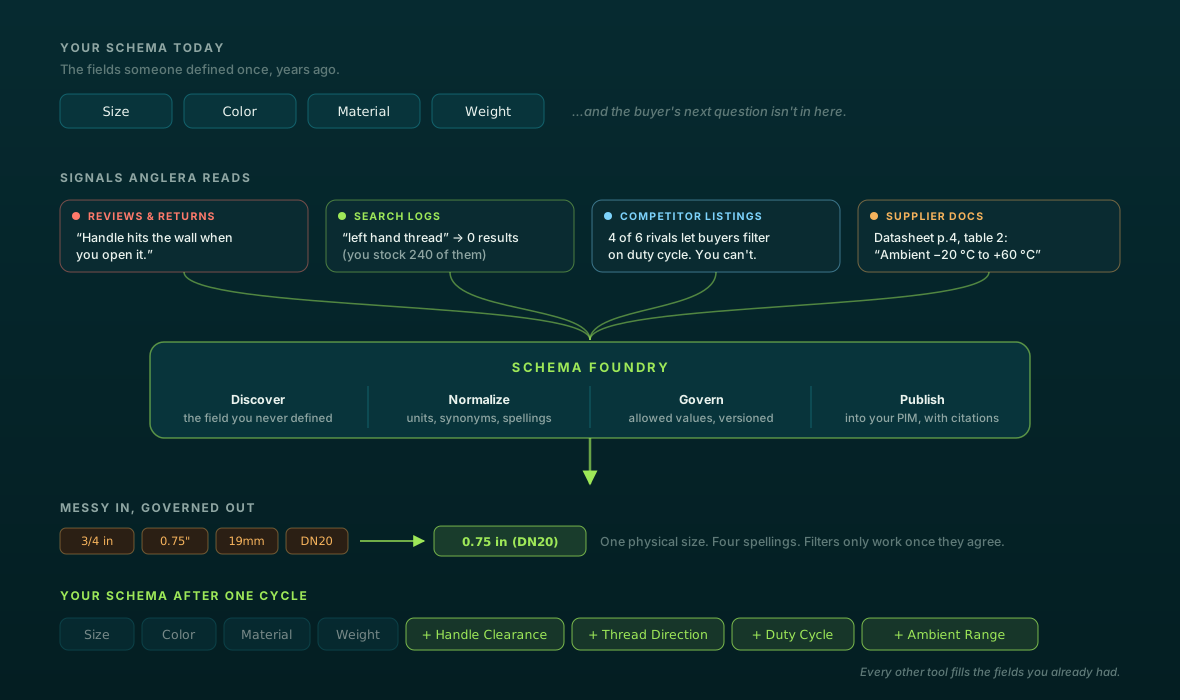
Filling the fields you defined has an invisible ceiling: a catalog can hit 100% complete and still miss the attribute that loses the sale, because completeness is measured against a schema someone drew years ago. Schema Foundry reads competitor listings, buyer searches, review complaints and your supplier docs, and proposes the fields you never defined — which is where Contentserv stops.

How Schema Foundry works
Schema Foundry: signals from reviews, search logs, competitor listings and supplier documents reveal attributes missing from your schema; the Foundry discovers, normalizes and governs them, so your schema ends the cycle with more fields than it started with.

What Contentserv does

Contentserv (now branded Centric PXM) is an enterprise PIM/PXM platform that centralizes product information management, digital asset management, syndication, and digital shelf analytics in a single suite. It is widely used in fashion, lifestyle, consumer goods, and luxury sectors where rich media and localized content are core requirements.

Pricing: Subscription-based with Starter, Professional, and Enterprise tiers; pricing is not publicly disclosed and requires a direct quote. Costs vary by modules selected, user count, and data volume.

Contentserv website

When Contentserv is the right call

Teams that need governed product data at scale: ETIM/eCl@ss classification, versioned approval workflows, DAM, quality dashboards, and syndication to 1,000+ channels across locales.

We'd rather tell you here than in month three of an implementation.

Capability verdicts reviewed against Contentserv's public documentation on July 14, 2026. Vendors ship quickly — if something here is out of date, tell us and we'll correct it.

See it on your own SKUs.

Bring one category and your supplier files. In 30 minutes you'll see it enriched — complete, structured, and consistent enough to launch on — plus the attributes your schema didn't have yet.

Book a demo