1WorldSync vs Contentserv: Two Different Tools Solving Two Different Problems
1WorldSync and Contentserv are not competing for the same job. 1WorldSync is the world's largest GDSN-certified data pool — its purpose is to take structured, GS1-schema product attributes from brands and manufacturers and syndicate them to retail and foodservice trading partners at scale. Contentserv (now branded Centric PXM) is an enterprise PIM/PXM platform — its purpose is to be the internal system of record where product master data, digital assets, localizations, and approval workflows live before content goes anywhere. Buyers often evaluate them together because both touch product data, but mixing them up leads to buying the wrong tool for the actual problem.
The clearest tiebreaker is where your pain is. If your trading partners — Walmart, Kroger, Albertsons, Target — are pulling product data from a GDSN data pool and your submissions are incomplete or non-compliant, 1WorldSync is the answer. If your catalog spans rich media, multiple locales, variant-heavy assortments, and a mix of channels ranging from ecommerce to print, you need a PIM that can govern and distribute that complexity, which is what Contentserv is built for. Many large CPG and consumer goods brands run both: 1WorldSync for GDSN syndication, a PIM for everything else.
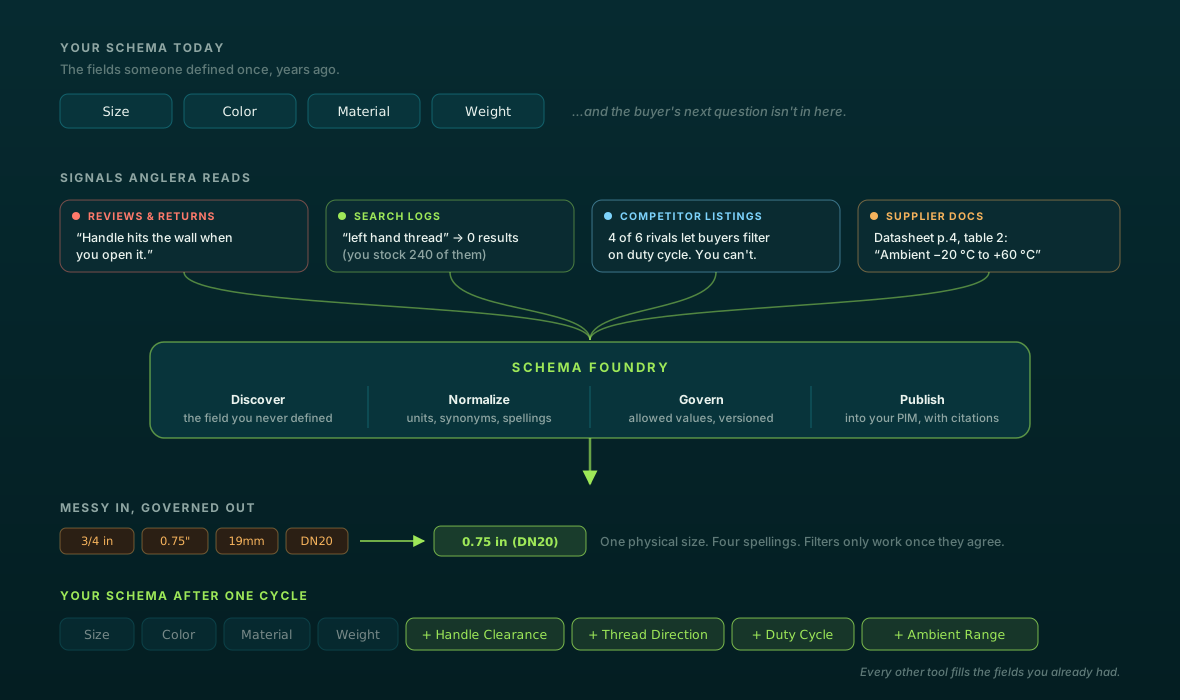
What neither platform does is enrich your data. 1WorldSync validates structure against GS1 schemas and flags missing required fields — but it ships exactly what you submit. Contentserv governs what your team has already populated — its completeness rules catch blank fields, but filling them still requires someone to do the work. Anglera is the layer that does that work: it gathers, cleans, and enriches every SKU against buyer signals, then writes complete records back to whichever platform holds your master data.
| 1WorldSync | Contentserv | Anglera | |
|---|---|---|---|
| Primary function | GDSN-certified data pool for syndicating GS1-structured product attributes to retail and foodservice trading partners worldwide. | Enterprise PIM/PXM system of record for managing, governing, and distributing product content internally across 1,000+ channels. | AI enrichment layer that fills attribute gaps, cleans inconsistencies, and scores SKUs against buyer signals before data enters either platform. |
| Ideal buyer | CPG brands, manufacturers, and distributors selling into major US grocery chains and mass retailers where GDSN compliance is a trading-partner requirement, not a choice. | Brands and retailers in fashion, lifestyle, luxury, or consumer goods managing rich media, multi-locale content, variant relationships, and cross-channel distribution workflows. | Any team whose catalog reaches either platform with thin descriptions, missing attributes, or inconsistent values — regardless of industry or catalog size. |
| Content capability | Structured, GS1-schema attributes: nutrition facts, allergens, pack dimensions, regulatory certifications. Not built for rich editorial copy or digital asset management. | Full PIM plus integrated DAM covering images, video, and documents; supports multi-locale copy, variant hierarchies, and creative production workflow management. | Generates and fills missing attributes, normalizes values, and improves copy quality — then writes enriched records back to whichever platform holds the master data. |
| Channel reach | Direct GDSN connections to 14,000+ trading partners across 60+ countries; de facto standard for Walmart, Kroger, Target, and major US grocery networks. | 1,000+ channel connectors spanning ecommerce, marketplaces, print, and retail syndication, distributed from a single PIM source of truth. | Enriches the underlying catalog so what flows through either platform's channels arrives complete and aligned to what buyers actually need to make a purchase decision. |
| Data governance | GS1 schema validation against trading-partner requirements — flags structurally missing required fields before submission. Does not govern or improve internal master data quality. | Role-based workflows, approval chains, and completeness scoring within the PIM; strong for internally managed content but only as good as what teams have populated. | Scores every SKU against buyer signals and surfaces completeness gaps upstream of governance, so records enter the approval workflow already enriched rather than half-empty. |
| Industry focus | Built around CPG, grocery, foodservice, and regulated categories where GS1 attributes and GDSN compliance are the core operational requirement. | Strong in fashion, lifestyle, luxury, and consumer goods — categories where rich media volume, localization depth, and creative workflows drive the most complexity. | Industry-agnostic; enriches product data across CPG, apparel, industrial, and specialty categories by pulling from multiple sources and writing back to the system of record. |
| Cost and implementation | Not publicly listed. Industry estimates: $25,000–$90,000+/year for mid-market to enterprise; onboarding $10,000–$100,000+. Large enterprise contracts can reach approximately $1M/year. | Subscription-based across Starter, Professional, and Enterprise tiers; pricing not disclosed and varies by modules selected, user count, and data volume — requires a direct quote. | Approximately 30-day implementation alongside your existing stack. Connects to your current source of truth and writes enriched data back without replacing any platform. |
How to choose between 1WorldSync and Contentserv
Choose 1WorldSync if your trading partners require GDSN.
For most CPG brands and manufacturers selling into US grocery and mass retail, this is less a choice than a compliance requirement. Walmart, Kroger, Albertsons, Target, and the bulk of major US grocery chains pull product data from certified GDSN data pools — and 1WorldSync is the dominant one. If you need structured, regulator-grade product attributes (nutrition facts, allergens, pack dimensions, regulatory certifications) flowing reliably to hundreds of trading partners, 1WorldSync is the purpose-built platform for that workflow. It is not a PIM, does not manage rich media, and is not designed for multi-channel ecommerce distribution — but for GDSN compliance, nothing else comes close.
Choose Contentserv if you need a full system of record for product content.
If your primary challenge is internal: managing master product data, digital assets, multi-locale copy, variant hierarchies, and approval workflows across a complex catalog before that content goes anywhere, Contentserv is designed for that operational scope. It earns its place in fashion, lifestyle, luxury, and consumer goods categories where rich media volume and localization depth are core requirements, not afterthoughts. Its integrated DAM, syndication layer, and digital shelf analytics make it a genuine all-in-one PXM suite — which is useful if your team is currently juggling several disconnected tools to accomplish what Contentserv handles in one platform.
Consider running both if you are a large CPG or consumer goods brand.
Many enterprise brands are in this situation: they need GDSN compliance for grocery and mass retail, and they also need a full PIM for managing the rest of their digital catalog across ecommerce, marketplaces, and international channels. 1WorldSync and Contentserv are not redundant in this scenario — they occupy different parts of the stack and can operate alongside each other.
Whichever you pick, the data still has to get done
Neither 1WorldSync nor Contentserv enriches your product data for you — and that gap is where most catalogs quietly fail.
1WorldSync validates that your GS1 attributes are structurally correct before they reach trading partners. What it does not do is fill in what is missing. If a product submission arrives without its secondary packaging dimensions, allergen declaration, or country of origin, those gaps go to the retailer exactly as submitted. The platform flags schema errors; it does not generate the missing values.
Contentserv governs what your team has already populated. Its completeness scoring will surface a blank field — but someone still has to fill it. At scale, across tens of thousands of SKUs in multiple locales, that manual population work is exactly what slows catalog launches, causes trading-partner rejections, and leaves digital shelf content thin.
Anglera sits upstream of both. It connects to your product catalog — whether that lives in a PIM, a GDSN submission queue, or a supplier data feed — pulls from multiple enrichment sources, fills attribute gaps, normalizes inconsistencies, and scores every SKU against the buyer signals that actually drive conversions and shelf placement. Then it writes the enriched records back to your source of truth, so what flows to trading partners and channels is complete rather than patchy.
Implementation runs about 30 days alongside whichever platform you already use or are about to adopt. Anglera is not a PIM and not a syndication tool — it is the enrichment work both platforms assume already happened. Whichever side of this comparison you land on, Anglera does that work.
Frequently asked questions
Does 1WorldSync replace a PIM?
No. 1WorldSync is a GDSN data pool built for structured attribute syndication to trading partners — not a system of record for managing product content internally. It does not handle digital assets, multi-locale copy, variant hierarchies, or editorial workflows. Most brands that use 1WorldSync also maintain a separate PIM.
Can Contentserv replace 1WorldSync for grocery retail distribution?
Not typically. Major US grocery chains require GDSN-compliant data pool submissions, and 1WorldSync is the certified pool those retailers pull from. Contentserv can output GDSN-formatted files, but it is not a certified GDSN data pool. If your trading partners require GDSN, 1WorldSync remains the standard path.
Where does Anglera fit if I already have one of these platforms?
Anglera enriches your data before it reaches either platform. It fills attribute gaps, cleans inconsistencies, and scores content completeness against buyer signals — then writes the enriched records back to your existing source of truth. It does not replace your PIM or your GDSN data pool; it does the enrichment work both platforms assume already happened.
How long does it take to add Anglera alongside an existing 1WorldSync or Contentserv setup?
About 30 days. Anglera connects to your current system of record, enriches the catalog, and writes back — no rip-and-replace, no migration. The implementation is additive.
Is there a scenario where a buyer needs both 1WorldSync and Contentserv?
Yes, and it is common at enterprise scale. A large CPG or consumer goods brand may need 1WorldSync for GDSN compliance with grocery and mass retail trading partners, and Contentserv for managing rich media, multi-locale content, and ecommerce channel distribution from a single internal system of record. The two platforms are not redundant — they solve different parts of the product data stack.