Contentserv vs EnterWorks: PXM Suite or B2B Data Hub?
Contentserv (now rebranded Centric PXM) and EnterWorks (now Precisely EnterWorks) are both enterprise PIM platforms — but they are optimized for different industries, different data problems, and different buyer priorities. Choosing between them is rarely a close call once you understand what each was actually built for. Where it does get complicated is when a buyer's catalog spans both worlds: rich consumer content on one side, complex technical product data on the other.
Contentserv's bet is on product experience. Its platform bundles PIM, DAM, syndication, and digital shelf analytics into a single suite designed for brands in fashion, lifestyle, consumer goods, and luxury where the content itself — imagery, localized copy, channel-specific experience — is as important as the underlying specs. EnterWorks takes the opposite approach: it is an enterprise PIM/MDM data hub with 20 years of history in B2B wholesale and distribution. Its customers are organizations like Orgill (hardware), US Foods (foodservice), and Johnstone Supply (HVAC) — environments where the catalog runs to hundreds of thousands of technically complex SKUs, governance workflows span large internal teams, and the system of record has to integrate cleanly with ERPs. Precision and control matter more than publishing velocity.
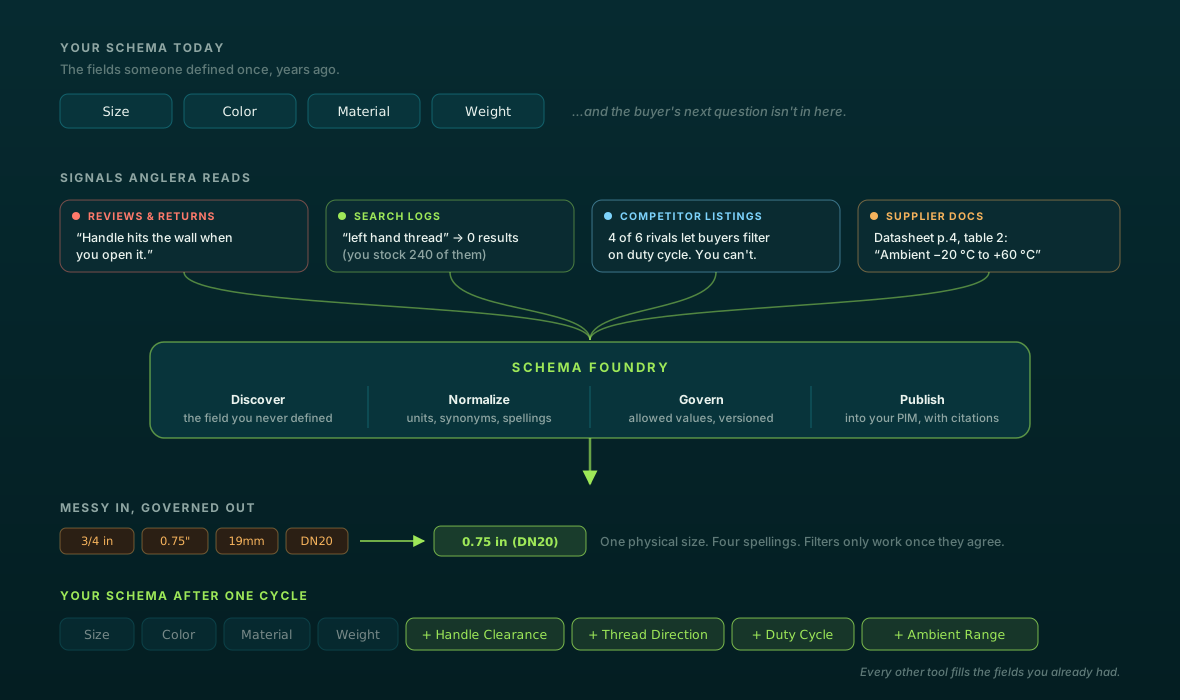
Both platforms share a foundational assumption: the product data flowing into them is reasonably complete. Contentserv surfaces where it is not — completeness dashboards and digital shelf analytics flag thin content, but they do not fill it. EnterWorks enforces business rules that reject bad records — the data has to be fixed before it clears governance, and that rework lands back on someone's team. The gap between raw supplier feeds and distribution-ready product data is where Anglera works, regardless of which platform stores the result.
| Contentserv | EnterWorks | Anglera | |
|---|---|---|---|
| Platform type | PXM suite that unifies PIM, DAM, channel syndication, and digital shelf analytics under one roof; positioned as the all-in-one product experience platform from content authoring to channel performance measurement | Enterprise PIM/MDM data hub focused on governed single source of truth; role-based workflows, configurable business rules, complex product relationships, and ERP integrations for operational control over large catalogs | Enrichment layer upstream of both — fills missing attributes, normalizes values, and scores completeness before data enters either platform's governance or distribution workflows |
| Industry and customer fit | Fashion, lifestyle, consumer goods, and luxury brands where rich media, localization, and omnichannel content publishing are core requirements; also consumer electronics and retail | B2B wholesale distributors, manufacturers, and large retailers with technically complex catalogs — Orgill, US Foods, Johnstone Supply, Fender; strongest in industries where operational accuracy matters more than content experience | Serves both profiles; particularly high-impact in B2B distribution environments where supplier data arrives thin and inconsistent across large SKU counts |
| Data governance and workflow | Role-based authoring, approval workflows, and localization management; governance is oriented toward content quality and channel-publishing readiness | Deep enterprise governance with configurable business rules, multi-step approval workflows, complex product relationship management, and MDM capabilities that extend beyond product data to broader master data | Enriches incoming supplier data before it enters governance queues — reducing the volume of exceptions, rejections, and manual rework that slow review workflows in either platform |
| DAM and digital assets | Native DAM is tightly integrated into the product experience layer; product content and digital assets are managed as a unified object — a meaningful differentiator for brands with high media volume | DAM capabilities included as part of the data hub; functional for asset storage and linking, but the platform's differentiation is data structure and governance rather than creative asset production or rich media management | Enriches structured product attributes — dimensions, specifications, certifications, copy — not binary assets; ensures the data layer underneath your digital assets is accurate and complete |
| Channel syndication reach | 1,000+ channel connectors natively; digital shelf analytics show how content is performing across retail channels; strong ecommerce, marketplace, and retail publisher reach built into the core platform | Integrates to ERP, ecommerce platforms, and syndication partners; Precisely's broader data ecosystem adds integration depth; emphasis is on data integrity into downstream systems, not syndication velocity | Channel-agnostic; reads from and writes enriched records back to your system of record, so downstream channels receive complete data through your existing integrations without reconfiguration |
| Pricing | Subscription-based with Starter, Professional, and Enterprise tiers; not publicly listed, requires a direct quote; tiered structure means smaller teams can enter at a lower cost than full enterprise deployment | Custom enterprise licensing only; base reported around $150,000, scaling with users and implementation complexity; no entry-level or trial tier — designed for organizations committing to a full enterprise deployment | Per-SKU enrichment pricing; designed to complement your existing PIM investment rather than replace it — cost scales with the catalog work being done, not with seat counts or platform tiers |
How to choose between Contentserv and EnterWorks
Choose Contentserv (Centric PXM) if your catalog is primarily consumer-facing and your primary challenge is publishing rich, localized product experiences across many channels simultaneously. Fashion brands, consumer goods companies, luxury retailers, and lifestyle brands — where imagery, copy variation by market, and digital shelf performance are daily operational concerns — are the clearest fit. The native DAM integration and digital shelf analytics make it a coherent suite for teams that want to manage the full product content lifecycle from one platform. The tiered pricing structure also means it is accessible without committing to a full enterprise deployment upfront.
Choose EnterWorks (Precisely EnterWorks) if you are a B2B distributor, manufacturer, or large retailer where operational data governance is the priority over content experience. If your catalog is technically complex — many spec attributes, complex product relationships, ERP dependencies, large internal teams with distinct roles in the data workflow — EnterWorks' configurable business rules, deep workflow engine, and MDM capabilities are built for exactly that environment. Its customer base (wholesale distributors like Orgill and US Foods, specialty manufacturers like Fender) is the clearest signal of where it performs best. Be prepared for an enterprise-grade procurement and implementation process; there is no low-cost entry point.
A note on acquisition context. Contentserv merged with Centric Software and has rebranded to Centric PXM, adding PLM capabilities to the portfolio — if product lifecycle management is part of your roadmap, that combined platform may carry additional weight in your evaluation. EnterWorks is now part of Precisely, a company focused broadly on data integrity software; buyers already using Precisely products for address validation, data quality, or location intelligence may find integration advantages worth exploring.
Whichever you pick, the data still has to get done
Both platforms govern the data you give them. Contentserv shows you where it is incomplete — its dashboards surface thin content and low attribute coverage, but the attributes do not fill themselves. EnterWorks rejects or holds records that fail business rules — the data has to be corrected before it clears, and that correction work falls back on your team or your suppliers. In both cases, the quality of what flows out is bounded by the quality of what went in.
Anglera works upstream of both. It connects to your existing system of record — whether that is Contentserv/Centric PXM, Precisely EnterWorks, or the ERP feeding either — and enriches every SKU before it reaches the governance layer. Missing dimensions, thin descriptions, inconsistent units, absent certifications: Anglera researches and fills them by crawling supplier sites and applying buyer-signal scoring, then writes the enriched records back to your source of truth. The data that enters your PIM's workflow is already complete.
The result is fewer failed business rules in EnterWorks, fewer completeness flags in Contentserv, and less manual editorial rework for your team. Whichever platform you have chosen, the data it governs and distributes gets more accurate from the start. Anglera connects to your existing system of record in roughly 30 days — no rip-and-replace, no parallel platform to maintain.
Frequently asked questions
Is Contentserv the same as Centric PXM?
Yes. Contentserv merged with Centric Software and rebranded to Centric PXM. The underlying PIM/PXM platform is the same; the combined company now positions itself across both product experience management and product lifecycle management. If you see either name in a vendor shortlist, they refer to the same platform.
Is EnterWorks part of Syndigo?
No. This is a common point of confusion. EnterWorks was acquired by Winshuttle in 2019 and then by Precisely in 2021. It is now Precisely EnterWorks, part of Precisely's data integrity software portfolio. Syndigo is a separate company focused on product content syndication and is not affiliated with EnterWorks or Precisely.
Which platform is better suited for wholesale distributors?
EnterWorks has the stronger track record in B2B wholesale distribution. Its reference customers include Orgill (hardware distribution), US Foods (foodservice distribution), and Johnstone Supply (HVAC distribution) — all environments with large, technically complex catalogs managed across cross-functional internal teams and ERP systems. Contentserv serves some distributors but its platform is most differentiated in consumer-facing content and rich media use cases.
Can either platform automatically enrich missing product attributes?
Both offer data quality tooling, but neither is built for automated attribute research at catalog scale. Contentserv surfaces completeness gaps through dashboards and digital shelf analytics. EnterWorks catches structural problems through business rules and validation. Neither platform crawls supplier sites, researches missing specs, or scores attributes against buyer search signals automatically. That use case — high-volume enrichment from external sources — is where Anglera operates as a dedicated layer on top of either platform.
Our suppliers send incomplete flat files. Which platform handles that better?
Neither platform was designed to fix incomplete supplier data — they are designed to govern and distribute data that is already accurate. EnterWorks will hold or reject records that fail business rules, returning the exception to your team. Contentserv will store the incomplete record and flag it for editorial attention. In both cases the gap stays open until someone fills it. Anglera is purpose-built for this scenario: it takes incomplete supplier inputs, researches and fills missing attributes, and writes complete records back to your PIM before they enter the governance workflow.