All comparisons
Works with EnterWorksPIM platforms

Anglera + EnterWorks

The bottom line

Keep EnterWorks as your governed system of record and syndication hub; add Anglera to do the work it assumes is already done — mining supplier PDFs and drawings, filling missing specs, and writing cited values back into it.

EnterWorks and Anglera solve different halves of the problem — this page is about the seam between them.
The frame for this comparison

Product data is a practice, not a project.

EnterWorks is built to model, govern, and audit the master record — so this comparison isn't about the hub, it's about who fills the attributes the hub is governing, week after week, as suppliers, channels, and buyer language keep moving.

01

Ground it

Mine every spec from every source.

Every value traced to a document you can open. The catalog is only as honest as what it was built from.

02

Align it

Aim the catalog at the buyer who actually buys.

Grounded data still loses if it answers questions nobody asked. Alignment is what turns specs into conversion.

03

Keep it alive

Product data is a practice, not a project.

Markets move, suppliers reissue, buyers change what they ask for. A catalog that is right in March is wrong by August unless something is watching.

Capability by capability

Where EnterWorks stops.

Scored against public documentation. Grouped by the three acts — so you can see which ones EnterWorks leaves on your desk.

01

Ground it

Mine every spec from every source.
Source mining
Where does it get specs from?
EnterWorksLimited

Structured feeds, spreadsheets, vendor portal; no document mining

AngleraYes

PDFs, spec tables, drawings, manuals, images, sites

Schema discovery
Does it find attributes that aren't in your schema yet?
EnterWorksNo

Team defines attributes via low-code domains; no discovery

AngleraYes

Proposes fields your schema never had

Governed vocabulary
Does it turn messy free-text into a governed pick list?
EnterWorksYour team

Code sets and validation rules; team curates values

AngleraYes

Normalizes and governs allowed values, versioned

Taxonomy & classification
Can it classify every SKU into your hierarchy?
EnterWorksYour team

Category hierarchies and channel mapping; team-configured rules

AngleraYes

Auto-classifies; channel and marketplace mapping

Citations & provenance
Can you see where any given value came from?
EnterWorksLimited

Audit trails of changes; no source-document citations

AngleraYes

Every value cites its source doc and page

02

Align it

Aim the catalog at the buyer who actually buys.
Buyer personas
Is the content written for your buyer, or generically?
EnterWorksNo

Channel-specific views; no persona-tailored enrichment output

AngleraYes

B2B specifier and B2C shopper enriched differently

Review, search & social signals
Does it learn what buyers ask from the live market?
EnterWorksNo

No review, search, or competitor signal mining documented

AngleraYes

Reviews, search, competitor rails, social — fed back

Copy & SEO
Does it write original, channel-ready copy?
EnterWorksYour team

Print and channel templating; authors write the copy

AngleraYes

Original copy per persona and channel

Product imagery
Can it produce usable images for SKUs that lack them?
EnterWorksLimited

DAM outputs image formats and resolutions; no generation

AngleraYes

Generates studio-grade imagery for photoless SKUs

03

Keep it alive

Product data is a practice, not a project.
Continuous re-enrichment
What happens when the market moves after go-live?
EnterWorksLimited

Scheduled imports and quality alerts; humans do rework

AngleraYes

Re-enriches on its own after go-live

Quality scoring
Does it score its own output and track catalog health?
EnterWorksYes

Dashboards track completeness and quality over time

AngleraYes

Scored against your standards; nothing publishes below bar

Write-back
Does enriched data land back in your system of record?
EnterWorksYes

Syndicates to ERP, ecommerce, GDSN, channel targets

AngleraYes

Writes back to PIM, ERP, warehouse, commerce

API, MCP & webhooks
Can your own tools and agents drive it headlessly?
EnterWorksLimited

REST API with Swagger; MCP is Data Integrity Suite

AngleraYes

API, webhooks, and MCP servers

Who does the work
Does it do the work, or help your team do it?
EnterWorksYour team

Software platform; customer's team performs the enrichment work

AngleraYes

Anglera owns the work; review is a guardrail

KeyYesships itLimitedlimited or gatedYour teamyour team still does itNodoesn't do itAnglera differentiator
What “buyer signals” actually means

Six signals sitting in your market right now.

“Buyer signals” is the emptiest phrase in this category, so here is the literal thing. Each of these is an observation from a live market, the gap it exposes, and the field that gets created as a result.

Supplier signal·New-item setup sheets from a vendor, before they reach the GDSN feed

A nitrile glove line arrives with quantity "1000" in the item field and "100/BX, 10 BX/CS" typed into a free-text notes column. The next vendor sends "10 boxes" with no per-box count at all.

Pack hierarchy is living in prose, not in modeled attributes. Either string can be stored as text; downstream, a case-price comparison and a GDSN packaging level both need integers and a unit code.

Field createdunits_per_inner_pack, inner_packs_per_case, base_unit_of_measureInteger counts, plus UOM restricted to EA, BX, CS, PL
Review signal·Customer Q&A thread on a distributor product page

"Is this 5 HP 184T motor C-face with feet, or rigid base only? The photo shows feet but the spec table doesn't say." Three near-identical questions sit on neighboring SKUs in the same family.

Mounting configuration is a purchase-blocking decision that currently exists only in the photo and the manufacturer's PDF. With no field, there's no filter, and the answer arrives by asking a human.

Field createdmounting_configurationRigid base, C-face with feet, C-face without feet, D-flange, vertical P-base
Competitor signal·A rival distributor's faceted navigation on LED high bays

Their left rail filters on DLC listing status, correlated color temperature (3000K / 4000K / 5000K), and lumen output band. The equivalent category on your site offers wattage and brand.

The energy-rebate buyer starts from DLC listing and CCT, because that's what the utility form asks for. Both values sit in the fixture cut sheets you already have; neither was ever promoted into an attribute, so the category can't be shopped the way it's actually bought.

Field createddlc_listing_status, correlated_color_temperature_kDLC Standard, DLC Premium, Not listed; CCT governed to 2700, 3000, 3500, 4000, 5000, 5700, or Field-selectable
Why catalogs rot

A governed record is not a complete one

Precisely's own materials put the emphasis on the control layer: dynamic data modeling, business rules, role-based views, security and audit logs, drag-and-drop routings and alerts, and a content repository with unlimited data attributes and complex relationships between products. That perimeter does its job. It decides who may change which attribute, and when. Governance and fill are different jobs. A rule can flag that `mounting_configuration` sits blank across the motor catalog — flagging it is not filling it. Someone still has to read the manufacturer's cut sheet, decide the 184T frame is C-face with feet, and write that value back in your vocabulary, this week and again when the vendor adds a frame size. That standing work is what Anglera runs alongside your hub: the hub stays the system of record; we keep the fields in it worth filtering on.

Messy in, governed out.

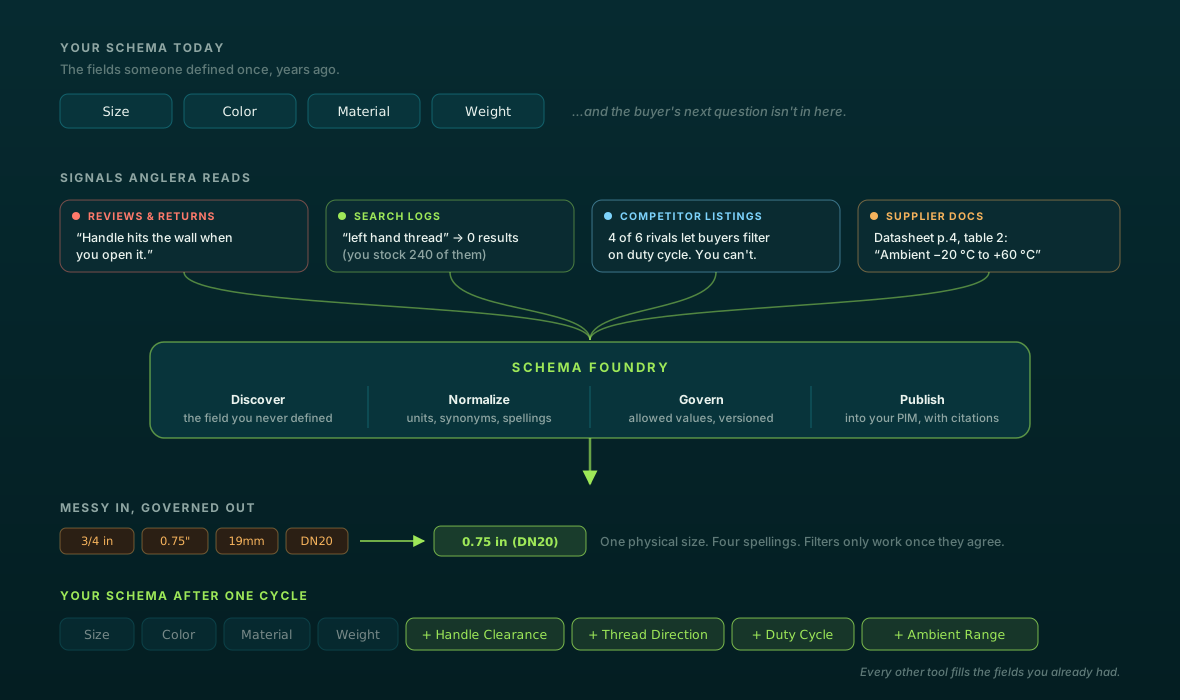
Values are normalized into a governed, versioned set of allowed values — so a filter works, and keeps working after the next import.

Nominal Size
3/4 in0.75"3/4"19mm3/4 inchDN20
0.75 in (DN20)

Six suppliers, six spellings, one physical size. Filters only work once they agree.

Finish
BlkblackBLACK MATTEMatte BlkRAL 9005
Black — Matte

Free text makes a colour filter useless. A governed value makes it a facet.

Material
SS316316 StainlessStainless Steel 316A4 Stainless
Stainless Steel — 316 / A4

Same alloy, four vocabularies, plus a trade name. Buyers search all of them.

And the part nobody else does

We don't just fill the template you handed us.

Filling the fields you defined has an invisible ceiling: a catalog can hit 100% complete and still miss the attribute that loses the sale, because completeness is measured against a schema someone drew years ago. Schema Foundry reads competitor listings, buyer searches, review complaints and your supplier docs, and proposes the fields you never defined — which is where EnterWorks stops.

How Schema Foundry works
Schema Foundry: signals from reviews, search logs, competitor listings and supplier documents reveal attributes missing from your schema; the Foundry discovers, normalizes and governs them, so your schema ends the cycle with more fields than it started with.

What EnterWorks does

EnterWorks (now Precisely EnterWorks) is an enterprise-grade PIM/MDM and DAM data hub with 20+ years of history powering large B2B and B2C catalogs. Its EnterWorks Enable platform centralizes product information as a governed single source of truth, with role-based workflows, business rules, complex relationships, and integrations to ERP, e-commerce, and syndication channels. It serves mid-market to large retailers, manufacturers, and wholesale distributors such as Orgill, US Foods, Johnstone Supply, and Fender. Note: EnterWorks was acquired by Winshuttle (2019) and is now part of Precisely (2021), not Syndigo.

Pricing: Custom enterprise licensing, quote-based. Reported base around $150,000 with cost scaling by users and implementation complexity; no free tier.

EnterWorks website

When EnterWorks is the right call

Mid-market to large distributors, manufacturers and retailers that need role-based workflows, complex product relationships, and governed syndication to ERP, ecommerce and GDSN from one record.

We'd rather tell you here than in month three of an implementation.

Capability verdicts reviewed against EnterWorks's public documentation on July 14, 2026. Vendors ship quickly — if something here is out of date, tell us and we'll correct it.

See it on your own SKUs.

Bring one category and your supplier files. In 30 minutes you'll see it enriched — complete, structured, and consistent enough to launch on — plus the attributes your schema didn't have yet.

Book a demo