Channable vs EnterWorks: Feed Syndication or Enterprise PIM?
Channable and EnterWorks are fundamentally different tools that address adjacent but distinct problems. Channable is a feed management and syndication platform: it takes product data you already have and pushes it to 2,500+ marketplaces and ad channels using rule-based (if/then) automation. Precisely EnterWorks is an enterprise PIM and MDM platform: it is where large manufacturers, distributors, and retailers govern product information as a structured, single source of truth — with approval workflows, business rules, and ERP integrations designed for multi-team organizations at scale.
A buyer genuinely comparing these two is likely at one of two decision points. If your problem is "we have product data and need to reach more channels faster," Channable is the right conversation. If your problem is "our product data is fragmented across ERPs, supplier spreadsheets, and legacy systems and we need a governed master record," EnterWorks is the right conversation. Very few organizations need both simultaneously — they are not substitutes; they address different stages of the product data lifecycle.
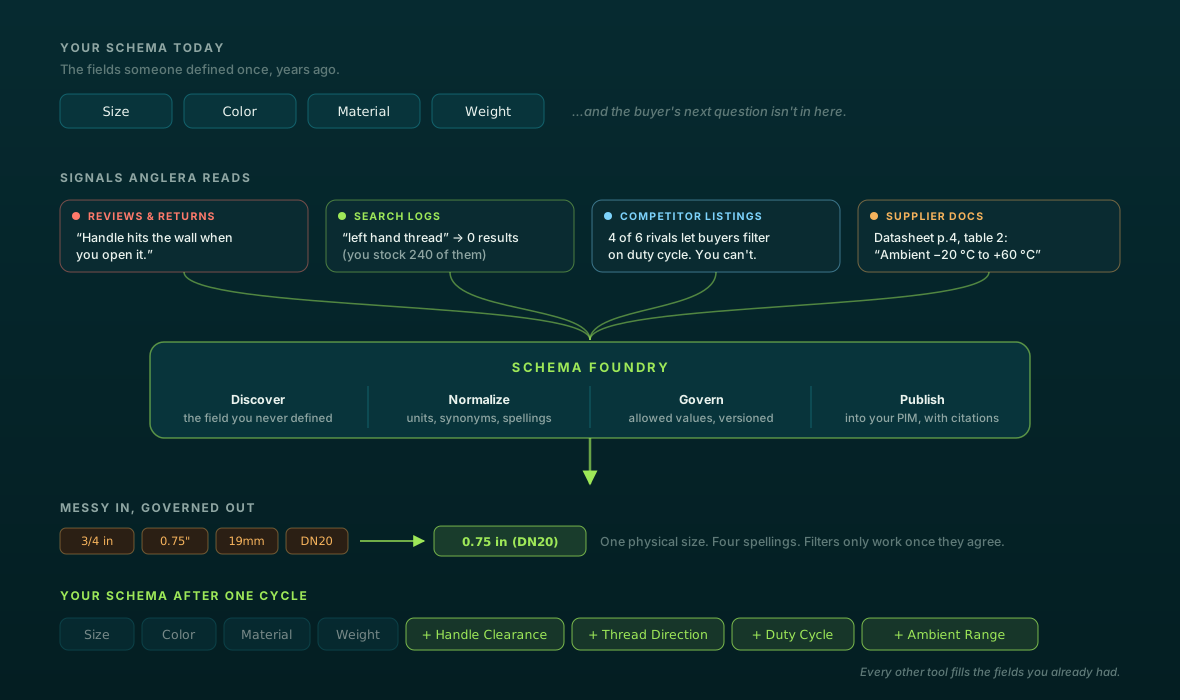
The gap both tools share is enrichment. Neither platform gathers missing product attributes, scores completeness against how buyers actually search, or automatically fills thin catalog records. Channable's rule engine can reformat fields that exist; EnterWorks can flag gaps and route contributor tasks. But neither sources the missing data. That is where Anglera fits — as a 30-day enrichment layer that supplies both platforms with better, buyer-signal-scored data before it flows downstream.
| Channable | EnterWorks | Anglera | |
|---|---|---|---|
| Primary function | Transforms and syndicates product feeds to 2,500+ channels — marketplaces, ad networks, comparison engines — using rule-based automation. Keeps pricing and inventory synchronized in real time. PPC and order management are paid add-ons. | Centralizes product information as a governed enterprise master record with role-based workflows, MDM, DAM, complex product relationships, and integrations to ERP, e-commerce, and syndication channels. | Enriches the product data itself — fills missing attributes, cleans inconsistencies, scores completeness against buyer signals — and writes results back to your source of truth before data flows into either platform. |
| Who it is built for | E-commerce retailers, brands, and marketplace sellers who have product data and need to publish it across many digital channels quickly. Self-serve SaaS that a feed manager or e-commerce team can operate without IT. | Mid-to-large enterprises — manufacturers, wholesale distributors, and retailers — with complex product hierarchies, governed attribute models, and multi-team data ownership. Customers include Orgill, US Foods, Johnstone Supply, and Fender. | B2B distributors, manufacturers, and retailers whose incoming supplier data is incomplete or inconsistent. Works alongside whichever platform you already run — does not replace either. |
| Pricing | Transparent SaaS pricing starting at approximately €59/month for 5,000 items. AI features, PPC automation, repricing, and most marketplace integrations are separate add-ons at €30–71/month each. | Custom enterprise licensing; no public pricing. Reported base around $150,000/year, scaling with user count and implementation complexity. Implementation services add further cost. No free tier. | Contact for pricing. Implementation in ~30 days, designed to complement your existing platform investment rather than replace it. |
| Implementation timeline | Days to a few weeks for a first feed; channel-by-channel rollout is incremental. No professional services required for standard setups. | Typically 6–18 months for a full enterprise deployment: data modeling, ERP mapping, taxonomy design, workflow configuration, team training, and change management. Implementation partners are commonly engaged. | Approximately 30 days from kickoff to enriched data writing back to your system of record — no rip-and-replace, no parallel system to maintain. |
| Data governance | Rule-based (if/then) transformations within the Channable interface. No MDM layer, no approval chains, no audit trails. Governance of master product data must happen upstream, before data reaches Channable. | Full enterprise governance: role-based editing, workflow approvals, business rule enforcement, audit trails, and MDM to manage product master records across large teams. DAM included for managing digital assets alongside structured attributes. | Adds a completeness scoring layer on top of whatever governance model you have — surfaces gaps and fills them before records enter workflows, so governed content is actually populated. |
| Data enrichment capability | Can reformat, filter, merge, or split existing fields via rule logic. Does not research or generate missing product attributes. Output quality is capped by the quality of what you put in. | Completeness dashboards and contributor workflows prompt teams to fill attribute gaps. Does not automatically gather or generate missing attributes — the gap stays until a contributor fills it manually. | Automatically gathers missing attributes from supplier sites and external signals, normalizes values across supplier formats, scores every SKU against buyer-signal benchmarks, and writes enriched records back to your source system. |
| Channel and integration depth | 2,500+ out-of-the-box channel integrations: Google Shopping, Amazon, Meta, Bol.com, Zalando, Criteo, and regional marketplaces globally. Particularly strong in European e-commerce. Does not participate in GDSN. | Configurable enterprise connectors to ERP systems, e-commerce platforms, and downstream syndication channels. Designed for deep bilateral integration with enterprise back-office systems, not broad channel count. | Channel-agnostic. Anglera reads from and writes to your existing PIM, ERP, or product data source — enriched data flows downstream through whichever integrations you already have in place. |
How to choose between Channable and EnterWorks
Choose Channable if:
- You are an e-commerce retailer, brand, or marketplace seller who already has product data and needs to publish it across Google Shopping, Amazon, Meta, and dozens of other channels from one interface.
- Real-time price and inventory synchronization across channels is a core operational requirement.
- Your team is small or agile — Channable is self-serve SaaS that a feed manager can operate without involving IT or a data modeling exercise.
- Your budget is in the low-to-mid thousands per year. The transparent per-item pricing is accessible to merchants at almost any scale.
Note: Channable assumes your data is already in good shape. If attributes are missing or descriptions are thin, Channable will faithfully distribute that thin content to 2,500 channels — it does not fix the underlying data problem.
Choose EnterWorks if:
- You are a large manufacturer, distributor, or retailer with tens of thousands to hundreds of thousands of SKUs fragmented across ERP systems, supplier spreadsheets, and legacy databases that need to become a governed master record.
- You need multi-team governance: role-based editing, approval chains, business rule enforcement, and audit trails that enforce data standards across departments.
- MDM and DAM capabilities are requirements — you need structured product attributes and digital assets managed together, with integration to SAP or other enterprise ERPs as the authoritative system.
- You have IT resources, a multi-month implementation timeline, and an enterprise budget. Licensing typically starts around $150,000/year.
The practical dividing line is company size and data maturity. Channable is a distribution accelerator for teams whose data is production-ready. EnterWorks is a governance infrastructure for enterprises whose data is not yet in one place, let alone clean. Choosing Channable when the real problem is governance means syndicating disorder at scale. Choosing EnterWorks when the real problem is channel reach means spending $150K+ to build infrastructure for a distribution need Channable could solve in a week.
Whichever you pick, the data still has to get done
Neither Channable nor EnterWorks enriches your product data — they distribute it and store it, respectively, and both assume that enrichment already happened somewhere upstream.
Channable's rule engine is powerful at transformation: it can rename fields, filter records, apply pricing logic, and reshape your data into channel-specific formats. What it cannot do is research a missing UNSPSC code, generate an accurate technical description, or determine that your buyers are filtering by amperage and your SKUs have no amperage value. The output is limited by what you put in.
EnterWorks governs whatever content you give it. Completeness dashboards flag empty fields and contributor workflows route tasks to the right people — but every gap stays until a human fills it. At tens of thousands of SKUs, that backlog never fully clears.
Anglera closes that gap before either platform sees the data. In roughly 30 days, it connects to your source of truth — your EnterWorks PIM, your ERP, or the flat files feeding Channable — identifies every missing attribute, gathers and validates values from supplier sites and buyer signal data, scores each record against real purchase-path behavior, and writes the enriched output back. What Channable then pushes to 2,500 channels is already complete. What EnterWorks governs and distributes downstream is genuinely populated, not just structured and empty.
The workflow is additive: Anglera does not replace your PIM, your feed manager, or your ERP integrations. It handles the enrichment work both platforms assume already happened — and keeps pace as your catalog grows or supplier feeds change.
Frequently asked questions
Can Channable replace a PIM like EnterWorks?
No. Channable is a distribution layer — it transforms and syndicates product data you already have, but it provides no governed master record, no MDM workflows, no approval routing, and no audit trails. If fragmented or ungoverned product data is your problem, Channable will faithfully syndicate that fragmentation to 2,500 channels; EnterWorks exists to fix the governance problem upstream.
Can EnterWorks replace Channable for multichannel syndication?
Partially. EnterWorks has configurable connectors to e-commerce and syndication platforms, and large enterprises sometimes route distribution through it. But it is not optimized for high-frequency, rule-based transformation across 2,500+ channels the way Channable is — pricing rule logic, real-time inventory sync, and rapid channel onboarding are Channable's core strengths. Many enterprises run a PIM as the system of record and a dedicated feed manager for real-time channel syndication.
Our suppliers send us incomplete data. Will either platform fix that?
Neither is designed to. Channable will forward incomplete attributes to channels — listing suppressions and low channel-quality scores follow. EnterWorks will store the incomplete record and surface it in completeness dashboards, but the gap remains until someone fills it manually. Anglera is built specifically for this scenario: it takes incomplete supplier inputs, researches missing attributes from authoritative sources, and writes complete records back before data reaches either platform.
Is EnterWorks still actively developed after the Precisely acquisition?
EnterWorks was acquired by Winshuttle in 2019 and by Precisely in 2021. Precisely continues to offer the platform under the EnterWorks brand as part of its data integrity portfolio. Buyers evaluating EnterWorks should ask Precisely directly about product roadmap, support tiers, and implementation partner availability — especially for greenfield deployments, where understanding the long-term investment trajectory matters.
How does Anglera fit if I am already using Channable?
Anglera enriches your catalog upstream of Channable — before data reaches the feed engine. It connects to your product source (PIM, ERP, or product database), fills missing attributes, cleans inconsistencies, and writes the enriched records back. By the time Channable transforms and pushes listings live, every SKU is already complete — reducing listing rejections, improving channel quality scores, and increasing visibility across every channel Channable reaches.