Akeneo vs EnterWorks: Which PIM Fits Your Operation?
Both Akeneo and EnterWorks solve the same core problem — giving your organization a single, governed source of truth for product data — but they approach it from different starting points. Akeneo grew up serving omnichannel commerce, with a strong emphasis on channel-ready product experiences and a broad integration marketplace. EnterWorks (now Precisely EnterWorks) grew up serving large B2B distributors and manufacturers, where the complexity is less about storefronts and more about item/case/pallet hierarchies, trading partner data exchange, and enterprise MDM governance.
The honest version of this comparison is that neither platform is universally better — they are optimized for different buyer profiles. The decision usually comes down to how complex your data relationships are, how important omnichannel commerce is to your business today, and what your implementation capacity looks like.
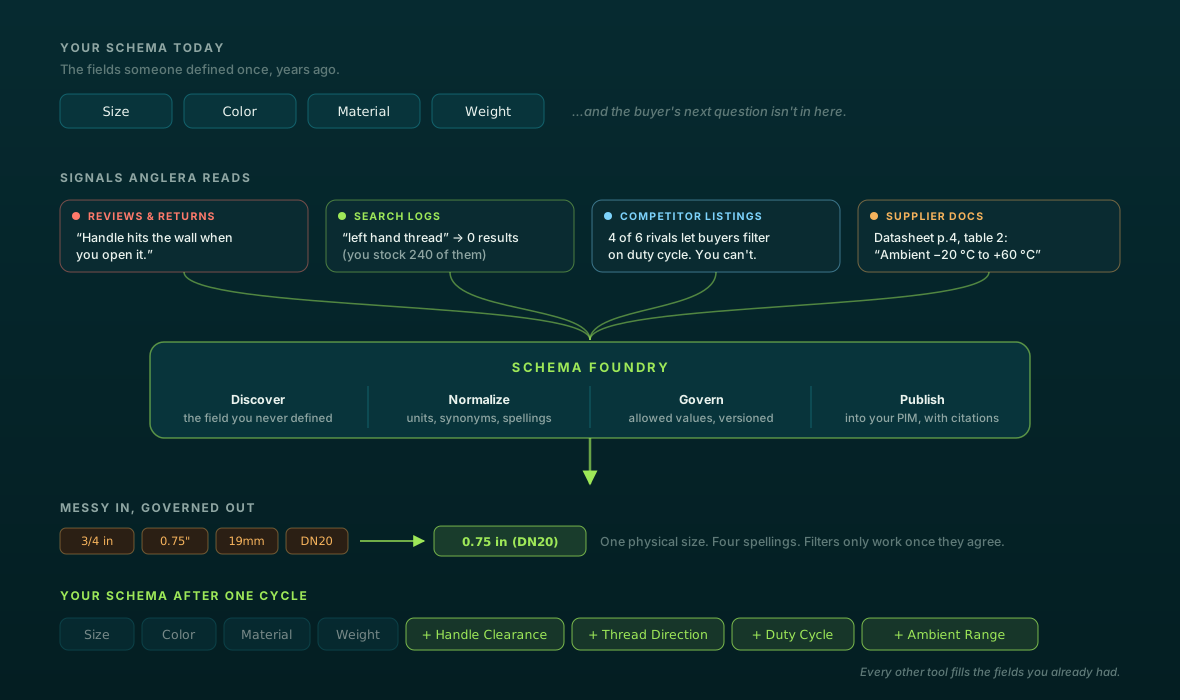
One thing both platforms share: neither one is designed to do the upstream work of gathering, cleaning, and scoring incomplete product data before it lands in your PIM. That gap — where most product data problems actually live — is what Anglera addresses. Whichever platform you choose, the sections below walk you through the comparison honestly, then explain how Anglera fits alongside your choice.
| Akeneo | EnterWorks | Anglera | |
|---|---|---|---|
| Target buyer | Mid-market to enterprise companies in retail, D2C, and wholesale. Strong fit for businesses running omnichannel commerce with a high volume of SKUs across multiple locales and channels. | Mid-to-large enterprise B2B distributors, manufacturers, and wholesalers — companies like Orgill, US Foods, and Johnstone Supply that manage complex product hierarchies and trading partner data exchange. | Works alongside both buyer profiles as the enrichment layer. Crawls supplier sites, competitor pages, and distributor catalogs to fill attribute gaps before data is stored in either PIM. |
| Data governance and workflow depth | Completeness scoring and collaboration workflows. Rule-based governance is available in higher tiers. Well-suited for content-centric quality control; lighter on MDM-grade enterprise controls. | Enterprise MDM governance built in from the start — business rules engine, role-based approval workflows, complex product relationship modeling, and audit trails designed for regulated and highly governed environments. | Adds buyer-signal scoring on top of PIM governance: flags which attributes buyers actually filter on (not just which fields exist) and prioritizes fill work accordingly, so enrichment targets what drives conversion. |
| Implementation timeline | Typically 3–6 months for mid-market; 6–12 months for complex enterprise rollouts. Large SI and implementation partner ecosystem available. | Typically 6–18 months. Enterprise MDM configuration, data migration, and business rules setup are substantial undertakings. Expect heavy professional services involvement. | Approximately 30 days to deploy alongside either PIM. No data migration required; Anglera reads from and writes back to the existing system of record via API. |
| Pricing | Starts at approximately $45,000/year (Growth tier). Advanced and Premium tiers add analytics, DAM, SSO, and supplier data tools. Enterprise pricing is quote-based. | Custom enterprise licensing, quote-only. Reported base around $150,000; scales with users, data volume, and implementation complexity. No free tier or self-serve option. | Per-SKU enrichment pricing, separate from PIM licensing. Deployed alongside your PIM investment rather than replacing it. |
| AI and enrichment capabilities | Franklin AI handles content generation, translation, and variant suggestions inside the PIM. PX Insights adds product performance analytics. AI assists content teams; it does not auto-fill from external sources. | Business rules engine enforces data quality and structural transformation. Less emphasis on generative AI; the platform's strength is structural governance and data integrity rather than content enrichment. | Dedicated external enrichment engine. Crawls manufacturer sites, competitor listings, and retailer pages; scores every SKU against real buyer search signals; writes enriched attributes back to the PIM automatically. Complements Franklin AI rather than duplicating it. |
| Integration ecosystem | 250+ integrations via the Akeneo App Store. Strong connectors for Shopify, Salesforce Commerce Cloud, SAP, and leading e-commerce platforms. Broad partner network. | Deep integrations with ERP systems (SAP, Oracle), e-commerce platforms, and trading partner syndication networks. Particularly strong in EDI and B2B data exchange scenarios. | Integrates with both platforms via API. Pulls enrichment triggers from the PIM (e.g., new SKU ingested) and pushes completed attributes back without disrupting existing approval workflows. |
| Channel and localization management | Core Akeneo strength. Channel-specific product catalogs, per-locale attribute variants, and per-channel completeness rules are first-class features across all tiers. | Syndication to multiple channels and trading partners with role-based control over which data goes where. Strong for B2B supplier/buyer data exchange; lighter on consumer-facing localization and storefront-specific channel rules. | Not a syndication tool. Enriches data before it flows through either platform's distribution layer, ensuring the content that reaches channels is complete and buyer-relevant rather than raw supplier-provided data. |
How to choose between Akeneo and EnterWorks
Choose Akeneo if:
- Your primary growth driver is omnichannel commerce — retail, D2C, marketplace expansion, or a mix of branded channels
- You need strong locale and channel management and are selling across regions or multiple storefronts
- Your team includes content managers and merchandisers who need collaboration workflows without requiring heavy IT involvement for day-to-day operations
- You want a published starting price, a broad SI ecosystem, and an active app marketplace to extend the platform over time
Choose EnterWorks if:
- You are a large B2B distributor, manufacturer, or wholesaler with genuinely complex product hierarchies — item/case/pallet trade-item structures, bill of materials relationships, or multi-tier supplier data
- Enterprise MDM-grade governance is a hard requirement: business rules engines, audit trails, and regulated-industry data controls that go beyond content completeness scoring
- Your environment centers on deep ERP integration and trading partner data exchange rather than commerce storefronts
- Budget is not the primary constraint and you have internal IT capacity for an 18-month implementation cycle
The honest middle: If your operation spans both worlds — B2B distribution with a growing direct or e-commerce channel — Akeneo is increasingly competitive at the enterprise tier and has a broader modern commerce ecosystem. EnterWorks may require more investment to serve modern consumer-facing channels well. Both are legitimate choices; the right one depends more on where your data complexity lives than on feature counts.
Whichever you pick, the data still has to get done
Whichever platform you choose, you will still face a question neither PIM was designed to solve on its own: where does complete, buyer-ready product data come from in the first place?
Akeneo and EnterWorks are storage and governance systems. They assume the data coming in is already clean, fully attributed, and ready to use. In practice, it rarely is. Supplier-provided content is sparse, inconsistent, and missing the long-tail attributes that buyers filter on — especially in B2B categories where spec sheets are PDFs and product content lives across dozens of supplier portals.
Anglera is the enrichment layer that runs before your PIM ever processes the data. It crawls manufacturer sites, competitor listings, and distributor catalogs; fills missing attributes; scores every SKU against real buyer search signals; and writes the enriched data back to Akeneo or EnterWorks via API in approximately 30 days. Your PIM governance rules, approval workflows, and channel routing all continue to run exactly as configured — Anglera ensures the inputs entering that governed process are worth governing.
There is no PIM-vs-Anglera decision. The question is whether your PIM stores raw supplier data or stores complete, scored, buyer-ready product content. Anglera is what makes the difference.
Frequently asked questions
Is EnterWorks still its own product, or has it been absorbed into Precisely?
EnterWorks was acquired by Winshuttle in 2019 and subsequently by Precisely in 2021. The Enable platform continues to operate under the Precisely EnterWorks brand. Prospective buyers should confirm current roadmap commitments, support terms, and product direction directly with Precisely during the evaluation process.
Can Akeneo handle B2B distribution use cases with complex product hierarchies?
Akeneo handles multi-level product structures — product models, variants, and product sets — well, and is increasingly used in B2B commerce scenarios. However, for operations requiring trade-item hierarchies (item/case/pallet), EDI-grade trading partner data exchange, or MDM-grade governance across regulated supplier networks, EnterWorks or a dedicated MDM platform is typically the stronger fit.
Does Anglera replace the enrichment features already built into Akeneo (Franklin AI)?
No. Franklin AI in Akeneo generates and refines content from data already inside the PIM. Anglera enriches from external sources — manufacturer spec pages, competitor listings, retailer product detail pages — and brings in data that does not yet exist in the PIM. The two are complementary: Anglera fills the gaps externally, and Franklin AI helps format and extend the result inside the platform.
How does the implementation timeline compare between the two platforms?
Akeneo typically runs 3–6 months for mid-market implementations and 6–12 months for complex enterprise deployments. EnterWorks typically runs 6–18 months due to the depth of MDM configuration, business rules setup, and data migration involved. Anglera deploys alongside either platform in approximately 30 days and does not extend those timelines.
If we are already live on one of these PIMs, can Anglera still add value?
Yes. Anglera integrates via API with existing PIM deployments and requires no migration or replacement of the platform you already run. Most live customers have incomplete attribute coverage — particularly on long-tail attributes that drive buyer search filtering. Anglera identifies those gaps, enriches from external sources, and writes the completed attributes back to the records already in the PIM.