Contentserv vs Informatica PIM: Which Platform Fits Your Product Data Strategy?
Contentserv (now Centric PXM) and Informatica Product 360 are both enterprise-grade platforms built to centralize and govern product information — but they approach the problem from very different directions. Contentserv is a PXM suite designed for teams that live and die by rich product experience: native DAM, digital shelf analytics, and multi-channel syndication in one product. Informatica Product 360 is an MDM-grade PIM for organizations where product data is one discipline inside a much larger enterprise data governance program.
Neither is a clear winner. The right call depends almost entirely on your organizational profile: how large your data governance footprint is, whether you need native content management tools, and how much implementation runway you have. A mid-market distributor and a Fortune 500 manufacturer can both have legitimate reasons to choose the same platform — or opposite ones.
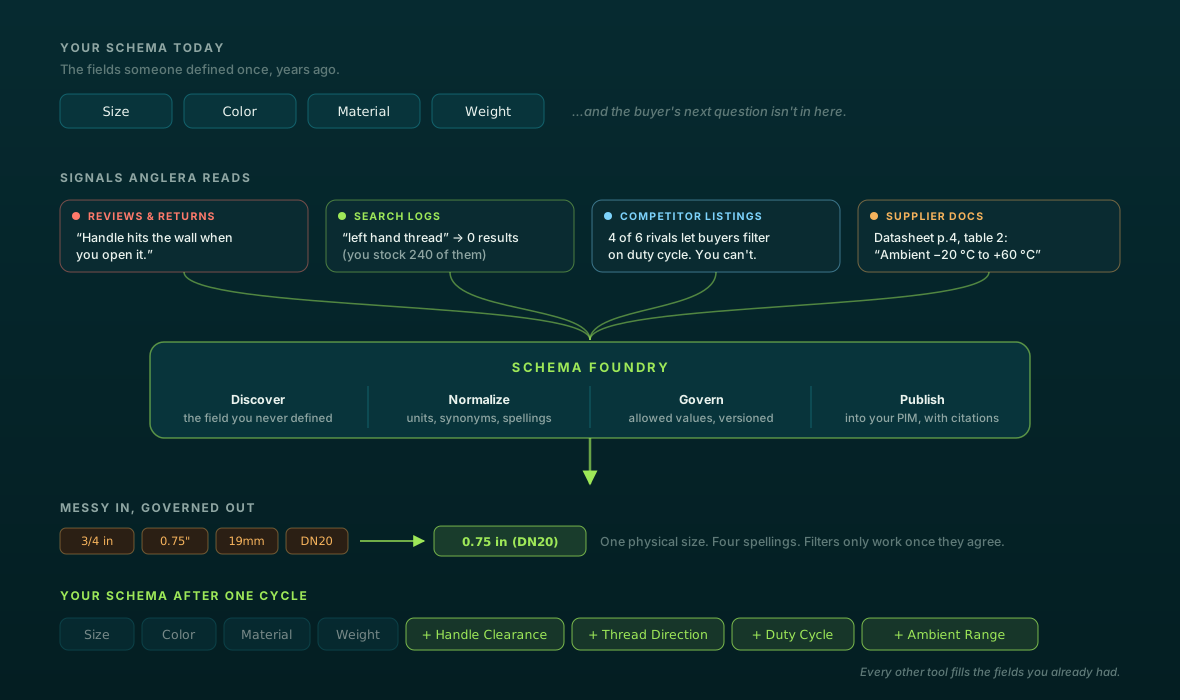
One thing both platforms share: they assume your product data is already reasonably complete before you start managing and distributing it. Filling attribute gaps, resolving supplier inconsistencies, and scoring completeness at the SKU level is work that happens upstream of the PIM — and it is the problem Anglera is built to solve, regardless of which platform you ultimately choose.
| Contentserv | Informatica PIM | Anglera | |
|---|---|---|---|
| Platform focus | PXM suite — PIM, DAM, syndication, and digital shelf analytics unified in one product. Built for experience-driven product storytelling across 1,000+ channels. | MDM-grade PIM — Product 360 sits inside Informatica's broader data governance stack and is designed for master data accuracy, deduplication, golden records, and enterprise data lineage. | Not a PIM or MDM. Anglera enriches the product attributes that live in whichever platform you choose, then writes them back — so both systems receive cleaner, more complete records from day one. |
| Best-fit industry | Fashion, lifestyle, luxury, and consumer goods — sectors where localized content, rich imagery, and multi-channel distribution define the product experience. | Manufacturers, industrial distributors, and regulated industries where data accuracy, governance workflows, and ERP integration are the primary concern. | Works across both verticals. Anglera pulls from supplier sites, distributor feeds, and web sources to fill attribute gaps regardless of your category mix or channel count. |
| AI and enrichment | AI-assisted content generation and attribute suggestions inside the PXM workflow, primarily editorial and localization-focused. | "Agentic AI PIM" — AI agents that validate and enrich data inside the platform, integrated with Informatica's CLAIRE AI engine for broader MDM governance. | Dedicated enrichment engine. Anglera crawls supplier sites and web sources, generates structured attributes, scores completeness against buyer signals, and writes enriched data back to your PIM — whether Contentserv or Informatica. |
| Data governance and MDM | Governance focused on product content quality — workflow approvals, completeness scoring, and role-based access within the PXM context. Not a full MDM system. | Enterprise MDM backbone. Product 360 extends Informatica's MDM platform with master data matching, deduplication, golden record management, and lineage tracking across the enterprise. | Complements governance by delivering attribute-complete records before they enter your approval workflows — reducing manual review cycles regardless of which governance model your platform applies. |
| DAM and digital shelf | Native DAM and digital shelf analytics are core product features, giving teams real-time visibility into how product content performs on retail channels. | DAM and digital shelf analytics are not native. Informatica Product 360 focuses on data management and relies on integrations for content distribution and shelf performance monitoring. | Not a DAM or shelf analytics tool. Anglera enriches the structured product attributes that feed into both — improving the data quality that ultimately drives shelf performance scores. |
| Implementation complexity | Modular; mid-market to enterprise. Implementations typically run 3–6 months depending on channel count and data complexity. | High complexity. Tied to the broader Informatica stack, implementations commonly run 6–12+ months and require dedicated IT and data governance resources. | Roughly 30-day implementation alongside either platform. Anglera connects via API or file export and begins enriching immediately — no infrastructure rebuild, no dependency on the PIM timeline. |
| Pricing | Quote-only. Starter, Professional, and Enterprise tiers; costs vary by modules selected, user count, and data volume. Not publicly listed. | Quote-only. Standard, Professional, and Enterprise tiers; widely cited as expensive. Costs scale with data volume, users, and the breadth of the Informatica stack you license. | Separate subscription priced by SKU volume. No dependency on which PIM or MDM you use, and no requirement to expand your existing platform license. |
How to choose between Contentserv and Informatica PIM
Choose Contentserv (Centric PXM) if your primary driver is rich product experience. This fits teams in fashion, lifestyle, consumer goods, or any sector where localized content, high-volume digital assets, and multi-channel consistency are daily operational requirements. If you want a single vendor for PIM, DAM, syndication, and digital shelf analytics — and you do not have a pre-existing enterprise MDM investment — Contentserv is the faster, more cohesive path. It is generally more accessible for mid-market organizations and does not require integrating with a broader data governance stack to get value.
Choose Informatica Product 360 if your primary driver is enterprise data governance. This fits large manufacturers, industrial distributors, and enterprises where product data is one stream inside a much wider MDM program. If you already run Informatica products for customer or supplier data, extending to Product 360 for product master data is a natural progression. The implementation is heavier and the cost is higher, but the governance depth — golden records, deduplication, lineage, workflow automation — is difficult to match with a pure-PXM platform.
If you are between the two: Contentserv is the better starting point for teams that need to ship faster and do not have a dedicated data governance function. Informatica is the better choice if product data management is subordinate to a broader enterprise data strategy, and you have the IT and budget runway to support it.
Whichever you pick, the data still has to get done
Both Contentserv and Informatica Product 360 are built to manage and distribute product data — not to gather and build it out from scratch. When a new supplier joins, when SKU counts double, or when category expansion introduces thousands of incomplete records, the platform expects structured, attribute-complete data to arrive. Filling those gaps manually — pulling specs from supplier sites, reconciling distributor feeds, scoring completeness against what buyers actually need — is time-consuming work that neither system automates end-to-end.
That is exactly the gap Anglera fills. Anglera connects to your PIM via API or file export, crawls supplier and web sources to build out missing attributes, scores every SKU for completeness against your buyer signals, and writes the enriched data back to your system of record in roughly 30 days. Your PIM stores the data; Anglera does the work of making it complete before it gets there.
This is not a replacement for either platform — it is the enrichment layer that makes both perform better. Whether your team runs Contentserv or Informatica Product 360, the product data flowing into your workflows is richer, the manual review queue is shorter, and the records your channels receive are more likely to convert.
Frequently asked questions
Is Contentserv or Informatica PIM better for a mid-market distributor?
Contentserv is generally the better fit for mid-market distributors. It is modular, faster to implement, and does not require integrating with an enterprise MDM stack to get value. Informatica Product 360 is designed for large enterprises with complex data governance programs across multiple systems — the implementation overhead and cost structure reflect that.
Does Informatica Product 360 replace a separate PIM, or is it an MDM add-on?
Product 360 is Informatica's PIM — it handles product information management as a primary function. But it is built on top of Informatica's MDM platform, so it is more accurately described as an MDM system with deep PIM capabilities. Organizations that only need PIM without the broader MDM stack may find it more infrastructure than necessary.
Does Contentserv include digital shelf analytics natively?
Yes. Digital shelf analytics is a native component of the Contentserv (Centric PXM) suite, giving teams visibility into how product content performs across retail channels. Informatica Product 360 does not include native digital shelf capabilities and relies on integrations for that function.
Can Anglera work with both Contentserv and Informatica PIM?
Yes. Anglera integrates with both platforms via API or file export. It enriches product attributes and writes them back to whichever system you use as your source of record — typically in about 30 days, with no dependency on which PIM you have chosen.
What does Anglera do that neither PIM does on its own?
Anglera crawls supplier sites, distributor feeds, and web sources to build out missing product attributes — then scores every SKU for completeness against buyer signals and writes the enriched data back to your PIM. Both Contentserv and Informatica Product 360 assume your data is reasonably complete before you manage and distribute it. Anglera is what makes that assumption true.