Contentserv vs Feedonomics: PIM/PXM or Feed Management — Which Problem Are You Solving?
Contentserv and Feedonomics are not direct competitors — they operate at different points in the product data stack, and a buyer evaluating both is likely trying to solve two distinct problems at once. Contentserv (now branded Centric PXM) is a system of record: a PIM, DAM, and digital shelf analytics suite designed to centralize, govern, and distribute product content at scale. Feedonomics is a managed service that transforms, optimizes, and pushes product feed data to 300+ ad channels and marketplaces, with dedicated specialists handling setup and ongoing error resolution. One stores and governs product truth; the other gets that truth in front of buyers on Google, Amazon, and Walmart.
The buying decision rarely comes down to choosing one over the other in a pure head-to-head. More often, the question is sequencing: which problem is more urgent right now, and which platform solves it? If your catalog is ungoverned — product data scattered across ERP, spreadsheets, and supplier portals with no clear system of record — Contentserv addresses the root cause. If you have a reasonably organized PIM but struggle to get feed data into channel-native formats and keep it optimized at scale, Feedonomics addresses the distribution layer without requiring you to rebuild the content stack.
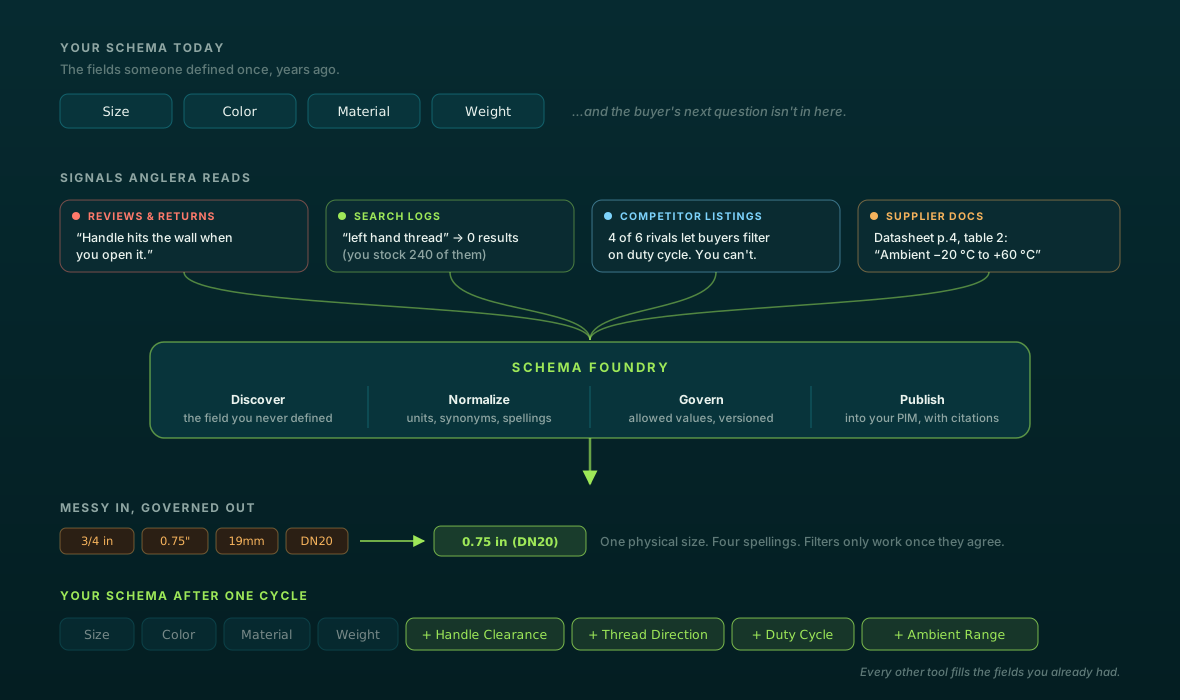
What both platforms share is an assumption: that the product data feeding into them is already buyer-ready. Contentserv expects complete, well-structured attributes to govern and distribute. Feedonomics can optimize feed format and structure per channel, but it cannot improve what the underlying content actually says. In practice, most catalogs arrive from suppliers with thin descriptions, missing attributes, and copy written for the factory floor — not for how buyers search and decide. That upstream gap is the one neither platform is designed to close on its own.
| Contentserv | Feedonomics | Anglera | |
|---|---|---|---|
| Primary function | Enterprise PIM/PXM/DAM suite — the system of record that centralizes product data, digital assets, localization, and channel governance in a single platform. Built around the assumption that Contentserv is where product truth lives. | Managed feed management and syndication service — transforms, optimizes, and distributes product data across 300+ ad channels and marketplaces. Not a system of record; assumes product data already exists elsewhere and focuses on getting it into channel-ready shape. | Enrichment layer — connects to your PIM or feed source, enriches every SKU against buyer signals, and writes results back to the system of record. Works upstream of both platforms rather than replacing either. |
| Channel distribution reach | 1,000+ channels via built-in syndication within the PXM suite; distribution is native to the platform and governed by the same data model that manages the master record. | 300+ ad channels and marketplaces — Google Shopping, Amazon, Microsoft Ads, Walmart, and more — with channel-specific feed optimization and error resolution handled by dedicated specialists. | Does not syndicate or distribute. Enriches the content that Contentserv or Feedonomics then pushes to channels, so every downstream destination gets better source data. |
| Service model | SaaS platform — your team configures, manages, and uses the platform. Contentserv provides onboarding and support, but day-to-day operations and content authoring are internal responsibilities. | Managed service — dedicated feed specialists handle setup, ongoing optimization, and channel error resolution on your behalf. The service layer is a core product differentiator, not an optional add-on. | Fully managed enrichment — Anglera runs the enrichment process and writes results back to your PIM without requiring ongoing internal effort after the ~30-day implementation. |
| Content governance and DAM | Full DAM and content governance built in — manage digital assets, localized copy, approval workflows, and channel-specific content variations from within the same system. Particularly strong in rich-media categories: fashion, lifestyle, consumer goods, and luxury. | No DAM and no master content store. Feedonomics transforms and formats existing feed data for channel distribution; it does not store, govern, or version-control product content. | No DAM — writes enriched attributes and copy back to whichever PIM governs the master record. Content governance stays in Contentserv or your existing PIM. |
| Feed-level optimization | Distributes clean, governed product data to channels but does not specialize in per-channel feed optimization — attribute mapping to channel-specific schemas, bid signal fields, or feed error diagnosis at the channel level. | Core competency: transforms source data into channel-native formats, catches and resolves feed errors, and optimizes attributes per marketplace or ad platform to maximize product approval rates and visibility. | Enriches the source data before it reaches any channel — richer titles, complete attributes, buyer-signal-aligned copy — so Feedonomics pushes higher-quality content downstream and Contentserv distributes a stronger master record. |
| Pricing model | Subscription tiers (Starter, Professional, Enterprise); pricing not publicly disclosed. Quote required. Costs vary by modules selected, user count, and data volume. | Custom quote only. Pricing tied to SKU count, number of channels, and service tier. No revenue-share model and no public pricing. | Per SKU enriched — layers onto your existing PIM or feed investment rather than replacing it. Implementation is ~30 days. |
How to choose between Contentserv and Feedonomics
Choose Contentserv if your core problem is governing product content at scale. You need a single system of record that unifies PIM, DAM, localization, and syndication in one vendor relationship. Contentserv's strengths are most pronounced for mid-market and enterprise companies in rich-media categories — fashion, lifestyle, consumer goods, luxury — where digital assets, multi-locale content, and approval workflows are non-negotiable. If you are consolidating product data from scattered sources and need a governed master record before you can do anything else well, Contentserv addresses that foundation. Its 1,000+ channel syndication also reduces the need for a separate feed tool if your distribution requirements are broad rather than ad-channel-specific.
Choose Feedonomics if you already have a system of record — whether a PIM, ERP, or even a well-maintained spreadsheet — and your problem is specifically optimizing and managing feed distribution to ad channels and marketplaces. Feedonomics' managed-service model is its defining advantage: feed specialists handle channel onboarding, attribute mapping, error resolution, and ongoing optimization without requiring you to build that expertise in-house. If your primary KPIs are feed approval rates, ad product coverage on Google and Amazon, and performance at the channel level, Feedonomics' depth in that lane outpaces what a general PIM syndication module provides.
If your stack already includes a PIM: Many mature ecommerce operations use both — Contentserv (or another PIM) as the master record for product content, and Feedonomics to optimize and push feeds to specific ad channels and marketplaces. They are complementary by design. The question then becomes which to invest in first based on where the biggest gap is today: ungoverned content or underperforming distribution.
Whichever you pick, the data still has to get done
Both Contentserv and Feedonomics take product data as they find it and do something useful with it. Contentserv governs and distributes it. Feedonomics optimizes and syndicates it. What neither platform does automatically is make the underlying data better — more complete, more aligned with how buyers actually search, compare, and filter.
Supplier data rarely arrives buyer-ready. Attributes are missing or inconsistently formatted. Titles are written for procurement catalogs, not search discovery. Descriptions reflect the factory spec sheet, not the decision criteria that drives a conversion. Contentserv gives you a well-organized, governed place to store and distribute that content. Feedonomics gets it into channel-native formats and keeps it error-free at the feed level. But the quality gap in the source data travels through both platforms untouched.
Anglera is the layer that closes that gap before it compounds downstream. It connects to your PIM or feed source via API, pulls your existing SKUs, enriches every attribute and description against buyer signals — how your actual customers search, compare, and decide — and writes the improved content back to the system of record. Your Contentserv instance gets richer master data to govern and distribute across 1,000+ channels. Feedonomics pushes higher-quality, more complete feeds to Google, Amazon, and Walmart. Whichever platform you choose — or both — the content Anglera writes back is buyer-ready from the start, not just well-organized or well-distributed. Implementation is ~30 days with no platform migration required.
Frequently asked questions
Are Contentserv and Feedonomics competitors?
Not directly. Contentserv is a PIM/PXM system of record — the platform where product data is created, governed, and maintained. Feedonomics is a feed management and syndication service that transforms and distributes product data to ad channels and marketplaces. They operate at different points in the product data stack and are often used together: Contentserv as the master record, Feedonomics to optimize and push feeds to specific channels.
Which should I implement first — Contentserv or Feedonomics?
Start with whichever problem is most urgent. If you lack a governed system of record — product data scattered across ERP, spreadsheets, and supplier portals with no clear source of truth — address that first with Contentserv or another PIM. If you already have a reasonably organized PIM and the problem is feed quality, approval rates, and managed distribution to Google Shopping, Amazon, and other ad channels, Feedonomics solves that without requiring you to rebuild the content foundation.
Does Feedonomics replace a PIM like Contentserv?
No. Feedonomics transforms and distributes product data but does not store, govern, or enrich master product content. It is a distribution and optimization layer, not a system of record. If you need DAM, localization workflows, approval processes, and governed content across multiple channels, that still requires a PIM like Contentserv sitting behind it.
What does Anglera do that neither Contentserv nor Feedonomics handles?
Anglera enriches the source product data against buyer signals — how buyers actually search, compare, and filter — before it reaches either platform. Contentserv governs and distributes content; Feedonomics optimizes and syndicates feeds; Anglera improves what the content actually says at the attribute and copy level, then writes results back to the PIM so both platforms work from richer source data rather than raw supplier copy.
How long does Anglera take to implement alongside Contentserv or Feedonomics?
Approximately 30 days from kickoff to enriched SKUs written back to the PIM. Anglera connects to your existing system of record via API — no platform migration, no changes to your Contentserv data model or Feedonomics feed configuration required.