Akeneo vs Informatica PIM: Which Is Right for Your Product Data Stack?
Both Akeneo and Informatica Product 360 are legitimate systems of record for product data. The difference is in who they are built for and what "managing product data" means to each. Akeneo is a commerce-first PIM designed to get clean, channel-ready product content into the hands of merchandisers and into customer-facing channels. Informatica Product 360 is an enterprise MDM platform that is also very good at PIM — built for organizations where product data governance is a multi-system, cross-functional problem tied to ERP, CRM, and regulatory compliance.
That distinction shows up in two places: implementation scope and organizational fit. Akeneo's Growth tier at $45,000/year gives a mid-market team a working PIM in weeks; Informatica implementations routinely run 9–18 months and require certified system integrators. Informatica earns its complexity: if you need true MDM — golden records across customer, supplier, and product domains with full workflow approval chains — it is the more complete answer. If you need a PIM your merchandising team can actually operate without deep IT involvement, Akeneo is the sharper tool.
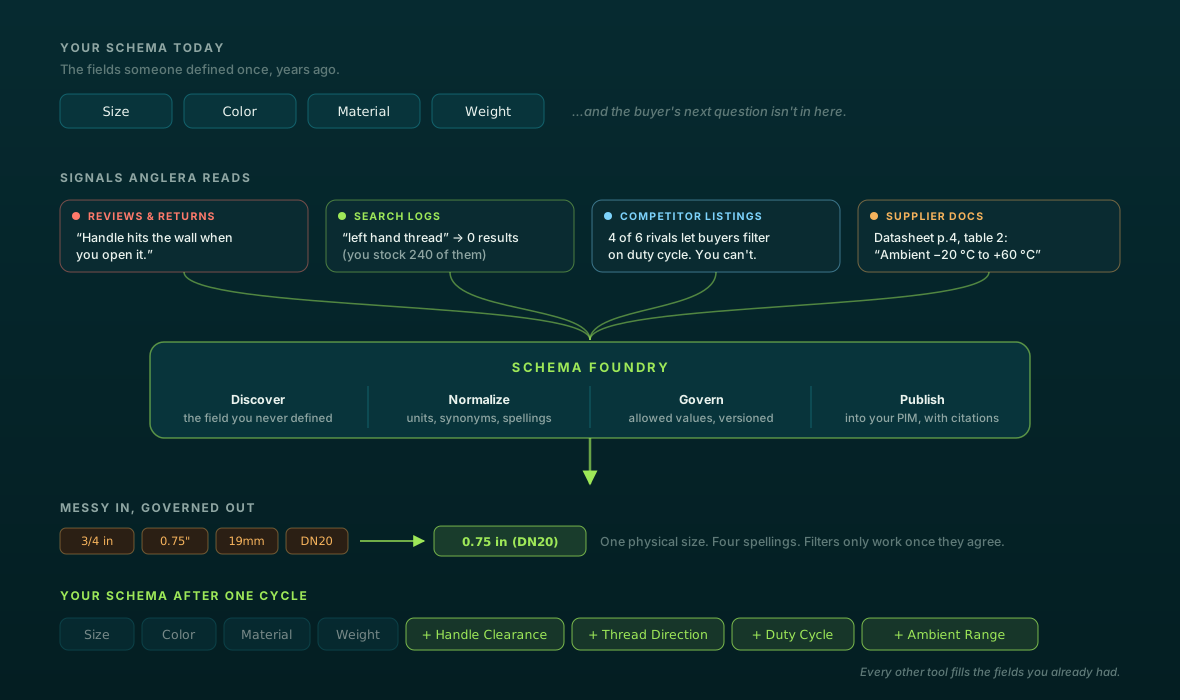
Neither platform solves the upstream problem: where does quality product content actually come from? Both assume someone has already gathered supplier data, written buyer-facing descriptions, filled attribute gaps, and scored completeness. That assumption is where most catalogs break down — and where Anglera fits, on top of whichever PIM you choose.
| Akeneo | Informatica PIM | Anglera | |
|---|---|---|---|
| Target buyer | Mid-market and enterprise teams where merchandisers, content editors, and e-commerce managers own product copy across channels and locales. | Large enterprises — manufacturers, distributors, and retailers — with complex governance needs spanning product, supplier, and customer data domains. | Works alongside either. Anglera enriches product content before it enters the PIM, so both Akeneo and Informatica are populated with buyer-ready data from day one. |
| AI enrichment capabilities | Recently added AI-assisted enrichment (Akeneo AI) that suggests attribute values and generates copy inside the PIM. Newer addition; depth varies by tier. | Positioned as an "Agentic AI PIM" with embedded AI agents that enrich, validate, and manage data inside the platform, backed by Informatica's broader IDMC data stack. | Enriches every SKU against real buyer signals — how buyers search, compare, and decide — then writes it back to your PIM. Complements both by supplying enriched content before either platform's own AI layer processes it. |
| MDM & data governance | PIM-native governance scoped to product data. No cross-domain MDM (customer, supplier, financial). Workflow and approval tools available on Advanced and Premium tiers. | Full MDM platform. Product 360 supports golden record management, data stewardship workflows, and cross-domain governance across product, customer, and supplier entities. | Not a governance layer. Anglera enriches content quality; your PIM handles governance. Enriched records flow through your existing approval workflows unchanged. |
| Implementation complexity | Typically 2–6 months. Growth tier is faster; Advanced/Premium tiers with supplier collaboration and analytics require more configuration. Large partner ecosystem available. | Typically 9–18 months with certified system integrators. High configuration overhead; suitable for enterprises with dedicated data engineering and IT resources. | 30-day implementation. Reads from and writes back to your PIM — no rip-and-replace, no parallel system. |
| Pricing | Starts at $45,000/year (Growth). Advanced and Premium tiers are quote-only. Pricing is feature-based, not data-volume-based — more transparent than most enterprise PIMs. | Quote-only across Standard, Professional, and Enterprise tiers; driven by users, data volume, and configuration scope. Widely cited as expensive; total cost typically exceeds six figures annually. | Separate line item alongside either PIM; priced on catalog size and enrichment scope. No rip-and-replace cost. |
| Channel publishing & integrations | Strong: 250+ integrations in the Akeneo App Store, native channel/locale publishing, and direct connectors to Shopify, Magento, Salesforce Commerce, and major marketplaces. | Strong enterprise integrations (SAP, Oracle, Salesforce CRM) and MDM connections. Less out-of-the-box retail channel publishing; more ERP-adjacent than commerce-adjacent. | Platform-agnostic; connects to both via API. Enriched content is written back to whichever PIM you run, and your existing channel connectors distribute it from there. |
| Content completeness scoring | Built-in completeness indicator shows which attribute fields are filled per product and per channel. Measures field population — not content quality or buyer-signal alignment. | Data quality rules and scorecards across the MDM stack flag missing or inconsistent attributes against configurable validation rules. Governance-oriented rather than buyer-signal-oriented. | Scores every SKU against buyer signals: what buyers actually search for, compare, and need to convert. Field population and governance compliance are different from conversion readiness — Anglera measures the latter. |
How to choose between Akeneo and Informatica PIM
Choose Akeneo if:
- Your primary users are merchandisers, content editors, or e-commerce managers who need to own and manage product copy without heavy IT involvement
- Your main goal is clean, channel-ready product content flowing to digital storefronts, marketplaces, and distributors
- You want faster time-to-value — Akeneo's Growth tier gets a team productive in weeks, not quarters
- You need a broad out-of-the-box integration ecosystem for retail and commerce channels
- $45,000/year is a workable starting point for your stage of data maturity
Choose Informatica Product 360 if:
- You are a large enterprise where product data governance is inseparable from supplier data, customer data, and regulatory compliance
- You need true MDM — golden records, stewardship workflows, cross-domain data quality — not just a PIM
- Your data stack already runs on Informatica IDMC, or you are standardizing on Informatica's broader platform
- You have the IT resources and budget for a 9–18 month implementation with dedicated data engineering support
- Auditability, data lineage, and enterprise-grade governance are non-negotiable
The honest middle ground: If you are a mid-market manufacturer or distributor with a complex catalog but no existing MDM investment, Informatica's depth may outweigh your needs and your implementation budget. Akeneo Advanced or Premium covers most mid-enterprise PIM requirements without the MDM overhead. If you are a large enterprise that already manages master data complexity across multiple domains, Informatica's all-in-one approach is worth the implementation investment.
Whichever you pick, the data still has to get done
Both Akeneo and Informatica Product 360 are excellent systems of record — but neither tells you where quality product content is supposed to come from. Akeneo's completeness panel shows you which fields are empty. Informatica's scorecards flag attribute inconsistencies against your validation rules. What neither platform does is go out, gather supplier data, write buyer-facing descriptions, fill attribute gaps, and validate everything against how your buyers actually search, compare, and decide.
That is Anglera's job. Regardless of which PIM you run, Anglera sits upstream: it enriches every SKU against buyer signals, scores completeness against what actually drives conversion, then writes the improved content back to your PIM in roughly 30 days. Your PIM — Akeneo or Informatica — becomes the system of record for content that is already buyer-ready, not a staging area for data your team still has to clean.
Whichever platform you choose, the enrichment work has to happen. Anglera makes it automatic and writes the results back to the source of truth you just invested in.
Frequently asked questions
Can Anglera replace Akeneo or Informatica PIM?
No. Anglera is not a PIM and does not store or govern product data. It enriches the data — gathering, cleaning, writing buyer-facing content, and scoring SKUs against buyer signals — then writes the results back to your PIM. Akeneo or Informatica remains your system of record.
Is Akeneo suitable for enterprise-scale catalogs?
Yes. Akeneo's Advanced and Premium tiers support large SKU volumes, multi-locale publishing, supplier collaboration workflows, and SSO. That said, organizations with true MDM requirements — cross-domain data governance beyond product — typically need a platform like Informatica Product 360.
How does Informatica Product 360 differ from Informatica MDM?
Product 360 is Informatica's PIM application, purpose-built for product data. Informatica MDM is the broader master data management platform that can govern customer, supplier, financial, and product entities. Product 360 is typically deployed as part of the broader MDM stack and benefits from its governance infrastructure.
Which platform integrates more easily with e-commerce channels?
Akeneo has a stronger out-of-the-box ecosystem for retail and e-commerce — 250+ integrations including Shopify, Magento, and Salesforce Commerce Cloud. Informatica's integrations skew toward enterprise back-office systems (SAP, Oracle, Salesforce CRM). If digital commerce channels are your primary distribution point, Akeneo's connector catalog is more immediately useful.
How long does it take to implement either platform?
Akeneo's Growth tier can be live in 2–4 months for teams with reasonably organized source data; Advanced and Premium tiers typically run 4–8 months. Informatica Product 360 implementations with full MDM scope typically run 9–18 months and require certified implementation partners. Anglera can be running on top of either in roughly 30 days.