Akeneo vs Channable: PIM vs Feed Management, Compared Honestly
Akeneo and Channable sit at different points in the product data journey, which means they rarely compete head-to-head — but choosing the wrong one for your actual problem is an expensive mistake.
Akeneo is a PIM: the governed system of record where you store, structure, and maintain authoritative product content across SKUs, locales, and teams. Channable picks up after the catalog is ready — it transforms that data into channel-ready listings and keeps prices, inventory, and content synchronized across 2,500+ marketplaces and ad networks in real time. One organizes the data; the other moves it.
The real question is which problem you are trying to solve. If your catalog is disorganized, incomplete, or inconsistently maintained across teams and suppliers, you have a PIM problem and Akeneo is the right conversation. If your data is reasonably solid but getting it to 20 channels simultaneously is the bottleneck, Channable addresses that directly. Many mid-market companies end up running both — Akeneo as the source of truth, Channable as the distribution layer — and the stack works well when the data flowing between them is complete and accurate.
| Akeneo | Channable | Anglera | |
|---|---|---|---|
| Primary role in the stack | PIM — the system of record. Centralizes, structures, and governs product content for downstream use across teams and channels. | Feed syndication hub. Transforms your existing catalog into channel-ready listings and keeps data synchronized across 2,500+ marketplaces and ad networks. | Enrichment layer. Gathers missing attributes, cleans content, scores SKUs against buyer signals, and writes the results back to whatever source of record you already use. |
| Pricing model | Starts at $45,000/year (Growth package). Advanced and Premium tiers add analytics, DAM, SSO, and supplier portals. No self-serve pricing; requires a sales call. | Starts at ~€59/month for 5,000 items. AI features, PPC automation, repricing, and marketplace integrations are separate add-ons at €30–71/month each. | Contact for pricing. Complements either platform without replacing it. Typical implementation is about 30 days with no rearchitecting of your existing stack. |
| Data enrichment capability | Provides structure and AI-assisted workflows for enrichment, but the actual work of filling missing attributes depends on your team, suppliers, and integrations. Quality reflects what goes in. | Rule-based (if/then) transformation to reshape data for channel requirements. Designed to reformat and route catalog data, not to generate or fill missing product content. | Core function. Automatically gathers, cleans, and enriches product attributes at scale — filling gaps that Akeneo workflows leave open and ensuring Channable feeds start with complete, accurate data. |
| Channel distribution | Distributes via 250+ app store integrations. Not a native real-time feed sync tool — downstream distribution depends on connected partners and platforms. | Real-time sync to 2,500+ channels including Google Shopping, Meta, Amazon, and price comparison sites. PPC automation and marketplace order management available as add-ons. | Not a distribution tool. Enriches data upstream so every channel — however you distribute — receives complete, buyer-ready product content. |
| Implementation complexity | Enterprise implementation. Requires data modeling, workflow setup, and often a partner agency. Longer time to value; typically several months for a full rollout. | Lighter lift. E-commerce teams typically connect a product source, configure transformation rules, and get first feeds running within days to a few weeks. | Around 30 days. Connects to your existing source of truth — no rearchitecting required, no new system of record to maintain. |
| Best-fit team | Product managers, catalog ops, and e-commerce teams at mid-market to enterprise companies managing large or complex catalogs with multiple contributors and locales. | E-commerce merchants and performance marketers who need catalog listings and ad feeds synchronized across many channels without manual feed management. | Works alongside whichever team already owns the catalog. Typically governed by catalog ops or e-commerce leadership; no dedicated data engineering team required. |
| Ecosystem and integrations | 250+ marketplace and tech integrations via app store. Strong connectors for ERPs, DAMs, and major e-commerce platforms. PX Insights analytics and recent AI enrichment additions. | 2,500+ channel connections with deep marketplace and ad network coverage. Includes Google, Meta, Amazon, Bol.com, and more. Add-on modules for PPC and repricing. | Reads from and writes back to your PIM or catalog source. Works with Akeneo natively as an enrichment input; improves the data quality flowing into Channable before distribution begins. |
How to choose between Akeneo and Channable
Choose Akeneo if:
- You manage a large or complex catalog — many product families, attributes, locales, or variants — and teams across marketing, suppliers, and e-commerce all need governed workflows to contribute and approve content
- Data inconsistency, missing attributes, or lack of a single source of truth is the core problem slowing you down
- You need long-term catalog infrastructure that integrates with your ERP, DAM, and downstream platforms
- Budget can support an enterprise platform ($45,000+/year) and a structured implementation
Choose Channable if:
- Your catalog data is already reasonably structured and the bottleneck is getting it to many channels fast
- You are an e-commerce merchant managing product feeds for Google Shopping, Meta, Amazon, and other channels simultaneously
- Real-time price and inventory sync matters — listings need to reflect stock levels and pricing changes without manual updates
- You want a lower entry cost (~€59/month) and faster time to value than a full PIM deployment
Choose both if you are a mid-market or enterprise retailer where Akeneo owns the master catalog and Channable handles the distribution layer. This is a common and well-established stack. The gap that remains — and that neither tool was built to fill — is the enrichment work required to make the data inside Akeneo genuinely complete before it flows to Channable and then to channels.
Whichever you pick, the data still has to get done
Neither Akeneo nor Channable solves the enrichment problem — and both quietly assume it has already been handled.
Akeneo provides the structure and workflows for enrichment, but filling in missing specifications, writing consistent descriptions, scoring content completeness, and identifying attribute gaps across thousands of SKUs still requires someone or something to do the actual work. Many teams lean on supplier data that is incomplete, or on marketing teams that enrich manually at a pace that can not keep up with catalog growth. The PIM holds the data; nobody has solved the work of improving it at scale.
Channable is downstream of this problem. It transforms whatever it receives. If your catalog has thin descriptions, missing technical attributes, or inconsistent formatting, those problems follow every listing to every channel. Rule-based transformation can reshape data — it can not generate what was never there.
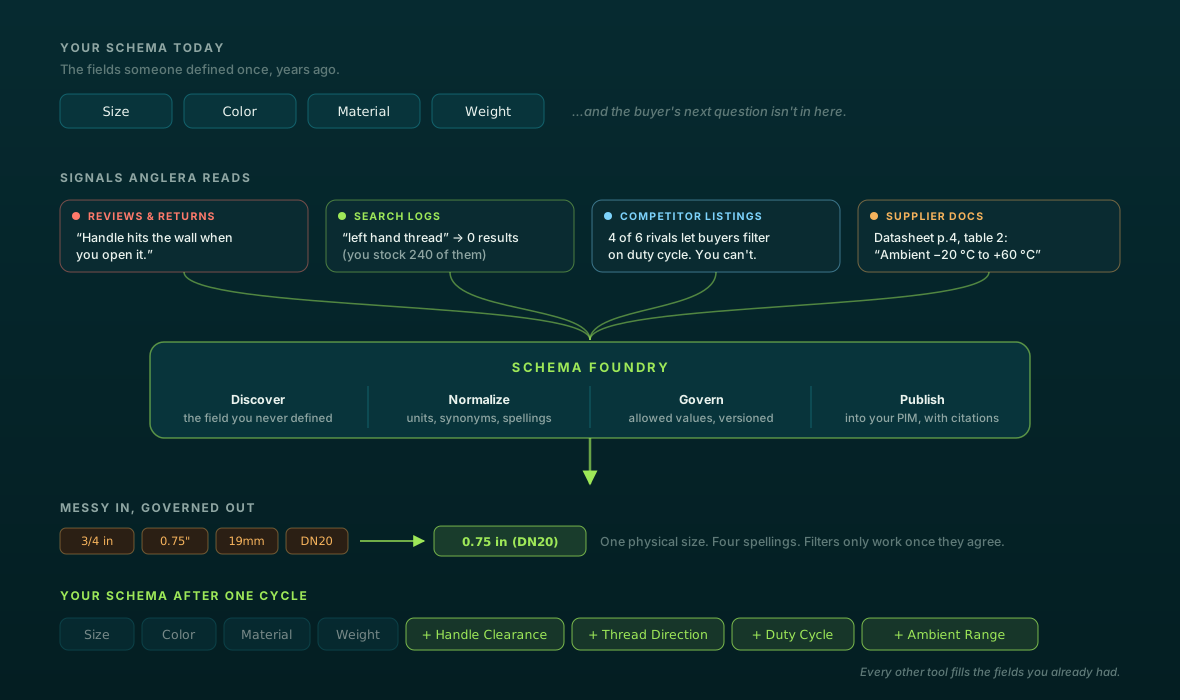
That is where Anglera fits. Anglera connects to your existing source of truth — Akeneo, your ERP, or wherever your catalog lives — automatically gathers and cleans product data, enriches attributes against buyer signals, and writes the results back. In about 30 days, your PIM holds better data, and everything downstream (including Channable feeds) starts from a stronger foundation. Whichever platform you choose, Anglera does the enrichment work those platforms assume already happened.
Frequently asked questions
Can Channable replace Akeneo?
No. Channable transforms and syndicates catalog data; it does not provide a governed system of record for managing product content across teams, locales, and workflows. If data governance, catalog structure, or supplier collaboration is the problem, Channable does not address it. If distribution and feed management is the bottleneck, it does.
Do I need Akeneo if I already use Channable?
It depends on catalog complexity. Many Channable customers manage product data in a spreadsheet, ERP, or e-commerce platform and route it directly through Channable without a PIM. If that works at your scale, you may not need Akeneo. If multi-locale content, supplier onboarding, or catalog governance becomes a bottleneck, a PIM becomes worth evaluating.
Where does Anglera fit if I use both Akeneo and Channable?
Anglera works upstream of both. It enriches data in your PIM so that when Akeneo distributes to Channable and Channable pushes to channels, every step starts with complete, buyer-ready product content. You do not change your stack — you improve what flows through it.
How long does it take to implement Akeneo?
Akeneo is an enterprise platform. Implementation typically involves data modeling, workflow configuration, and often a partner agency — commonly several months depending on catalog size and complexity. Akeneo does not publish a standard implementation timeline, and the process varies significantly by company.
My catalog data is incomplete. Will Akeneo or Channable fix that?
Neither tool fixes incomplete data on its own. Akeneo gives you the workflows and structure to improve data over time, but the enrichment work still needs to happen — either manually, via suppliers, or through a purpose-built enrichment tool. Channable will distribute whatever data it receives, gaps included. If catalog completeness is the core problem, that is the problem to solve first, before evaluating PIM or syndication platforms.