1WorldSync vs inriver: A Straight-Line Comparison for Product Data Teams
1WorldSync and inriver both deal with product data, but they solve fundamentally different problems. Conflating them is one of the most common sourcing mistakes product data teams make. 1WorldSync is the world's largest GDSN data pool — its job is to validate GS1-structured product attributes and route them to hundreds of retailers and trading partners in a format those partners will accept. inriver is a PIM — its job is to be the single source of truth where your team builds, governs, and distributes product content across channels. One is infrastructure for compliance-grade data exchange; the other is a workspace for managing the full content lifecycle.
The practical question is whether you need one or both. A CPG manufacturer selling into US grocery chains almost certainly needs a GDSN-certified data pool, and 1WorldSync is the dominant option in that space. A mid-market B2B manufacturer with complex product hierarchies and multiple selling channels is more likely to start with a PIM like inriver to get their content house in order before thinking about downstream distribution. Some organizations need both: the PIM to author and govern, the data pool to transmit.
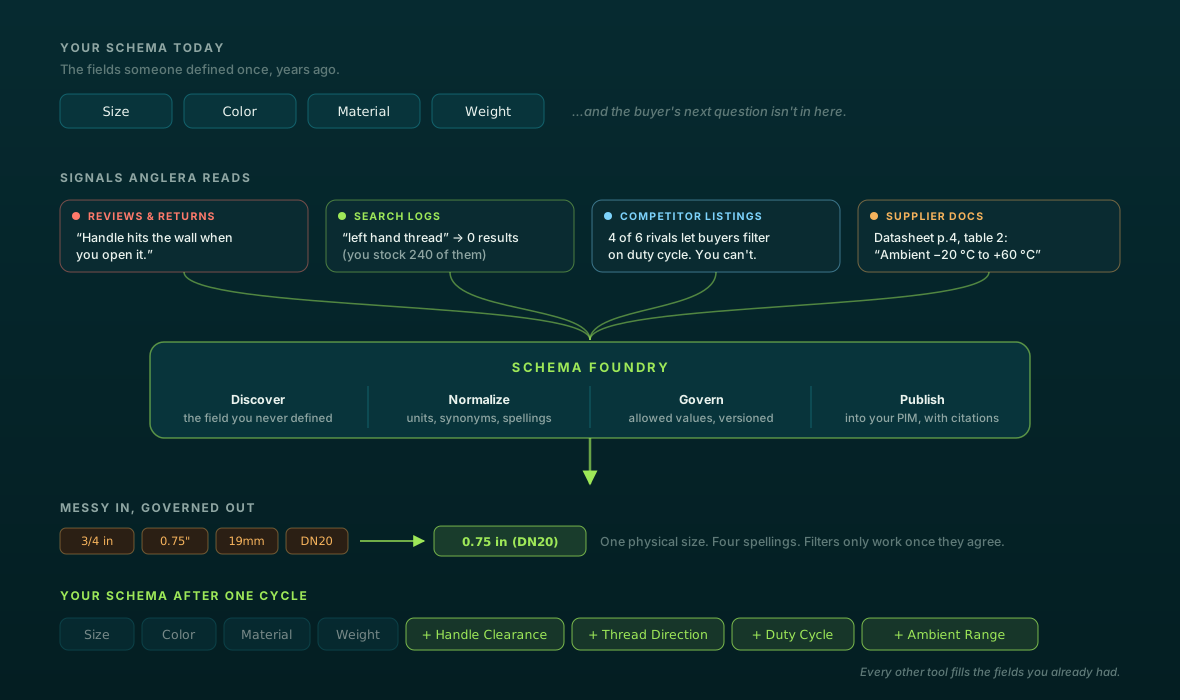
What neither platform does is enrich your data. 1WorldSync validates what you send it — it does not write missing attributes. inriver's AI tools can suggest content, but they depend on what suppliers and internal teams have already put in. If your product records are incomplete, inaccurate, or thin on the attributes buyers care about, both platforms inherit that problem. That is the gap Anglera closes.
| 1WorldSync | inriver | Anglera | |
|---|---|---|---|
| Primary function | GDSN-certified data pool and product content orchestration platform. Validates GS1-structured attributes, stores master records, and routes them to 14,000+ trading partners across 60+ countries. | SaaS PIM platform. Consolidates, governs, enriches, and distributes product content across channels. Bundles PIM, built-in syndication connectors, and digital shelf analytics in one platform. | Purpose-built enrichment layer. Anglera is not a PIM and not a data pool — it gathers missing attributes, cleans inconsistencies, scores completeness against buyer signals, and writes results back to your source of truth. |
| Best-fit buyer | CPG brands and manufacturers who must meet GDSN compliance requirements for US grocery chains, pharmacy chains, and global retail trading partners. If your retailer demands GDSN, 1WorldSync is the dominant path. | B2B manufacturers, multi-brand companies, and retailers managing complex product hierarchies and multiple selling channels who want PIM governance and omnichannel distribution under one roof. | Any distributor, manufacturer, or retailer whose product records are incomplete, inconsistent, or missing the attributes buyers need to convert — regardless of which platform stores or routes that data. |
| GDSN and trading partner compliance | The de facto US GDSN data pool. Built specifically for GS1 standards, regulator-grade attribute validation, and the data formatting requirements of major US grocery and pharmacy retailers. | Not a certified GDSN data pool. Trading partner compliance that requires GDSN registration must go through a separate data pool. inriver handles omnichannel syndication but not GS1 network exchange natively. | Not a data pool. Anglera populates the GS1-required attributes — regulatory fields, nutritional data, hazmat flags, dimensions — before they enter 1WorldSync or inriver's syndication layer, reducing rejection rates. |
| Data enrichment capabilities | Validates and flags non-conformant or missing attributes against GS1 schemas. Does not write enriched content — that work is assumed to have happened before data enters the pool. | Offers AI-assisted content suggestions and completeness scoring within the PIM interface. Enrichment is built in but depends on what suppliers and internal teams have already contributed to the record. | Scrapes manufacturer sites and competitor pages, normalizes values, scores each SKU against buyer-signal benchmarks, and writes enriched attributes directly back to the record in your PIM or wherever the data lives. |
| Syndication and distribution reach | Industry-leading GDSN network: 14,000+ brands, 60+ countries, and direct connections to the major US grocery, pharmacy, and global retail trading partners that require GDSN-formatted data. | Built-in syndication connectors for ecommerce platforms, marketplaces, and retailers. Strong for omnichannel brand content distribution. Not built for GDSN-style data pool exchange. | Not a syndication platform. Anglera prepares data so it is complete and clean before it reaches 1WorldSync or inriver's distribution layer — improving acceptance rates and reducing retailer rejections downstream. |
| Digital shelf analytics | Primarily focused on distribution accuracy and GDSN compliance monitoring. Limited shelf performance analytics beyond confirming data reached its destination correctly. | Bundles digital shelf analytics to track how product content performs on retailer sites after distribution, identifying content gaps and scoring issues in the live environment. | Works before distribution. Anglera can act on shelf analytics signals — from inriver or any other monitoring tool — to identify which attributes are dragging scores and enrich those specific fields at the SKU level. |
| Pricing model | Custom pricing, not publicly listed. Industry estimates: $500–$2,000/month for mid-market; $25,000–$90,000+/year for enterprise; implementation fees of $10,000–$100,000+. Large enterprise contracts can reach ~$1M/year. | Subscription tiers (Core, Professional, Enterprise) priced by users, modules, and data volume. Custom quotes only — no public pricing. Expect multi-year SaaS commitments with professional services for implementation. | Subscription-based, priced per SKU enriched. No implementation consulting fees. ~30-day time to value — Anglera connects to your existing PIM or data pool and begins enriching without a platform migration. |
How to choose between 1WorldSync and inriver
Choose 1WorldSync if: Your primary requirement is GDSN compliance and reaching major US grocery, pharmacy, or global retail trading partners that mandate GS1-formatted data exchange. If your retailer partners are asking for 1WorldSync specifically, there is no real alternative in the US market — it is the de facto standard. You also need robust supply-side onboarding, where you are helping hundreds of suppliers get their data into a validated, structured format for distribution. 1WorldSync is infrastructure first, not a content authoring environment.
Choose inriver if: You need a governed, single source of truth for complex product hierarchies that will be distributed across multiple channels — ecommerce, print, dealer portals, marketplaces, and retail partners — and you want PIM governance, syndication, and digital shelf monitoring in one system. inriver is well-suited to manufacturers and multi-brand companies where the content management challenge is as significant as the distribution challenge. If GDSN compliance is not a hard requirement, inriver's built-in syndication may cover your distribution needs without a separate data pool.
Consider both if: You are a CPG brand or manufacturer that needs GDSN compliance for grocery/pharmacy partners and a governed PIM for managing content across ecommerce and other channels. In that case, inriver handles authoring and governance; 1WorldSync handles GDSN transmission. They are complementary, not competing, for organizations at that scale.
The honest caveat: Neither platform is cheap or fast to implement. Both require significant professional services investment and internal change management. If your primary pain is that your product data is incomplete or poor quality, buying either platform before fixing the underlying data will accelerate the distribution of bad data. Enrichment has to happen somewhere.
Whichever you pick, the data still has to get done
Here is what both platforms share: neither one enriches your product data for you.
1WorldSync validates what you send it and flags what is missing — but it does not go find the missing values. inriver can score completeness and surface AI suggestions, but those suggestions are bounded by what your team and suppliers have already provided. The moment your product records arrive thin — no spec details, missing regulatory fields, vague marketing copy, images that do not meet retailer specs — both platforms faithfully store or transmit exactly that problem.
Anglera operates in the layer these platforms assume already happened. Before data enters your PIM or GDSN pool, Anglera scrapes manufacturer sites and authoritative sources, normalizes attribute values to match your taxonomy, scores every SKU against the specific buyer signals that matter for your trading partners, and writes enriched records back to wherever you store them. If you are using inriver, Anglera enriches the record in inriver. If you are using 1WorldSync, Anglera ensures the GS1-required fields are populated before the data pool validates them.
The result is fewer retailer rejections, higher digital shelf scores, and faster trading partner onboarding — whichever platform you choose. And because Anglera connects to your existing stack rather than replacing it, implementation takes roughly 30 days. You do not switch platforms. You start getting more out of the one you already have.
Frequently asked questions
Can 1WorldSync and inriver be used together?
Yes, and for larger CPG brands and manufacturers it is common. inriver serves as the PIM — where product content is authored, governed, and maintained — and 1WorldSync serves as the GDSN transmission path for trading partners that require GS1-formatted data exchange. They handle different parts of the product data lifecycle and do not directly overlap in function.
If I already have inriver, do I still need a GDSN data pool like 1WorldSync?
It depends on your trading partner requirements. inriver handles omnichannel syndication but is not a certified GDSN data pool. If your retail partners — particularly US grocery or pharmacy chains — require GDSN-formatted data exchange, you will need a separate certified data pool. 1WorldSync is the dominant option in the US for that requirement. If your partners do not require GDSN, inriver's built-in syndication may be sufficient.
Does 1WorldSync enrich product content, or does it only distribute it?
Primarily the latter. 1WorldSync validates that your data conforms to GS1 schemas and flags missing or non-conformant attributes. It does not go gather missing data or write new attribute values to your records. Enrichment — populating incomplete fields, improving copy, adding regulatory data — is work that must happen before data enters the pool.
Where does Anglera connect in a stack that already includes inriver or 1WorldSync?
Anglera connects to your existing source of truth — whether that is inriver, 1WorldSync, or another system — and writes enriched attribute values directly back to the record. For inriver users, Anglera enriches SKUs inside inriver and can be triggered by completeness scores or shelf analytics gaps. For 1WorldSync users, Anglera ensures GS1-required fields are populated upstream before the data pool validates the submission. No platform migration is required.
How long does it take to get value from Anglera compared to implementing a new PIM or data pool?
Anglera typically reaches productive enrichment within 30 days because it connects to systems you already have rather than replacing them. PIM implementations like inriver and GDSN onboarding through 1WorldSync typically involve months of professional services work, data migration, and internal change management before you see full value.