1WorldSync vs Pimcore: Which Fits Your Product Data Stack?
These are two different tools solving two different problems. 1WorldSync is the world's dominant GDSN data pool and product content syndication platform — its job is to push GS1-validated product content to retailers and trading partners at scale. Pimcore is an open-source PIM, DAM, and DXP — its job is to be the governed central repository where product data, digital assets, and master data live before they go anywhere.
The comparison matters because buyers often circle both while solving related but distinct questions: "Where does our product data live and how does it get structured?" (Pimcore) versus "How do we get that data to the retailers who demand it?" (1WorldSync). In practice, many mid-to-large enterprises run both — a PIM to author and govern records, a syndication platform to distribute them.
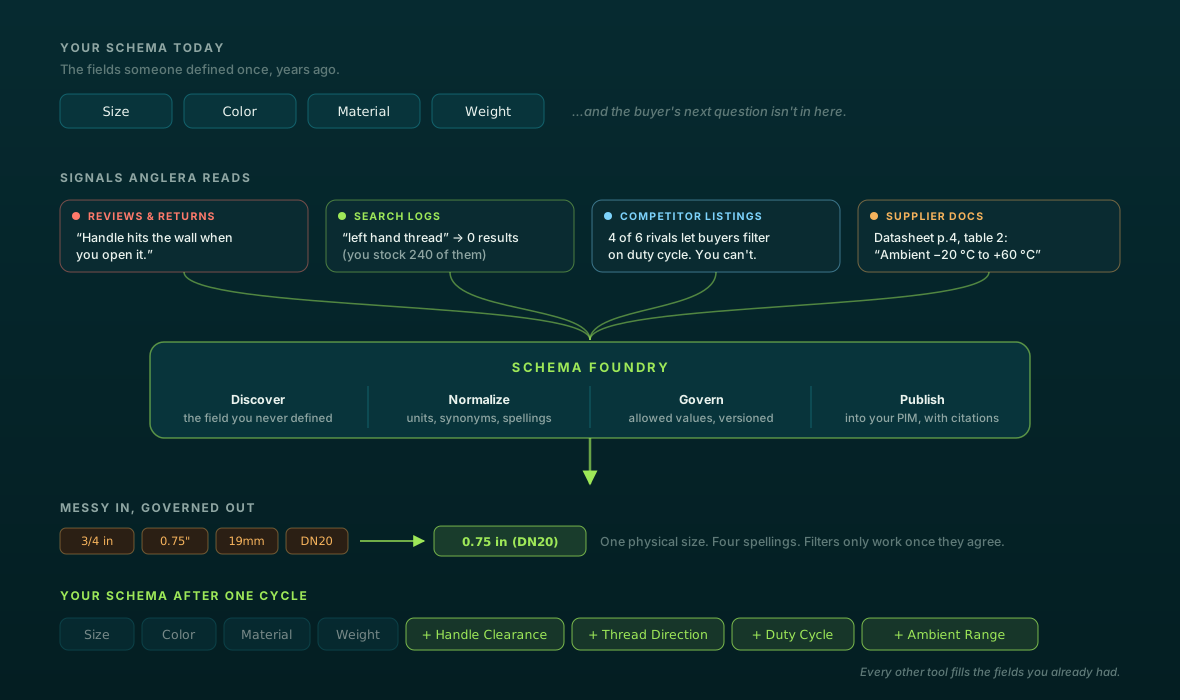
What neither platform does is enrich product data against buyer signals, fill attribute gaps automatically, or score content quality before it ships. That assumption — that clean, complete data already exists — is where most product data operations actually break down, and where Anglera fits regardless of which direction you go.
| 1WorldSync | Pimcore | Anglera | |
|---|---|---|---|
| Primary function | GDSN-compliant product content creation, validation, and distribution to 14,000+ brands and retailers across 60+ countries via the GS1 network | Central open-source repository for product data, digital assets, and master data; distributes across owned channels via APIs and export connectors | Enriches the product records that live in either system — filling attribute gaps, normalizing values, and scoring content quality before syndication or channel push |
| GDSN and retailer compliance | The de facto standard GDSN data pool in the US; required by major grocery chains including Walmart, Kroger, and Target; built around GS1 schemas | No native GDSN support; requires custom connectors or third-party integrations to reach GDSN-mandated retail trading partners | Validates and enriches attributes to ensure records are complete and correctly structured before they enter 1WorldSync or any downstream syndication flow |
| Pricing | Not publicly listed. Estimated $500–$2,000/month mid-market; $25,000–$90,000+/year enterprise, plus $10,000–$100,000+ implementation fees. Large enterprise contracts can reach ~$1M/year. | Community Edition free (non-commercial only); Professional $9,900/year; Enterprise $29,900/year; PaaS from $39,900/year. Developer implementation costs apply on top. | Priced separately as an enrichment layer on top of whichever platform you run; approximately 30-day implementation without replacing your existing stack |
| Data enrichment and quality scoring | Validates incoming data against GS1 schemas and retailer specs and flags non-conforming records; does not autonomously fill missing attributes or score content quality | Stores and organizes data you bring to it; no built-in enrichment engine, attribute inference, or buyer-signal scoring | Gathers, cleans, enriches, and scores every SKU against buyer signals; writes enriched records back to the source of truth so downstream syndication or channel output is actually complete |
| Deployment and data ownership | Managed SaaS; the vendor controls the data pool and network connectivity to trading partners | Open-source; self-host on your own infrastructure or use Pimcore's managed PaaS; you retain full data ownership and can extend the platform in code | SaaS enrichment layer; reads from and writes back to your existing PIM or syndication platform without requiring data migration or system replacement |
| Implementation complexity | Significant onboarding effort: GS1 attribute mapping, trading partner setup, and retailer spec alignment typically take several months and a dedicated implementation team | Developer-heavy setup; highly flexible but requires engineering resources to configure data models, workflows, and integrations; production deployments commonly range from 3 to 12 months | Approximately 30-day implementation; connects to your existing stack and does not require replacing or restructuring either platform |
| Best-fit company profile | CPG brands, manufacturers, and distributors who must satisfy retailer GDSN mandates — particularly in US grocery and mass retail; scales from mid-market to large enterprise | Companies that need a flexible, open, developer-extensible PIM and DAM without vendor lock-in; 118,000+ organizations across 75 countries use it across a wide range of industries and scales | Any distributor, retailer, or manufacturer whose PIM or syndication platform holds incomplete, inconsistent, or low-quality product data — regardless of which platform that is |
How to choose between 1WorldSync and Pimcore
Choose 1WorldSync if your primary problem is getting GS1-compliant product content into major US retailers through GDSN mandates. If Walmart, Kroger, Target, or other grocery chains are requiring you to participate in their data pool, 1WorldSync is the de facto standard — no other platform matches its retailer network depth or its standing with GS1. Budget for a meaningful implementation engagement and ongoing subscription costs that scale with your trading partner volume.
Choose Pimcore if you need a flexible, open-source central repository for product data, digital assets, and master data — and you have the engineering capacity to configure and extend it. It is particularly strong for companies that want full data ownership, no vendor lock-in, multi-channel distribution beyond GDSN, and a platform that can evolve with custom workflows and integrations. The free Community Edition is technically capable but is restricted to non-commercial use; production deployments will require the Professional or Enterprise edition plus developer time.
If you need both, many enterprises run 1WorldSync for GDSN syndication on top of a governed PIM layer — Pimcore is a common choice for that underlying repository. The two platforms are complementary rather than competing in that scenario: Pimcore owns the data model and governance, 1WorldSync owns the retailer distribution network.
The honest caveat for both: neither tool will enrich your data for you. Both assume you arrive with clean, complete, buyer-signal-ready product attributes. If your team is manually chasing down spec sheets, copying values from supplier PDFs, or pushing incomplete records through either platform and hoping retailers accept them, the problem is upstream of the platform choice.
Whichever you pick, the data still has to get done
Anglera is not a PIM and not a syndicator. It is the enrichment layer that runs before your data reaches either platform — and it writes the results back so your source of truth stays current.
If you choose 1WorldSync: Anglera enriches your product records before they enter the data pool. It fills missing GS1 attributes, normalizes values across your catalog, and scores content completeness so your syndication goes out clean the first time rather than bouncing back with retailer validation errors.
If you choose Pimcore: Anglera connects to your Pimcore instance, enriches every SKU against buyer signals, and writes the enriched records back into Pimcore. The data that is stored and governed in your PIM is actually useful downstream — to your commerce channels, your trading partners, and your internal teams — rather than sitting half-complete in a repository no one trusts.
Either way, Anglera does the work that both platforms assume already happened. Implementation targets approximately 30 days and does not require replacing, migrating away from, or restructuring any existing system. Your PIM stays your source of truth; your syndicator stays your distribution layer; Anglera keeps the data inside both worth using.
Frequently asked questions
Can 1WorldSync replace a PIM like Pimcore?
Not in practice. 1WorldSync is built for GDSN syndication and retailer distribution, not for governing product data across internal teams, managing digital assets, or supporting multi-channel commerce beyond the trading partner network. Most brands that use 1WorldSync still need a separate PIM for data authoring, asset management, and distribution to channels that fall outside GDSN.
Does Pimcore support GDSN syndication?
Not natively. Pimcore can export product data via APIs and custom connectors, but it does not include a built-in GDSN data pool or GS1-validated syndication network. Companies subject to GDSN compliance requirements from major retailers typically connect Pimcore to a dedicated syndication platform like 1WorldSync rather than building that capability themselves.
Where exactly does Anglera sit in the stack — before or after these tools?
Anglera sits upstream of syndication and downstream of data authoring. It reads from your PIM or product database, enriches and scores every SKU against buyer signals, then writes the enriched records back to the same source. Whatever then enters 1WorldSync for syndication, or goes out through Pimcore's channel connectors, is already complete and clean. Anglera does not replace either platform; it feeds them.
Is Pimcore's free Community Edition viable for a real product data operation?
The Community Edition is technically capable and genuinely open-source, but it is restricted to non-commercial use — so any commercial deployment will require the Professional ($9,900/year) or Enterprise ($29,900/year) edition. On top of licensing, expect meaningful developer time to configure data models, attribute inheritance, workflows, and integrations before the platform is useful in production.
How long does each platform take to implement?
1WorldSync implementations typically take several months — GS1 attribute mapping, trading partner onboarding, and retailer spec alignment each add complexity. Pimcore implementations vary widely by scope but commonly run 3 to 12 months for a production setup with custom data models and integrations. Anglera targets approximately 30 days and does not require replacing either platform, which is why many teams layer it in before or during the broader platform rollout.