Anglera + Pimcore
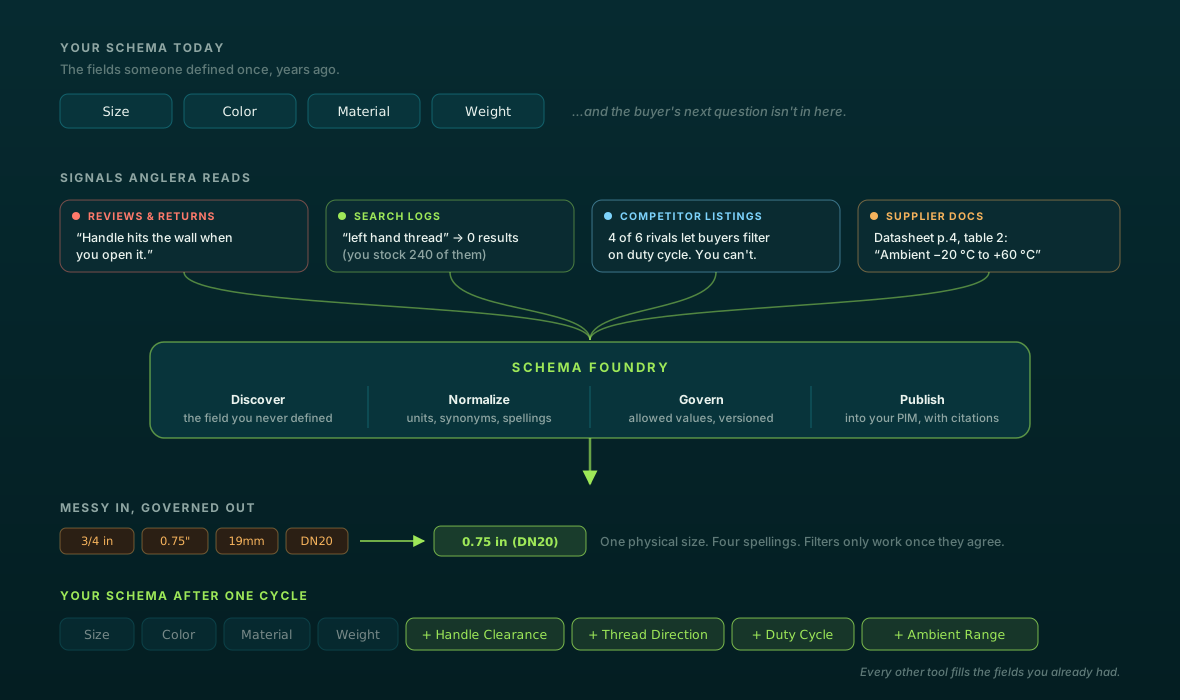
Pimcore is where your product data lives — it does not decide what that data should say. Pimcore has no concept of buyer signals: it cannot tell you that your industrial buyers filter by tensile strength before they filter by brand, or that your channel partners need a different attribute set than your DTC site. Anglera reads from your Pimcore instance, enriches every SKU against real buyer-search behavior, scores completeness against what actually drives conversion, and writes the finished records back — so Pimcore stores the truth and Anglera makes the truth good enough to sell.
What Pimcore does
Pimcore is an open-source PIM, DAM, MDM, and DXP platform used by over 118,000 companies across 75 countries. It provides a central repository for storing, organizing, and distributing product data, digital assets, and master data across channels — but does not enrich or score that data against buyer signals.
Pricing: Community Edition (free, non-commercial); Professional Edition $9,900/year; Enterprise Edition $29,900/year; PaaS starting at $39,900/year.
Pimcore vs Anglera, side by side
| Pimcore | Anglera | |
|---|---|---|
| Primary function | Central repository for storing and distributing product data, assets, and master data | Intelligent enrichment engine that gathers, cleans, scores, and writes back buyer-signal-optimized product content |
| Buyer-signal enrichment | None — Pimcore holds whatever data you put in; content quality is your team's responsibility | Core capability: enrichment is driven by how buyers actually search, compare, and decide — not supplier copy |
| Manual effort required | High — teams must manually author, validate, and maintain product content inside the platform | Minimal — Anglera automates gathering, cleaning, gap-filling, and scoring so editors focus on exceptions only |
| AI / search readiness | No built-in AI enrichment; third-party integrations or custom dev required | AI-native: every attribute written is tuned for downstream search, filtering, and LLM-based discovery |
| Time to value | Implementation typically 3–12 months depending on data model complexity and partner involved | ~30 days to first enriched SKUs writing back to your existing PIM |
| Relationship to your PIM | IS your PIM — the system of record | Works alongside your PIM (including Pimcore) — reads in, enriches, writes back without replacing it |