Contentserv vs Pimcore: Which PIM Fits Your Team?
Contentserv and Pimcore both sit at the center of a product data stack, but they reflect fundamentally different bets on how that stack should be built and owned.
Contentserv (now branded Centric PXM) is a managed, all-in-one enterprise suite: PIM, DAM, syndication, and digital shelf analytics delivered under a single commercial subscription. It targets fashion, lifestyle, and consumer goods companies that need rich-media workflows, localization, and channel distribution without assembling those capabilities themselves. Pimcore takes the opposite approach — an open-source platform covering PIM, DAM, MDM, and DXP that developer-led teams configure, extend, and host on their own terms. Its 118,000+ deployments span everything from industrial distributors to luxury retailers precisely because the data model is unconstrained.
The practical gap between them comes down to build vs. buy. Contentserv sells governed outcomes with a managed implementation path; Pimcore sells flexibility and control with a development investment attached. Neither platform automatically improves the product data that lives inside it — enrichment, in both cases, remains a separate problem for teams to solve.
| Contentserv | Pimcore | Anglera | |
|---|---|---|---|
| Platform type | Commercial enterprise PXM suite — PIM, DAM, syndication, and digital shelf analytics delivered as a managed, all-in-one product under a vendor subscription | Open-source PIM/DAM/MDM/DXP platform — a developer-extensible foundation that teams configure, integrate, and host; not a managed SaaS by default | Enrichment layer only — not a PIM or DXP; reads from whichever platform you already run, enriches every SKU against buyer signals, and writes results back |
| Licensing & pricing | Subscription-based with Starter, Professional, and Enterprise tiers; pricing not publicly disclosed — requires a direct quote; varies by modules, user count, and data volume | Community Edition free (non-commercial); Professional $9,900/year; Enterprise $29,900/year; PaaS starting at $39,900/year — the most transparent published pricing of any major PIM | Priced per SKU enriched — layers onto the existing PIM investment; no platform migration and no displacement of sunk cost |
| Out-of-the-box scope | Broad native scope: PIM, DAM, syndication to 1,000+ channels, and digital shelf analytics available within the suite without custom development | Deep but assembly-required: PIM, DAM, MDM, and DXP capabilities are present but integrations, channel connectors, and workflows are built by developers rather than configured from a vendor UI | Does not replace either platform's scope — enriches the product content that both then store, govern, and distribute |
| Target buyer | Enterprise teams in fashion, lifestyle, consumer goods, and luxury that need a vendor-managed PXM with rich-media workflows, multi-locale support, and channel syndication without a large internal development team | Developer-led organizations — including industrial distributors, manufacturers, and agencies — that want full control over their data model, no vendor lock-in, and the ability to extend or self-host the platform | Works for both buyer profiles — any organization with an existing PIM and a catalog that needs richer, buyer-ready content |
| Enrichment capability | AI-assisted content generation inside the platform; teams configure workflows and review output; Contentserv cites 80% reduction in copy time as a case study benchmark; enrichment logic is driven by supplier data and internal rules | No native enrichment tooling — Pimcore stores and distributes data as-entered; enrichment requires a custom integration or a third-party tool; buyer-signal intelligence is not part of the core platform | Autonomous enrichment driven by how real buyers search, compare, and filter — not reformatted supplier copy; writes enriched attributes and descriptions back to Contentserv or Pimcore without a copywriter in the loop |
| Implementation path | Vendor-led managed implementation; timeline and cost depend on module scope and data complexity; a structured onboarding engagement is the standard path | Developer-driven; implementation timeline depends entirely on internal engineering resources; the open-source model means no vendor-dictated timeline, but also no managed rollout support by default | ~30 days from kickoff to enriched SKUs written back to the PIM; no platform migration or rebuild required; works alongside either choice |
| Vendor lock-in risk | Higher: data and workflows live inside a proprietary commercial platform; migrating away requires exporting and rebuilding in a new system | Lower: open-source codebase means the data model and application layer are owned by the customer; no license dependency on a single vendor | None — Anglera is PIM-agnostic; if you switch PIMs, Anglera connects to the new one; no data is locked in the enrichment layer |
How to choose between Contentserv and Pimcore
Choose Contentserv if your team lacks deep developer resources and needs a governed, all-in-one PXM that works out of the box. Contentserv's strength is in managed complexity: if you operate in fashion, lifestyle, or consumer goods with rich media, multiple locales, and channel syndication requirements, the native DAM, digital shelf analytics, and 1,000+ channel connectors eliminate the need to assemble those capabilities separately. The trade-off is cost opacity and vendor dependency — you will need a quote to know what you are actually paying, and migrating away later is non-trivial.
Choose Pimcore if your team is developer-led and values control, flexibility, and transparent licensing over managed simplicity. Pimcore's open-source foundation means no vendor lock-in, a fully configurable data model, and published pricing tiers that start at $9,900/year for Professional use. It is a strong fit for industrial distributors, manufacturers, and agencies that need to model complex attribute hierarchies or build custom integrations — provided they have the engineering capacity to implement and maintain the platform. If your team does not, Pimcore's flexibility becomes a liability rather than an asset.
A few signals that clarify the choice:
- If you need channel syndication to 1,000+ retailers and marketplaces without custom connector work, Contentserv's native scope saves significant development time.
- If you need to self-host for data sovereignty reasons or want to avoid any commercial license dependency, Pimcore's open-source model is difficult to match at any price point.
- If budget predictability matters, Pimcore's published pricing tiers give you a floor to plan against; Contentserv requires a sales conversation before you see a real number.
- If your catalog complexity is driven by deep attribute hierarchies and developer-defined data models (common in industrial distribution and B2B manufacturing), Pimcore's unconstrained schema tends to win over Contentserv's more opinionated structure.
Whichever you pick, the data still has to get done
Both Contentserv and Pimcore are organized around the same premise: your product data has been gathered, cleaned, and enriched before it arrives in the PIM. Contentserv provides AI-assisted content tools to help close that gap inside the platform; Pimcore leaves it entirely to the team. In practice, neither assumption holds. Supplier data arrives as raw specs, inconsistent formats, and copy written for the factory floor — not for the buyers who search, compare, and filter before purchasing.
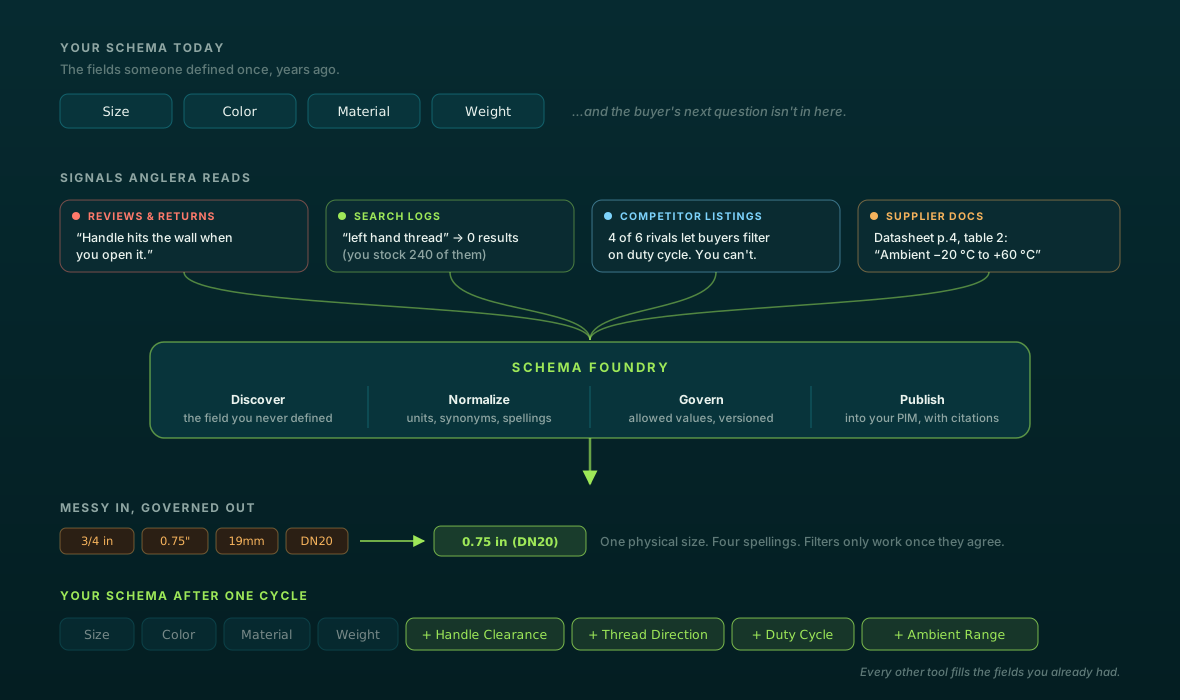
Anglera is the layer that does that upstream work. It connects to your Contentserv or Pimcore instance via API, pulls your existing SKUs, enriches every attribute and description against buyer signals — the actual search terms, comparison criteria, and decision filters your customers use — and writes the improved content back to the PIM record. Your system of record stays in place. Contentserv continues to govern and syndicate; Pimcore continues to store and distribute. The difference is that the content flowing through either platform is buyer-ready from the start, not just well-organized. Implementation is approximately 30 days with no platform migration required, regardless of which PIM you choose.
Frequently asked questions
What is the main difference between Contentserv and Pimcore?
Contentserv is a managed, commercial enterprise PXM suite that bundles PIM, DAM, syndication, and digital shelf analytics under a single vendor subscription — designed for teams that need governed outcomes without deep internal development. Pimcore is an open-source PIM/DAM/MDM/DXP platform that developer-led teams configure and extend themselves, with fully transparent published pricing and no vendor lock-in. The choice is essentially build vs. buy: Contentserv sells managed complexity; Pimcore sells maximum control.
Is Pimcore really free?
The Community Edition is free but limited to non-commercial use. For commercial deployments, Pimcore's Professional Edition starts at $9,900/year and the Enterprise Edition at $29,900/year — making it the most price-transparent major PIM on the market. PaaS (hosted) deployments start at $39,900/year. Keep in mind that implementation, development, and maintenance costs on top of the license are real and can be significant depending on catalog complexity.
Does Contentserv include channel syndication?
Yes. Contentserv's suite includes native syndication to 1,000+ channels as part of its PXM offering. Pimcore does not include pre-built syndication connectors at the same scale — channel integrations on Pimcore are built by developers or sourced from third parties. If broad, out-of-the-box channel reach is a primary requirement and your team does not want to build connectors, Contentserv has a clear advantage on this dimension.
Can Anglera work with both Contentserv and Pimcore?
Yes. Anglera is PIM-agnostic. It connects to Contentserv or Pimcore via API, reads existing SKUs, enriches attributes and descriptions against buyer signals, and writes the improved content back to the same PIM record. No platform migration is required, and the implementation takes approximately 30 days regardless of which system you run.
Which PIM is better for B2B distributors and manufacturers?
It depends on technical resources. Pimcore's unconstrained data model handles complex B2B attribute hierarchies well and is used by a significant number of industrial distributors and manufacturers globally — particularly those with developer capacity to configure and maintain it. Contentserv is better suited to B2B-adjacent teams in consumer goods, fashion, and lifestyle that need rich media workflows and channel syndication without building those capabilities from scratch. For distributors without a development team, Contentserv's managed approach typically reduces implementation friction; for those with one, Pimcore's flexibility and transparent pricing often win.