Akeneo vs Pimcore: Which PIM Is Right for Your Team?
Akeneo and Pimcore are both credible choices for centralizing product data, but they are built on fundamentally different philosophies. Akeneo is a cloud-native SaaS PIM designed for commerce teams that want a managed, integration-rich platform with a low infrastructure burden. Pimcore is open-source, self-hostable, and intentionally broader — spanning PIM, DAM, MDM, and digital experience in a single codebase. The right choice depends on your team's technical depth, budget structure, and how much platform scope you actually need.
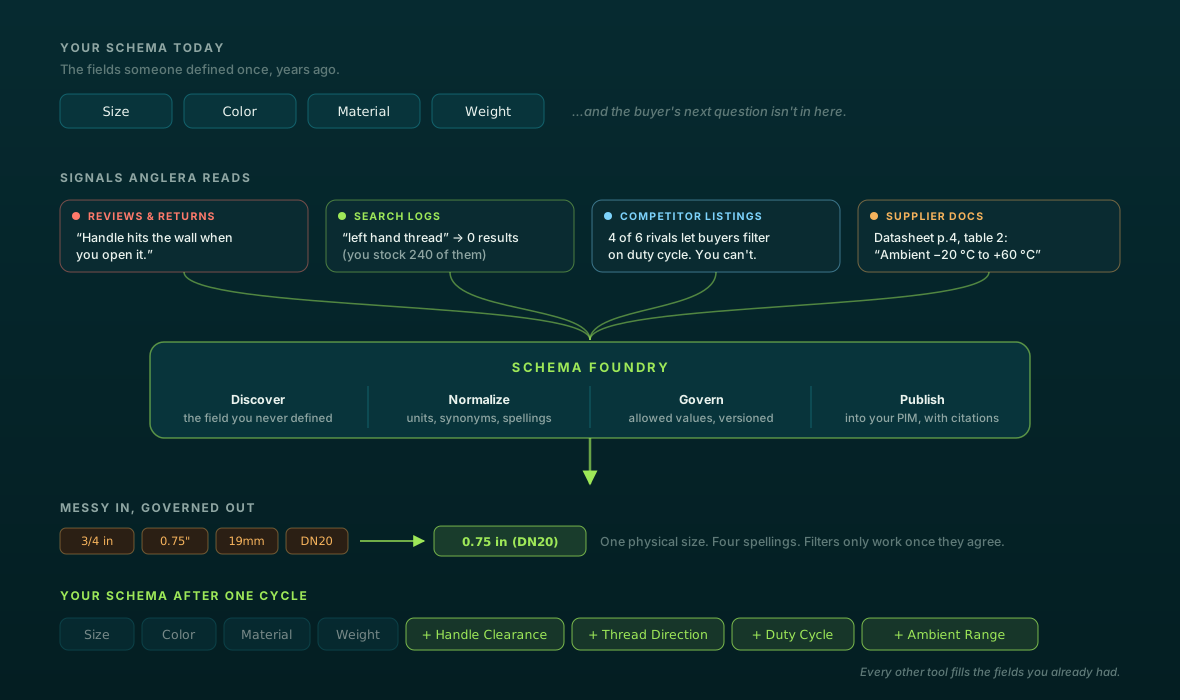
What neither platform does is enrich product data automatically. Both assume the content you load into them is already accurate, complete, and aligned to what buyers are searching for. In practice, it rarely is. Supplier feeds are inconsistent, attribute coverage is patchy, and neither Akeneo nor Pimcore crawls external sources or scores SKUs against real buyer signals. That gap is where Anglera sits — not as a third PIM, but as the enrichment layer that does the work both platforms assume already happened.
This page gives you a straight read on each tool so you can pick the one that fits your team, then explains how Anglera connects to either one.
| Akeneo | Pimcore | Anglera | |
|---|---|---|---|
| Deployment model | Cloud-native SaaS. Akeneo hosts and maintains the infrastructure. No self-hosting option. | Open-source. Self-host on your own infrastructure (Community, Professional, or Enterprise editions) or use their managed PaaS offering starting at $39,900/yr. | SaaS enrichment layer. Connects via API to Akeneo or Pimcore regardless of how either is deployed — cloud or self-hosted. |
| Pricing | Starts at $45,000/yr (Growth package). No self-serve pricing; requires a sales conversation. Upper tiers add SSO, analytics, collaboration workflows, and supplier data tools. | Community Edition is free for non-commercial use. Professional: $9,900/yr. Enterprise: $29,900/yr. PaaS: from $39,900/yr. Self-hosting adds infrastructure and developer maintenance costs on top of the license. | Priced separately by SKU volume, on top of whichever PIM you choose. Implementation is typically ~30 days and does not require replacing or re-platforming your existing system. |
| Platform scope | PIM-first. Strong product content management, localization, and channel distribution. DAM is available. Not a full MDM or digital experience platform. | One codebase for PIM, DAM, MDM, and DXP/CMS. The broadest scope of any platform in this comparison. More complex to configure, but a genuine single-platform option for organizations that need all of it. | Enrichment only — not a PIM, DAM, MDM, or DXP. Adds data depth that neither platform provides natively, then writes it back into whichever system you use as your source of truth. |
| AI and enrichment capabilities | AI-assisted attribute enrichment and completeness scoring added in recent releases. Useful for filling structured content gaps. Does not crawl external sources or score SKUs against live buyer signals. | No native AI enrichment. Data quality is entirely dependent on what is fed in manually or via integrations. There is no built-in mechanism to fill gaps, validate accuracy, or score completeness. | Dedicated enrichment engine. Crawls supplier sites, spec sheets, and public sources; fills attribute gaps; scores each SKU against real buyer search signals; writes enriched data back directly to your Akeneo or Pimcore instance via API. |
| Integration ecosystem | 250+ pre-built integrations via the Akeneo App Store, covering ERPs, ecommerce platforms, marketplaces, and channels. Strong partner and SI network for implementation support. | Open-source extensibility via custom development. No comparable pre-built integration marketplace. Connecting to external systems requires developer effort, which can be significant for complex stacks. | Pre-built connectors to both Akeneo and Pimcore. Also connects upstream to supplier catalogs and downstream to sales channels, adding enrichment at the point where raw data enters the PIM. |
| Implementation timeline | Structured onboarding with partner SIs. Typically 3–6 months for a full rollout depending on catalog size, locale count, and channel complexity. | Developer-heavy configuration means longer timelines. Six to twelve months is common for catalogs with complex data models. The flexibility of open-source comes at the cost of setup time. | ~30-day implementation on top of either PIM. Anglera handles enrichment configuration while the PIM handles catalog structure — the two workstreams do not block each other. |
| Best-fit profile | Mid-market to enterprise commerce teams that want a managed SaaS PIM, do not have developers to maintain infrastructure, and value a broad pre-built integration marketplace. | Technical teams with in-house developers who need PIM, DAM, MDM, and digital experience in a single platform — and want open-source control, self-hosting, or a lower entry-level license cost. | Any team using either platform that needs product data enriched, scored against buyer signals, and kept current — without building and maintaining enrichment pipelines in-house. |
How to choose between Akeneo and Pimcore
Choose Akeneo if:
- Your team does not have developers available to configure and maintain an open-source platform
- Your primary use case is commerce — syndicating accurate product content to channels, retailers, and ecommerce storefronts
- You want a large pre-built integration marketplace (250+ connectors) and an established SI partner network
- You prefer a managed SaaS environment with no infrastructure responsibility
- You are comfortable with a $45,000/yr starting price and a sales-led buying process
Choose Pimcore if:
- You have in-house developers and want full control over configuration, hosting, and extensibility
- You need PIM, DAM, MDM, and digital experience management in a single codebase — and do not want to stitch together separate tools
- Budget is a constraint at the outset: the Community or Professional editions offer a lower entry point than Akeneo, even accounting for developer time
- You are in a regulated environment or have data-sovereignty requirements that make self-hosting necessary
- Long-term platform ownership matters more to you than out-of-the-box ease of use
One honest note on Pimcore's "free" edition: The Community license is non-commercial. Commercial use requires at minimum the Professional edition. Factor in infrastructure costs and developer time when modeling total cost of ownership — the gap between Pimcore and Akeneo narrows considerably once those are included.
Whichever you pick, the data still has to get done
Both Akeneo and Pimcore are systems of record for product data. What they are not is a source of enrichment. Akeneo's AI assist can help fill known attribute gaps within structured templates; Pimcore provides no enrichment capability at all. Both platforms start from the premise that the data arriving in them is already complete, accurate, and aligned to what buyers are actually searching for. It is rarely any of those things.
Anglera is built for exactly that gap. It crawls supplier catalogs, product sheets, and external sources; identifies missing or inaccurate attributes across your SKU catalog; scores each product against real buyer signals; and writes the improved data back to your PIM via API. No new system of record. No workflow disruption. The PIM stores the data — Anglera does the work.
If you choose Akeneo, Anglera connects via the Akeneo API and pushes enriched, buyer-signal-scored attributes directly into your catalog. If you choose Pimcore, Anglera connects to Pimcore's data model and does the same. Implementation is typically ~30 days in either case and runs in parallel with your PIM rollout rather than after it. Whichever platform you land on, the enrichment problem does not solve itself — and Anglera is the layer that solves it.
Frequently asked questions
Can Akeneo and Pimcore both handle multi-language and multi-locale catalogs?
Yes. Both support multi-locale product data. Akeneo has strong built-in localization workflows and channel-specific content rules. Pimcore handles localization too, though configuration requires more developer involvement. If you are managing catalogs across many locales simultaneously, Akeneo's structured workflow tooling has an edge out of the box.
Is Pimcore really free to use?
The Community Edition is free, but only for non-commercial use. Commercial deployments require the Professional edition ($9,900/yr) at minimum. Self-hosting also adds infrastructure costs and ongoing developer maintenance that can exceed the license fee — especially at scale. Model total cost of ownership carefully before assuming Pimcore is the low-cost option.
Does Akeneo replace a DAM?
Akeneo includes media management and asset linking as part of its platform, but it is not a full-purpose DAM. Pimcore's DAM module is more complete natively. If managing and transforming large volumes of digital assets — not just linking them to products — is a primary requirement, that distinction matters when comparing the two.
Where does Anglera sit in the stack — before or after the PIM?
Either works, but most deployments use the PIM as the system of record: Anglera pulls from it, enriches the data, and writes improved attributes back. This means your PIM stays the source of truth and Anglera's output lands exactly where your downstream channels already read from. No additional routing required.
Do I need to wait until my PIM implementation is finished before starting with Anglera?
No. Anglera's ~30-day implementation can run in parallel with your PIM rollout. Enrichment configuration and catalog data modeling are largely independent workstreams. Starting them together typically means enriched data is available in your PIM from day one of go-live, rather than weeks or months after.