Feedonomics vs Pimcore: Choosing the Right Layer for Your Product Data
Feedonomics and Pimcore are not really competing for the same job. Feedonomics is a managed feed syndication platform — its job is to take your product data and get it in front of shoppers across Google Shopping, Amazon, Walmart, and 300+ other destinations. Pimcore is the system of record where that data lives: an open-source PIM, DAM, and DXP that centralizes and organizes product information before it goes anywhere.
Most organizations evaluating both are not choosing between them so much as figuring out which layer to prioritize, or whether they need one without the other. A manufacturer building a product catalog from scratch needs Pimcore first. A retail brand with already-organized data that needs to appear on every channel needs Feedonomics. Some need both, in sequence.
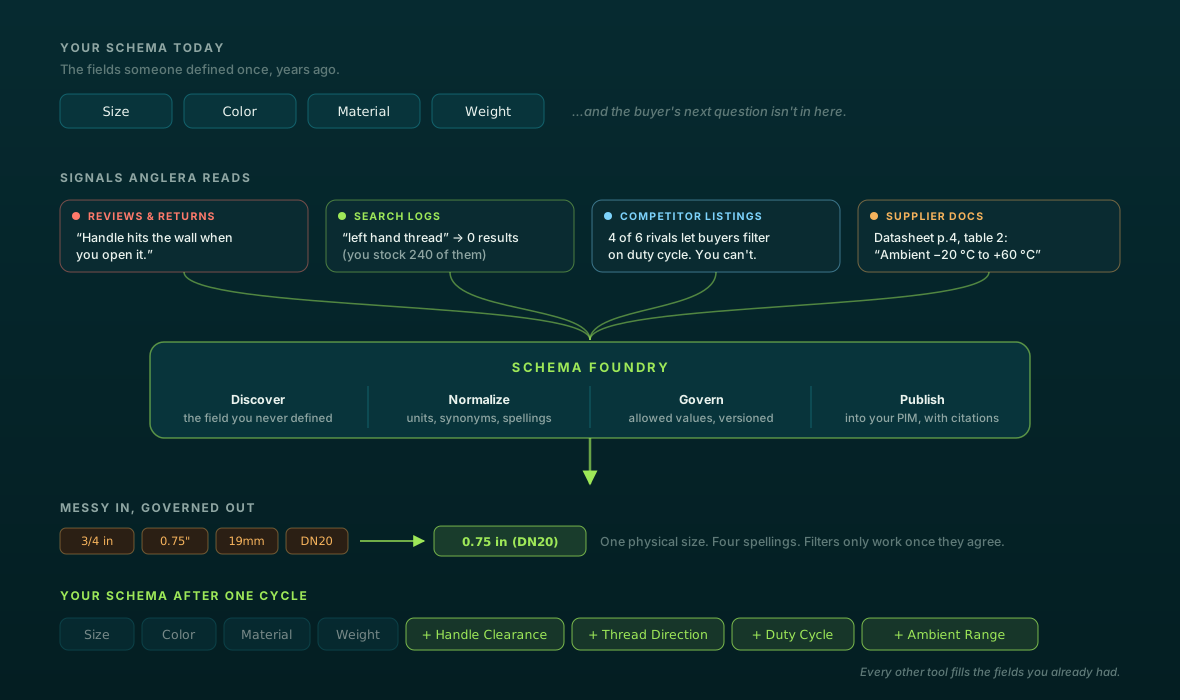
What neither tool does is enrich the underlying data itself — gathering missing attributes, cleaning inconsistencies, and scoring each SKU against what buyers actually search for. That is the gap Anglera fills, and it does so regardless of which of these platforms you are running.
| Feedonomics | Pimcore | Anglera | |
|---|---|---|---|
| Primary function | Transforms, optimizes, and syndicates product feeds to 300+ ad channels and marketplaces | Stores, organizes, and distributes product data, digital assets, and master data from a single open-source repository | Enriches and scores product data against buyer signals, then writes it back to your PIM or data pipeline |
| Data enrichment and buyer-signal scoring | Reformats and maps feed fields for channel compatibility; does not fill missing attributes or score SKUs against buyer demand | Provides the data model and storage layer; expects complete, clean data to already exist before ingestion — no enrichment tooling built in | Core capability: gathers missing attributes, cleans inconsistencies, and scores every SKU against real buyer signals before data reaches either platform |
| Channel distribution | 300+ pre-built integrations including Google Shopping, Amazon, Microsoft Ads, and Walmart — managed by Feedonomics specialists | API-driven delivery to any downstream system; no pre-built retail channel connectors at the scale Feedonomics offers | Not a distribution layer; hands enriched, scored data back to your PIM or feed source so downstream syndication is cleaner |
| Service and deployment model | Managed service — Feedonomics specialists handle feed setup, optimization, and ongoing error resolution on your behalf | Self-managed via Community, Professional, or Enterprise editions, or hosted via PaaS; requires internal developer resources or a systems integrator | SaaS enrichment layer; approximately 30-day implementation alongside your existing stack — no displacement of either tool |
| Pricing | Custom quote only — varies by SKU count, channel count, and service tier; no revenue-share model and no public pricing | Community edition free (non-commercial); Professional $9,900/yr; Enterprise $29,900/yr; PaaS from $39,900/yr | Contact for pricing — scoped to catalog size and enrichment depth |
| Expected data quality at entry | Works best when product data is already structured and reasonably complete; its strength is transformation and distribution, not gap-filling | Accepts data in any state but provides no tooling to fill gaps, normalize inconsistent values, or validate attribute completeness | Designed specifically for incomplete or inconsistent catalogs — gap-filling, normalization, and scoring is the core job |
| Openness and extensibility | Closed, managed SaaS platform; extensibility is handled through Feedonomics specialists and feed configuration | Fully open-source; highly extensible via plugins, custom bundles, and APIs; large developer and integrator community across 75 countries | SaaS with API-based integration into your PIM, DAM, or data pipeline — no rip-and-replace required |
How to choose between Feedonomics and Pimcore
Choose Feedonomics if your primary challenge is distribution reach. You have reasonably complete product data and need it appearing on Google Shopping, Amazon, Walmart, and dozens of other channels without your team manually managing each feed. The managed-service model is a strong fit for retail brands, agencies, and e-commerce teams that want feed specialists handling channel complexity, error resolution, and ongoing optimization on their behalf. If you are on BigCommerce already, the integration is a natural fit.
Choose Pimcore if your primary challenge is data governance and centralization. You need a single system of record for product information, digital assets, and master data — especially if your data model is complex, your team has developer resources to customize, or you want to avoid vendor lock-in. Pimcore's open-source model gives full control, and the tiered pricing makes it accessible to both mid-market buyers and large enterprises.
Consider running both if distribution and centralization are both problems. Many organizations run Pimcore as the upstream PIM and use Feedonomics downstream to push data to channels. That is a sensible stack — but it surfaces a third problem: the data stored in Pimcore still needs to be complete, clean, and optimized before Feedonomics syndicates it. That is where enrichment becomes the missing piece.
Whichever you pick, the data still has to get done
Neither Feedonomics nor Pimcore enriches your product data. Feedonomics assumes your attributes are already complete and formats them for each channel. Pimcore stores whatever you give it and makes it accessible — but it has no mechanism to fill missing specs, normalize inconsistent values, or score a SKU against what buyers in your category actually search for.
Anglera slots in as the enrichment layer that makes both platforms work better. It reads your catalog from Pimcore (or any upstream source), gathers missing attributes, cleans inconsistencies, scores every SKU against real buyer signals, and writes the enriched data back to Pimcore. Feedonomics then syndicates complete, high-quality product data instead of distributing the gaps.
If you are running Feedonomics without a PIM, Anglera still applies: it enriches your source data before it reaches the feed layer, reducing the attribute errors and reformatting work that even Feedonomics specialists spend time resolving. Either configuration takes roughly 30 days to implement — and the result is a cleaner, more complete catalog, no matter where it lives or where it goes next.
Frequently asked questions
Are Feedonomics and Pimcore direct competitors?
Not really. They occupy different layers of the product data stack. Pimcore is a system of record — a PIM where product data lives and is governed. Feedonomics is a distribution layer — a feed platform that gets product data in front of shoppers on 300+ channels. Many enterprises use both in sequence rather than choosing between them.
Can Pimcore replace Feedonomics for channel syndication?
For basic delivery via API, Pimcore can push data to downstream systems and channels. But it does not offer the 300+ pre-built retail channel integrations, feed optimization tooling, or managed specialist service that Feedonomics provides. For serious multi-channel distribution at scale, Feedonomics is the more purpose-built tool.
Does Feedonomics require a PIM like Pimcore?
No. Feedonomics can pull product data from an e-commerce platform, ERP, flat file, or any structured source — a PIM is not required. That said, a well-governed PIM as the upstream source tends to produce cleaner, more consistent feeds and reduces the error resolution work Feedonomics specialists have to do.
Where does Anglera fit if I already use Pimcore and Feedonomics together?
Anglera works on the data inside Pimcore before Feedonomics distributes it. It fills missing attributes, cleans inconsistencies, and scores each SKU against buyer signals — so what Feedonomics syndicates is already complete and optimized rather than raw. You do not need to change either platform to add Anglera.
How long does it take to implement Anglera alongside an existing PIM or feed platform?
About 30 days. Anglera connects to your existing data sources, enriches your catalog, and writes results back to your PIM or data pipeline — without displacing Pimcore, Feedonomics, or any other tool already in your stack.