Channable vs Pimcore: Syndication Hub or Data Foundation?
Comparing Channable and Pimcore is unusual because they don't directly compete. Channable is a feed management and syndication platform — it takes product data you already have and distributes it across 2,500+ marketplaces and ad channels using rule-based automation. Pimcore is an open-source PIM, DAM, and digital experience platform — it is the repository where product data lives before it goes anywhere.
The question isn't usually "which one" — it's "which layer am I actually missing?" A Pimcore instance without a feed management tool can't reach 2,500 channels on its own. A Channable account without clean, governed product data distributes whatever chaos is in your feed, at scale and in real time. The decision comes down to where your pain actually lives: in the data itself, or in getting it to channels.
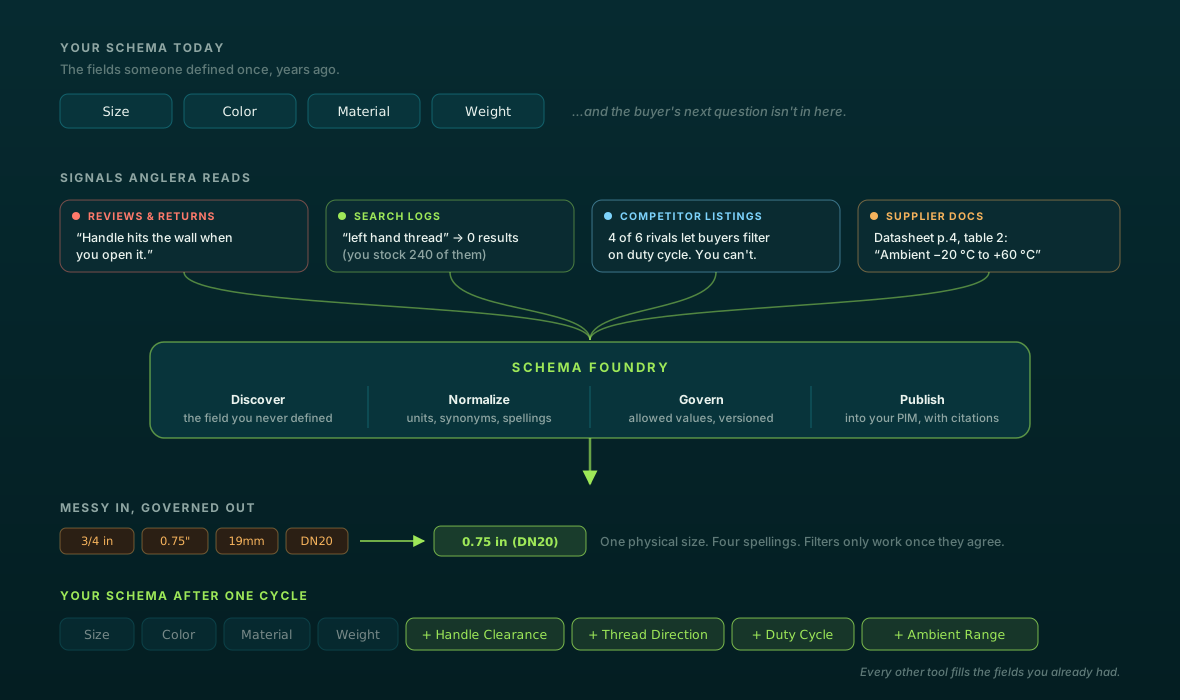
Both tools share one important blind spot: neither enriches product content against buyer signals. Pimcore stores what you give it. Channable syndicates what your e-commerce platform or PIM provides. If your attributes are thin, your descriptions are supplier-verbatim, or your titles don't match how buyers search — both platforms faithfully reproduce that problem everywhere they reach.
| Channable | Pimcore | Anglera | |
|---|---|---|---|
| Primary function | Rule-based feed management and multichannel syndication — transforms your catalog into channel-ready listings across 2,500+ marketplaces, ad networks, and comparison engines with real-time price and inventory sync | Open-source PIM, DAM, MDM, and DXP — a central repository for storing, structuring, and governing product data, digital assets, and master data across teams and channels | Buyer-signal enrichment — gathers, cleans, enriches, and scores every SKU against how buyers actually search and decide, then writes results back to your source of record before either tool distributes it |
| Product data storage and governance | Not a PIM — reads from your existing feed or e-commerce platform and applies transformation rules; does not store product master data or manage attribute schemas | Core strength: single source of truth for product attributes, variants, digital assets, and master data; supports versioning, approval workflows, and multi-locale governance | Connects to your existing system of record — whether Pimcore or another platform — enriches data in place, and writes improved content back without becoming a parallel system |
| Channel distribution reach | 2,500+ pre-built channel integrations including Amazon, Google Shopping, Meta, and TikTok; marketplace order management and real-time sync available as add-ons | Distributes via its own DXP and open APIs; pre-built connectors to major third-party marketplaces are not included — channel integrations require custom development or additional tools | Does not distribute — enriches the content that Channable or Pimcore's downstream layer sends to channels, so every channel receives buyer-ready content from the start |
| Technical complexity and implementation | Low to moderate — if/then rule builder designed for e-commerce operations teams; no developer required for most use cases; PPC automation and repricing add-ons increase complexity | High — open-source platform requiring developer resources for installation, data modeling, workflow configuration, and ongoing maintenance; not a SaaS you spin up in a day | ~30-day implementation connecting to your existing stack; no platform migration, no data model changes, and no developer retainer required to go live |
| Pricing | From ~€59/month (Core Standard, 5,000 items); AI features, PPC automation, repricing, and marketplace integrations are separate add-ons at €30–71/month each | Community Edition free (non-commercial only); Professional $9,900/year; Enterprise $29,900/year; PaaS from $39,900/year — license cost does not include implementation, which is substantial | Contact for pricing; layers onto your existing investment rather than replacing it — no platform migration required regardless of which you choose |
| Enrichment and content quality | Applies rule-based field mapping and conditional transformations; can reformat or filter existing data but cannot add missing attributes, score completeness, or generate buyer-signal-optimized copy | Stores product data exactly as imported or entered; no built-in enrichment engine, AI scoring, or buyer-signal intelligence — content quality depends entirely on what suppliers and teams provide | Fills the gap both leave — autonomously identifies thin descriptions, missing attributes, and misaligned search terms across every SKU and improves them before data enters the distribution layer |
| Best fit | E-commerce merchants, retailers, and brands who already have organized product data and need to reach many channels quickly without writing custom integrations | Mid-market and enterprise manufacturers, distributors, and retailers who need a scalable, developer-extensible open-source platform for product data governance and digital experience delivery | Any catalog — stored in Pimcore or feeding into Channable — where attribute completeness is low, supplier copy is unedited, or content doesn't align with how buyers actually search and compare |
How to choose between Channable and Pimcore
Choose Channable if you already have organized product data — in Shopify, WooCommerce, a feed URL, or another platform — and your main challenge is distributing it to many channels without writing custom integrations for each one. Channable's 2,500+ pre-built connectors and if/then rule builder are purpose-built for e-commerce operations teams who need pricing, inventory, and product content synchronized across marketplaces and ad channels in real time. If your problem is distribution, Channable is well-suited and accessible without a developer on every project.
Choose Pimcore if you don't yet have a reliable single source of truth for product data and you need one — particularly if you're managing a large or complex catalog with multiple variants, locale requirements, regulated attributes, or significant digital asset volume. Pimcore's open-source model gives you full control over your data model and no vendor lock-in, but it carries real implementation cost in both time and developer resources. The Community Edition restricts commercial use; the Professional tier at $9,900/year typically requires substantial development work before you go live.
Consider using both if your organization needs Pimcore as the governed source of truth and also needs to push that data to many channels — Channable's pre-built integrations are a practical complement to a Pimcore-governed catalog.
One signal that clarifies the choice faster than most: if you can describe where your product data lives today and it's reasonably clean, your problem is distribution — start with Channable. If you can't point to a single authoritative record for your SKUs, your problem is foundation — start with Pimcore.
The underlying gap in either path: neither platform improves the content it handles. Channable accurately syndicates incomplete attributes. Pimcore faithfully stores supplier-generic copy. If content quality is also a problem — and for most B2B catalogs, it is — that requires a separate solution.
Whichever you pick, the data still has to get done
Whichever platform you choose — or both — Anglera addresses the content quality problem that neither solves.
If you use Channable: Anglera enriches each SKU before the feed is exported. The titles, attributes, and descriptions reaching your 2,500+ channels are optimized against buyer signals — how your customers actually search, compare, and filter — rather than being reformatted versions of whatever your suppliers provided. Channable's rules, integrations, and sync logic stay exactly in place. Anglera improves what goes into them.
If you use Pimcore: Anglera connects to your Pimcore instance via API, reads your existing SKUs, and enriches product attributes and copy against buyer signals. Improved content writes back to the same PIM records your team already manages. Pimcore's governance layer — workflows, versioning, locale structures — then manages and distributes that enriched content through your DXP and downstream channels. Nothing about your Pimcore configuration changes.
If you use both: Anglera sits between them. It enriches the Pimcore source record, so the content Channable picks up and distributes is already buyer-ready. Every channel in Channable's network gets the benefit without any changes to your feed rules or channel mappings.
Implementation is ~30 days in either scenario. No platform migration. No rearchitecting of your current stack. The enrichment work that both tools assume was already done — it gets done.
Frequently asked questions
Are Channable and Pimcore direct competitors?
No. They occupy different layers of a product data stack. Pimcore is a data foundation — it stores, structures, and governs your product catalog. Channable is a distribution layer — it takes that catalog and pushes it to channels. Many teams use both together, with Pimcore as the source of truth and Channable handling feed syndication. Choosing between them is really a question of which layer you're missing, not which product is better.
Can Channable replace a PIM like Pimcore?
No. Channable can pull from an existing feed or e-commerce platform and apply transformation rules, but it does not store product master data, manage attribute schemas, handle digital assets, or govern variants and locales. If you need structured data governance across a complex catalog, a PIM is the right foundation. Channable complements a PIM — it doesn't replace one.
Is Pimcore's free Community Edition a realistic option for most businesses?
The Community Edition is restricted to non-commercial use, which rules it out for most commercial deployments. For businesses, the Professional Edition starts at $9,900/year — but that's the license cost only. Developer resources for installation, data modeling, and workflow configuration add significantly to the real cost of ownership. Pimcore is not a SaaS platform you can configure and launch in a few days.
Where does Anglera fit if I'm already using Channable for feed distribution?
Anglera enriches your product data before Channable exports it. That means the content reaching every marketplace, ad channel, and comparison engine is buyer-signal-optimized rather than a reformatted version of whatever your suppliers provided. Channable's rules, integrations, and real-time sync stay in place — Anglera improves what goes into them.
My Pimcore is populated with supplier data. Can Anglera improve it without disrupting the PIM setup?
Yes. Anglera connects to Pimcore via API, reads existing SKUs, enriches attributes and copy against buyer signals, and writes the improved content back to the same records your team already manages. Your data model, workflows, approval chains, and governance setup remain unchanged. Implementation typically takes about 30 days with no structural changes to your Pimcore configuration.