EnterWorks vs Pimcore: Enterprise-Managed PIM or Open-Source Platform?
EnterWorks and Pimcore are both product information management platforms, but they represent opposite ends of the PIM market: one is a Precisely-managed enterprise system with 20+ years of deployment history at large B2B distributors and retailers; the other is a fully open-source platform that 118,000+ organizations worldwide have deployed on their own infrastructure. The buying decision between them is less about features and more about how your organization wants to own and operate software.
EnterWorks — now Precisely EnterWorks after acquisitions by Winshuttle in 2019 and Precisely in 2021 — is an enterprise PIM and MDM data hub. It ships with role-based governance workflows, business rules, complex product relationship management, and deep integrations to ERP and e-commerce systems. It is designed for organizations that want a vendor-managed, fully supported system of record and are willing to pay enterprise licensing rates to get it. Pimcore starts from the other direction: a PHP/Symfony open-source core that any developer can run, extend, and connect to anything. Its modular architecture covers PIM, DAM, MDM, and DXP in a single platform, and it scales from a small product team deploying the free Community Edition to an enterprise running a custom-built implementation on Pimcore Cloud.
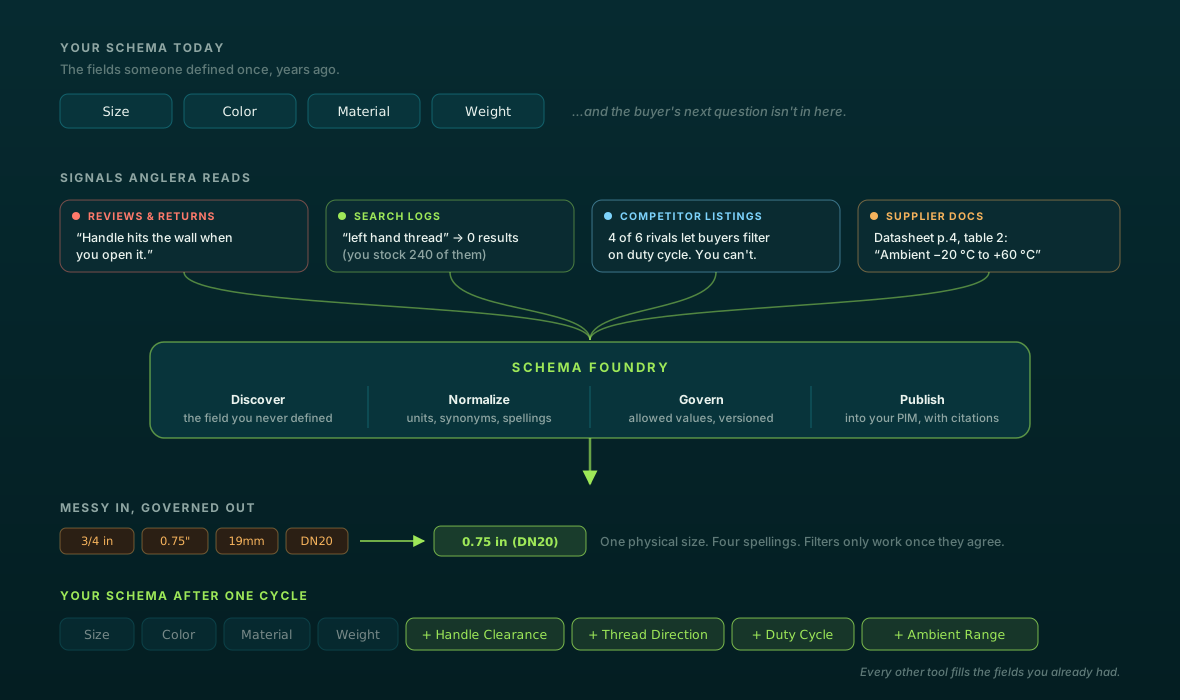
What both platforms share is a critical assumption: the product data you put into them is reasonably complete. EnterWorks governs and distributes the data your team enters; Pimcore organizes and publishes the same. Neither platform was built to research missing attributes, clean up inconsistent supplier feeds, or score content against how buyers actually search and decide. That preparation work — the gap between raw supplier data and distribution-ready product content — is what Anglera handles, regardless of which platform you choose.
| EnterWorks | Pimcore | Anglera | |
|---|---|---|---|
| Deployment model | Cloud-hosted SaaS or on-premises, managed under Precisely's enterprise infrastructure; no open-source option; updates and infrastructure are vendor-controlled | Fully open-source (PHP/Symfony); self-hosted on your own infrastructure or Pimcore Cloud (PaaS from $39,900/yr); your team or a Pimcore partner manages the stack | Connects via API to whichever deployment model you run — cloud, on-prem, or hybrid — without adding infrastructure overhead on your side |
| Pricing | Custom enterprise licensing, quote-based; reported base around $150,000/yr, scaling by users and implementation complexity; no free or self-serve tier | Community Edition free (non-commercial); Professional $9,900/yr; Enterprise $29,900/yr; PaaS from $39,900/yr; a rare open-source platform with a credible free starting point | Priced per SKU enriched, not per seat or annual platform fee; separate from your PIM investment and scales with catalog activity rather than team size |
| Governance and workflow management | Built-in role-based workflows, approval chains, and business rules; designed from the ground up for large teams with strict data governance requirements and compliance mandates | Configurable workflow engine that can replicate similar governance, but setup requires developer effort; depth of governance is proportional to implementation investment | Enrichment results flow back through your PIM's own approval process; Anglera does not bypass governance — it feeds clean, scored records into whichever review workflow you have configured |
| Openness and extensibility | Proprietary platform; customization through Precisely's professional services and a library of pre-built connectors to ERP, e-commerce, and syndication partners | Fully open-source on GitHub; any developer can fork, extend, or build custom modules; 118,000+ installs across 75 countries; large ecosystem of community and commercial partners | Pre-built connectors for common PIM APIs handle the integration; custom extraction logic is handled by Anglera's team, not yours, regardless of how customized your PIM is |
| Data enrichment and buyer-signal scoring | Stores and governs product data; enrichment requires external tools or manual input from your team; no native capability to research missing attributes from supplier sites or external sources | Centralizes and distributes product data with completeness scoring and basic editorial tools; no native enrichment against buyer signals or automated research of missing specs | Crawls supplier sites, normalizes values, fills missing attributes, and scores every SKU against how buyers actually search and compare; writes enriched records back to whichever PIM holds the source of truth |
| Target organization profile | Mid-market to large enterprise; customers include Orgill, US Foods, Johnstone Supply, and Fender; best suited to organizations with complex, multi-team catalogs and budget for enterprise licensing | Spans SMB to enterprise depending on internal developer resources; a lean team with strong PHP skills can run a sophisticated implementation; also used by large organizations that want full platform ownership | Optimized for B2B distributors, retailers, and manufacturers regardless of catalog size; ~30-day implementation alongside any PIM rather than replacing it |
| DAM and digital asset management | Integrated DAM within the EnterWorks Enable platform; manages product images, documents, and digital files alongside structured data as part of the same governed hub | Full-featured DAM is a core module, not a bolt-on; strong asset versioning, metadata management, and workflow capabilities built into the same open-source codebase | Identifies gaps in digital asset coverage alongside data gaps — missing images, thin specs, unlinked documents — and surfaces those as enrichment flags; does not replace DAM storage |
How to choose between EnterWorks and Pimcore
Choose EnterWorks if your organization is large enterprise, has complex multi-team governance requirements, and wants a vendor-managed system where Precisely owns the infrastructure and supports the stack. It is the right fit if you are already operating in an ERP-heavy environment — SAP, Oracle, or similar — and need a PIM/MDM that integrates deeply with those systems out of the box. Organizations like large wholesale distributors, national retailers, or manufacturers with tight regulatory or compliance workflows will find EnterWorks' built-in governance model worth the enterprise price. Budget in the $150,000+/yr range and be prepared for a meaningful implementation engagement; this is not a self-serve product.
Choose Pimcore if you have competent internal developers or a trusted implementation partner, and you want the freedom that comes with open source. Pimcore's pricing structure lets smaller teams start on the Community Edition and grow into paid tiers as the business demands — a path that simply does not exist with EnterWorks. It is also the better fit if you want to self-host for data sovereignty reasons, want to build custom integrations without going through a vendor's professional services, or need the PIM, DAM, MDM, and DXP in a single managed codebase. The trade-off is that governance and workflow depth require developer effort to configure, and implementation timelines scale with your customization ambitions.
Do not choose based on feature parity alone. Both platforms can manage large catalogs, support multi-team workflows, and connect to downstream channels. The real decision is operational: do you want a vendor to own the platform, or do you want to own it yourself?
Whichever you pick, the data still has to get done
Both platforms share the same assumption: by the time product data enters the PIM, it is already reasonably complete. EnterWorks will govern and distribute whatever your team enters; Pimcore will store, organize, and publish it. Neither was built to fix what suppliers sent you — thin descriptions, missing dimensions, inconsistent unit formats, attributes that exist in a PDF spec sheet but never made it into a structured field.
That gap is where Anglera works, and it works the same way regardless of which platform sits on the other side.
Anglera connects to your existing PIM as the source of truth — EnterWorks, Pimcore, or any other — and enriches in bulk. It crawls supplier sites for missing specs, normalizes values across inconsistent supplier feeds, scores completeness against your attribute model and against buyer-signal data (how your customers actually search and compare products), then writes the improved records back through the PIM's own API. The enriched data flows into whatever downstream channels you have already configured: e-commerce, ERP, syndication, print. Your existing integrations carry it the rest of the way.
The implementation takes roughly 30 days and does not require replacing or reconfiguring your PIM. If you choose EnterWorks, Anglera feeds clean, scored records into EnterWorks' governance workflow, where your team reviews and approves before publication. If you choose Pimcore, the same enriched records land in Pimcore's data model and flow through whatever publishing logic your developers have built. Whichever platform you pick, the data that goes into it gets better — and stays better as your catalog grows and supplier feeds change.
Frequently asked questions
Is EnterWorks part of Syndigo?
No. EnterWorks was acquired by Winshuttle in 2019 and subsequently became part of Precisely in 2021. Precisely is a data integrity software company focused on data enrichment, geocoding, and master data management — not a content syndication platform. EnterWorks is now marketed as Precisely EnterWorks.
Can Pimcore scale to enterprise catalog sizes?
Yes, with the right implementation. Pimcore's open-source architecture has been deployed at organizations managing millions of SKUs across dozens of channels. The ceiling is less a platform constraint and more a function of your infrastructure and the engineering resources you invest in the implementation. Pimcore's Enterprise and PaaS tiers include support agreements and performance architecture guidance for high-scale deployments.
Does either platform automatically enrich product content from external sources?
Neither does natively. EnterWorks governs and distributes data that your team or supplier feeds provide. Pimcore can extract structured data from uploaded supplier documents via its AI features and flags completeness gaps, but it does not automatically research missing attributes from external sources. Automated enrichment against buyer signals — crawling supplier sites, normalizing specs, scoring content — is what Anglera handles as a layer on top of either PIM.
How long does it take to implement EnterWorks versus Pimcore?
EnterWorks implementations typically run three to nine months for mid-market deployments and longer for complex enterprise rollouts; Precisely's professional services team is usually involved throughout. Pimcore timelines vary more widely — a developer-confident team can stand up a working system in weeks, while a full enterprise implementation with custom workflows and integrations can take six to twelve months. Anglera implements alongside either in approximately 30 days and does not depend on the PIM implementation being fully complete to begin enriching.
Can I use Anglera without switching my PIM?
Yes. Anglera is not a PIM and does not replace one. It connects to your existing system of record — whether that is EnterWorks, Pimcore, or something else — via API, enriches your SKUs, and writes the results back. If your team is satisfied with how EnterWorks or Pimcore governs and distributes data, the only thing Anglera changes is the quality and completeness of the data flowing through it.