1WorldSync vs Plytix: Which Product Content Platform Fits Your Catalog?
1WorldSync and Plytix are rarely compared head-to-head because they largely serve different markets. 1WorldSync is the enterprise infrastructure layer for CPG brands that must supply major grocery chains via GDSN compliance. Plytix is the SMB-friendly PIM for brands building and publishing product content across ecommerce channels. If you are evaluating both, you are likely a growing mid-market brand or distributor trying to decide whether your product data challenge is a syndication problem, a content management problem, or both.
The honest framing: neither platform enriches your product content. 1WorldSync validates that your GS1 attributes are correctly structured and routes them to trading partners as-is. Plytix organizes and publishes what you bring to it — its built-in AI generates copy from your existing attributes, which means thin source data produces thin output. Both tools assume your product content is complete and buyer-ready before it arrives.
That assumption is where most catalogs fall short. Thin supplier descriptions, missing specifications, and attributes that don't match how buyers actually search are catalog-wide problems. Whichever platform you choose, that content gap travels with you — through GDSN syndication, through ecommerce channel feeds, and onto every digital shelf.
| 1WorldSync | Plytix | Anglera | |
|---|---|---|---|
| Primary function | GDSN data pool — validates GS1-structured product attributes and syndicates them to 900+ retail trading partners globally | All-in-one PIM — centralizes product content, manages digital assets, generates AI copy, and publishes to ecommerce channel feeds | Enriches SKU content against buyer signals before it reaches either platform; writes improved data back to your source of truth |
| Who it's built for | Enterprise CPG brands and manufacturers whose retail buyers — Walmart, Kroger, Target — require GS1-structured data via GDSN | SMBs and growing mid-market brands that need one place to manage product content and publish to ecommerce channels and marketplaces | Any catalog owner — distributor, manufacturer, or retailer — with thin, incomplete, or unconverted product content regardless of company size |
| Pricing | Not publicly listed. Estimates: $500–$2,000/month mid-market; $25,000–$90,000+/year enterprise; plus $10,000–$100,000+ in implementation fees | Freemium tier available; paid plans from ~$733/month; unlimited users on all plans; add-ons for AI credits and extra distribution channels | Per-SKU enrichment pricing; no seat fees; complements your existing stack without requiring a new platform contract |
| Channel and trading partner reach | 900+ GDSN trading partners including major US grocery chains; the de facto standard for CPG retail compliance in North America | ecommerce channel feeds — Google Shopping, Amazon, and major marketplaces; does not participate in the GDSN network | Channel-agnostic — enriched content writes back to your PIM or content hub, then flows through whichever distribution path you use |
| Content authoring and AI | Portal-based attribute authoring with GS1 schema validation; focused on structured data compliance rather than buyer-facing copy quality | Built-in AI generation and translation for product descriptions; unlimited team members can collaborate; integrated DAM for asset management | Researches, generates, and scores buyer-signal-optimized content — descriptions, specifications, search terms — across your full catalog from a single enrichment run |
| Implementation complexity | Complex GDSN onboarding with per-trading-partner setup; typically months to full deployment; substantial implementation fees on top of licensing | Cloud SaaS; most teams are live within weeks; lower barrier to entry and faster time to first value | ~30-day implementation alongside your existing stack; no migration or rip-and-replace required; runs in parallel from day one |
How to choose between 1WorldSync and Plytix
Choose 1WorldSync if you are a CPG brand or manufacturer whose retail buyers — Walmart, Kroger, Target, Costco — require GDSN-compliant product data. This is an infrastructure decision as much as a software decision: 1WorldSync is the mechanism by which GS1-structured attributes move from supplier to retailer at scale. If your trading partners mandate GDSN compliance, a certified data pool is not optional. Budget for enterprise-level contracts and multi-month implementations.
Choose Plytix if you are an SMB or growing mid-market brand that needs to centralize product content and publish it across ecommerce channels and marketplaces. Plytix's unlimited-user model keeps costs predictable for small teams, and the built-in AI and DAM reduce the tool sprawl that typically afflicts growing catalogs. If GDSN compliance is not a requirement from your buyers, Plytix is the faster and lower-cost path to organized, distributable product content.
Do not choose 1WorldSync if you primarily sell DTC or through ecommerce channels where GDSN compliance is not mandated — the cost and operational complexity outweigh the benefit for most ecommerce use cases.
Do not choose Plytix if GDSN syndication to major grocery or big-box retailers is a hard requirement from your buyers. Plytix does not participate in the GDSN network and cannot substitute for a certified data pool in that context.
The overlap case: A manufacturer selling to both grocery retail and ecommerce sometimes needs both — 1WorldSync for GDSN-compliant trading partner sync, and Plytix (or another PIM) as the central content repository. In that architecture, a central PIM is the source of truth, and Anglera enriches the content there before it flows to either distribution layer.
Whichever you pick, the data still has to get done
Both 1WorldSync and Plytix move product data. Neither improves it.
1WorldSync validates that your GS1 attribute structure is correctly formed and routes the records to trading partners exactly as you submitted them — thin descriptions, missing specs, and supplier copy all syndicate without change. Plytix organizes your content and publishes it; its AI generates descriptions from your existing attributes, which means if those attributes are sparse or copied from a supplier sheet, the output reflects that.
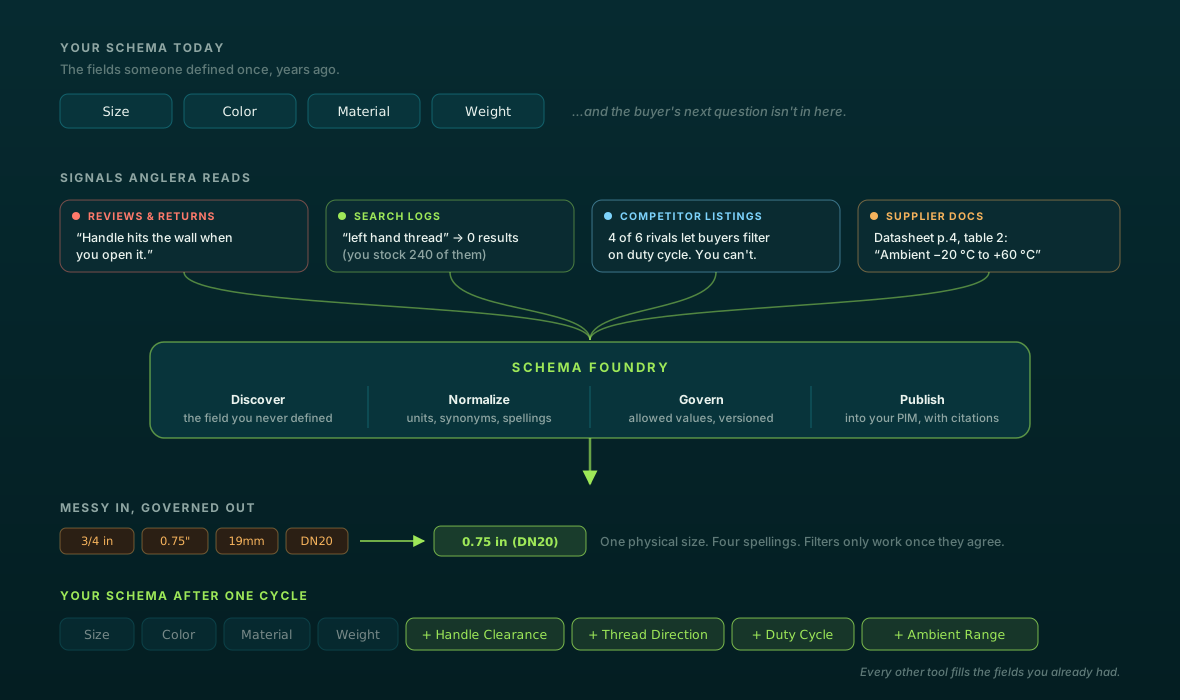
Anglera is the enrichment layer that belongs upstream of either platform. Before your content flows into 1WorldSync for GDSN syndication, or into Plytix for ecommerce channel publishing, Anglera enriches each SKU against buyer signals — the attributes, language, completeness scores, and search terms that move buyers from discovery to purchase. It writes the improved content back to your system of record so the quality gains flow through every downstream channel automatically.
Whichever platform you select, the content entering it will be better. ~30-day implementation alongside your existing stack. No rip-and-replace.
Frequently asked questions
Are 1WorldSync and Plytix designed for the same type of buyer?
Rarely. 1WorldSync primarily serves large CPG manufacturers and brands that supply major grocery chains and big-box retailers requiring GDSN compliance. Plytix is built for SMBs and mid-market ecommerce brands that need to manage and publish content to online channels. If you are evaluating both, the decision often hinges on one question: do your retail buyers mandate GDSN-structured data? If yes, 1WorldSync is the infrastructure layer. If no, Plytix — or another PIM — is likely the better starting point.
Can 1WorldSync and Plytix be used together?
Yes, and some brands that sell to both grocery retail and ecommerce do use both. In that setup, Plytix (or another PIM) typically serves as the central content repository, and 1WorldSync handles outbound GDSN syndication to trading partners. The risk is managing product data across two portals, which creates redundancy and inconsistency if the two systems are not kept in sync. Centralizing in a PIM and feeding both downstream is a cleaner architecture.
Does 1WorldSync replace the need for a PIM?
No. 1WorldSync is a distribution layer, not a content management system. It validates GS1 attribute structures and routes data to trading partners, but it is not the editorial home for your product content. Most 1WorldSync customers maintain a separate PIM — Akeneo, Salsify, Contentserv, or similar — and sync content into 1WorldSync for distribution. That means managing data in at least two systems, which is where Anglera's write-back model matters: enrich once in your PIM, and the improvement flows through every downstream system.
What does Anglera do that neither 1WorldSync nor Plytix does?
Anglera improves the content itself. It fills missing specifications, rewrites thin descriptions, adds search-optimized attributes, and scores every SKU against how buyers actually search and compare — then writes those improvements back to your system of record. Both 1WorldSync and Plytix distribute or organize whatever content you bring them. Anglera makes that content better before it gets there, so every downstream channel benefits automatically.