1WorldSync vs Rithum (ChannelAdvisor / CommerceHub): A Buyer's Comparison
These two platforms solve different distribution problems, and a buyer comparing them is usually dealing with a catalog that needs to go in two directions at once. 1WorldSync is the GDSN standard — the structured data pipe that CPG brands and manufacturers use to push GS1-compliant product attributes to grocery chains, mass retailers, and regulated trading partners across 60+ countries. Rithum is a commerce operations platform built from the 2023 merger of CommerceHub, ChannelAdvisor, and Dsco — its job is getting products listed, synced, and fulfilled across 420+ marketplace and retail channels.
The two platforms rarely face off in a true apples-to-apples evaluation. A food manufacturer asking "which GDSN data pool should we use?" is not in the same decision as a retailer asking "how do we manage our Amazon and Walmart marketplace feeds and drop-ship operations?" But some brands and distributors straddle both needs — traditional trading-partner compliance on one side, direct marketplace listing on the other — and need to understand where each platform's authority begins and ends.
One thing both tools share: neither enriches your product content. 1WorldSync validates that your attributes conform to GS1 schemas and routes the data to trading partners; Rithum maps your existing feeds to each channel's format and manages fulfillment workflows. Both move product data. Neither improves it. That gap matters when the content flowing through either pipe is thin, inconsistent, or written for a supplier's internal catalog rather than a buyer's search query.
| 1WorldSync | Rithum (ChannelAdvisor / CommerceHub) | Anglera | |
|---|---|---|---|
| Primary function | GDSN data pool and product content orchestration — create, validate, and distribute GS1-structured product data to 900+ trading partners | Commerce operations platform — list, feed-manage, and fulfill products across 420+ marketplace and retail channels | Enriches the underlying product content against buyer signals before it enters either platform — fills gaps, cleans attributes, and writes results back to your PIM |
| Who it is built for | CPG brands and manufacturers that must maintain GS1/GDSN compliance to push structured data to grocery chains, mass retailers, and regulated trade channels | Brands, retailers, and 3PLs that need to list, sync inventory, and route orders across Amazon, Walmart marketplace, eBay, and hundreds of other digital channels | B2B distributors, retailers, and manufacturers whose catalog is incomplete, inconsistent, or not yet optimized for how buyers actually search — regardless of which distribution platform they use |
| Channel network | GDSN trading partner network with deep penetration in US grocery (Kroger, Walmart, Target, Albertsons) and regulated CPG; 14,000+ brands across 60+ countries | 420+ marketplace, retailer, and drop-ship channels with broad coverage across DTC and marketplace commerce; 40,000+ brands and retailers | Channel-agnostic — enriched content written to your PIM flows through whichever distribution platform you use |
| Order and fulfillment operations | Product content only — no order management, inventory sync, drop-ship routing, or fulfillment automation | Full drop-ship management, marketplace order routing, inventory and warehouse integration, and return workflows across channels | Not a fulfillment or order platform — Anglera's scope is product content quality, not commerce operations |
| Data standards and compliance | GS1/GDSN certified; validates attributes against retailer-specific schemas and regulatory requirements; de facto standard for US food and CPG trade | Proprietary feed mapping per channel specification; no native GDSN compliance; strong in marketplace listing formats (Amazon, Walmart, eBay) | Works upstream of both — enriches and structures content so it passes validation in 1WorldSync and converts on Rithum-synced channels |
| Content enrichment | Validates schema compliance; does not generate, rewrite, or improve descriptions, missing attributes, or buyer-facing copy — thin content passes through as-is | Syndicates content as provided; no AI enrichment, buyer-signal scoring, or attribute gap-filling — distributes the problem at scale if content is weak | Gathers, cleans, enriches, and scores every SKU against buyer signals — the step both platforms assume someone else already handled |
| Pricing shape | Not publicly listed. Estimates: $500–$2k/month mid-market; $25k–$90k+/year enterprise, plus $10k–$100k+ implementation. Large enterprise can reach ~$1M/year | Custom enterprise pricing based on GMV and channel usage; not publicly listed | Transparent per-SKU pricing; ~30-day implementation; no platform rip-and-replace |
How to choose between 1WorldSync and Rithum (ChannelAdvisor / CommerceHub)
Choose 1WorldSync if your core requirement is GDSN compliance and structured data syndication to traditional retail trading partners. If Walmart, Kroger, Target, or any major US grocery chain requires you to synchronize product data through a GDSN-certified data pool, 1WorldSync is effectively mandatory — it is the de facto standard for CPG brands in food, beverage, and regulated categories. It is also the right choice if you are managing complex GS1 attribute hierarchies across dozens of trading partners and need a platform built specifically for that compliance burden.
Choose Rithum if your primary goal is marketplace and retail channel presence at scale. If you need to list products on Amazon, Walmart marketplace, eBay, and hundreds of other channels, manage drop-ship programs, automate inventory sync, and route orders across fulfillment partners, Rithum's operational breadth is purpose-built for that problem. It inherited ChannelAdvisor's marketplace intelligence, CommerceHub's drop-ship network, and Dsco's supplier connectivity — making it especially well-suited to retailers and brands running high-volume multichannel commerce operations.
If you need both, some CPG brands and large distributors run them in parallel: 1WorldSync for GDSN compliance with traditional grocery and mass retail trading partners, Rithum for direct marketplace listings and drop-ship fulfillment. These are complementary distribution lanes, not competing choices.
If your catalog content itself is the problem — missing attributes, thin descriptions, supplier copy that does not match how buyers search — neither platform solves that. Both assume your product data is already complete and buyer-ready. That is the upstream gap Anglera fills before your data enters either system.
Whichever you pick, the data still has to get done
Both 1WorldSync and Rithum are distribution platforms. They move product data. Neither improves it.
1WorldSync validates your attributes against GS1 schemas and routes them to trading partners — but the content quality it checks for is structural compliance, not whether a buyer reading your product tile will convert. Thin descriptions, missing specifications, and supplier-authored copy that does not match real search queries all pass validation and flow to every shelf. Rithum syndicates whatever feeds you provide across 420+ channels, which means if your content is weak going in, Rithum distributes that weakness at scale.
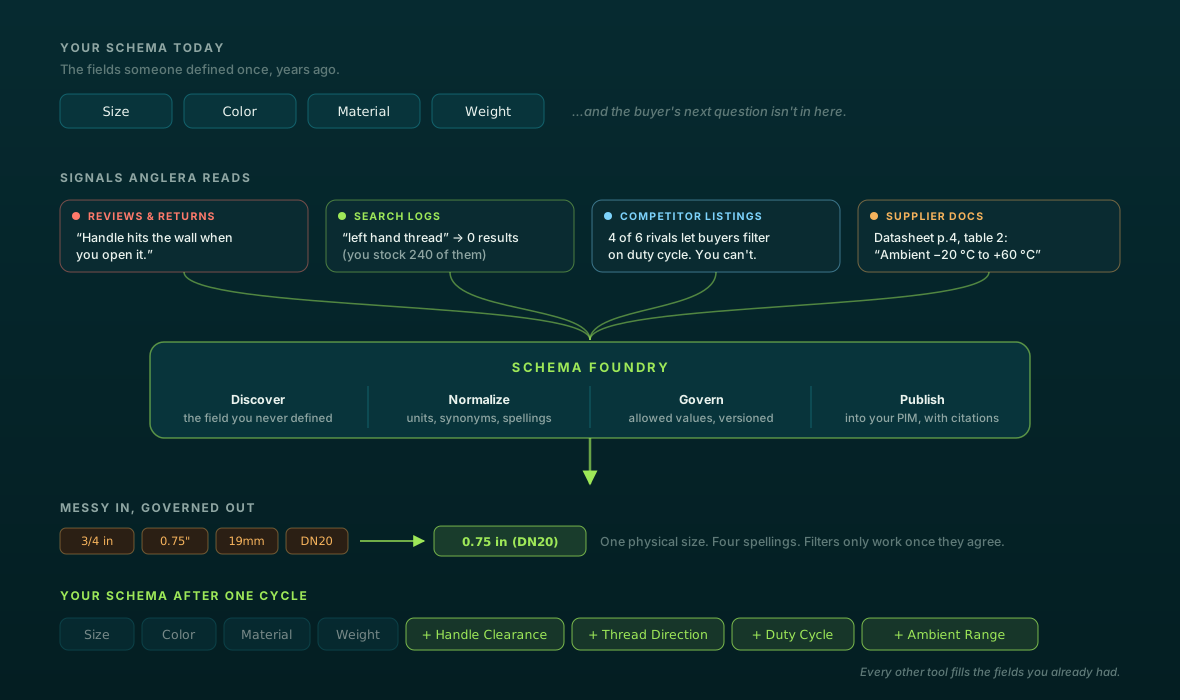
Anglera sits upstream of both. Before syndication, Anglera gathers raw product data from all available sources, enriches every SKU against real buyer signals — how your customers actually search, compare, and decide — fills attribute gaps, cleans inconsistencies, scores completeness, and writes the improved content back to your PIM. That means:
- What 1WorldSync distributes to trading partners is structured, complete, and compliant data that actually describes the product to the buyer — not just valid schema.
- What Rithum syndicates across 420+ channels is content optimized for each channel's search ranking and buyer expectations — not just a reformatted supplier feed.
Whichever platform you choose — or both — Anglera is the enrichment layer that makes the distribution work. Your PIM stores the data. Anglera does the work. Then 1WorldSync or Rithum carries it where it needs to go. Implementation is approximately 30 days, and Anglera writes back to your existing PIM with no platform migration required.
Frequently asked questions
Are 1WorldSync and Rithum direct competitors?
Largely no. They solve different distribution problems. 1WorldSync is a GDSN-certified data pool for CPG brands and manufacturers that need GS1-structured data flowing to grocery chains and regulated trading partners. Rithum is a commerce operations platform for listing, feed management, and drop-ship fulfillment across 420+ marketplace and retail channels. Some large brands use both in parallel — GDSN compliance for traditional retail and marketplace operations for digital channels — rather than choosing between them.
Can a brand or distributor use both 1WorldSync and Rithum at the same time?
Yes, and some do. A CPG brand may need 1WorldSync to maintain GDSN compliance with Kroger and Target while also using Rithum to manage Amazon and Walmart marketplace listings and drop-ship programs. The two platforms cover distinct distribution lanes rather than overlapping ones. The practical challenge is maintaining consistent, high-quality product content across both systems — which is where a dedicated enrichment layer upstream of both becomes important.
Does 1WorldSync do what Rithum does — or vice versa?
No. 1WorldSync does not manage marketplace listings, automate orders, or handle drop-ship fulfillment. Rithum does not offer GDSN certification, GS1 attribute validation, or trading-partner synchronization for regulated grocery channels. They are purpose-built for different parts of the product distribution stack.
Neither platform enriches product content — what does that mean in practice?
Both platforms distribute whatever product data you give them. If an attribute is missing, a description is thin, or a specification does not match how buyers search for the product, the platform will still syndicate it — it just will not flag or fix the content quality gap. For 1WorldSync, this means GS1-compliant but buyer-unfriendly data reaches trading partners. For Rithum, this means weak content gets amplified across hundreds of channels. Product enrichment — gathering data, filling gaps, optimizing for buyer intent — has to happen upstream, before distribution.
Where does Anglera fit if I already use one of these platforms?
Anglera works upstream of whichever distribution platform you use. It connects to your PIM, enriches your product catalog against buyer signals, and writes improved content back before syndication begins. If you use 1WorldSync, Anglera ensures what flows through your GDSN pipe is complete, accurate, and buyer-ready — not just schema-valid. If you use Rithum, Anglera ensures the content reaching 420+ channels converts rather than just appearing. Implementation takes approximately 30 days and does not require changes to your existing distribution setup.