All comparisons
Works with Rithum (ChannelAdvisor / CommerceHub)Syndication & feeds

Anglera + Rithum (ChannelAdvisor / CommerceHub)

The bottom line

Keep Rithum to list, sync, and fulfill across 420+ channels. Add Anglera upstream so what it syndicates isn't thin supplier copy: mined specs, governed attributes, buyer-signal-tuned content, cited to source.

Rithum (ChannelAdvisor / CommerceHub) and Anglera solve different halves of the problem — this page is about the seam between them.
The frame for this comparison

Product data is a practice, not a project.

Rithum's listings product begins at the upload and adapts what you send to each channel's spec — so the comparison isn't channel coverage, which is where its depth is, but what happens upstream of the upload: whether the record you keep sending actually gains each new marketplace's required attribute, or gets a per-channel value typed into an export.

01

Ground it

Mine every spec from every source.

Every value traced to a document you can open. The catalog is only as honest as what it was built from.

02

Align it

Aim the catalog at the buyer who actually buys.

Grounded data still loses if it answers questions nobody asked. Alignment is what turns specs into conversion.

03

Keep it alive

Product data is a practice, not a project.

Markets move, suppliers reissue, buyers change what they ask for. A catalog that is right in March is wrong by August unless something is watching.

Capability by capability

Where Rithum (ChannelAdvisor / CommerceHub) stops.

Scored against public documentation. Grouped by the three acts — so you can see which ones Rithum (ChannelAdvisor / CommerceHub) leaves on your desk.

01

Ground it

Mine every spec from every source.
Source mining
Where does it get specs from?
Rithum (ChannelAdvisor / CommerceHub)Limited

Ingests supplier feeds, CSV and APIs; no document mining

AngleraYes

PDFs, spec tables, drawings, manuals, images, sites

Schema discovery
Does it find attributes that aren't in your schema yet?
Rithum (ChannelAdvisor / CommerceHub)No

Catalog Assist fills channel-required fields; proposes no new attributes

AngleraYes

Proposes fields your schema never had

Governed vocabulary
Does it turn messy free-text into a governed pick list?
Rithum (ChannelAdvisor / CommerceHub)Limited

Standardizes values to channel specs; no versioned governed pick lists

AngleraYes

Normalizes and governs allowed values, versioned

Taxonomy & classification
Can it classify every SKU into your hierarchy?
Rithum (ChannelAdvisor / CommerceHub)Yes

AI Magic Mapper auto-maps SKUs to marketplace categories

AngleraYes

Auto-classifies; channel and marketplace mapping

Citations & provenance
Can you see where any given value came from?
Rithum (ChannelAdvisor / CommerceHub)No

No value-level source citation documented; review UI only

AngleraYes

Every value cites its source doc and page

02

Align it

Aim the catalog at the buyer who actually buys.
Buyer personas
Is the content written for your buyer, or generically?
Rithum (ChannelAdvisor / CommerceHub)No

Content tailored per channel spec, not buyer persona

AngleraYes

B2B specifier and B2C shopper enriched differently

Review, search & social signals
Does it learn what buyers ask from the live market?
Rithum (ChannelAdvisor / CommerceHub)Limited

Demand trends and A/B tests inform content optimization

AngleraYes

Reviews, search, competitor rails, social — fed back

Copy & SEO
Does it write original, channel-ready copy?
Rithum (ChannelAdvisor / CommerceHub)Limited

AI optimizes titles and descriptions against channel rules

AngleraYes

Original copy per persona and channel

Product imagery
Can it produce usable images for SKUs that lack them?
Rithum (ChannelAdvisor / CommerceHub)No

Stores and A/B tests images; no image generation

AngleraYes

Generates studio-grade imagery for photoless SKUs

03

Keep it alive

Product data is a practice, not a project.
Continuous re-enrichment
What happens when the market moves after go-live?
Rithum (ChannelAdvisor / CommerceHub)Limited

Real-time feed sync; enrichment suggestions need human approval

AngleraYes

Re-enriches on its own after go-live

Quality scoring
Does it score its own output and track catalog health?
Rithum (ChannelAdvisor / CommerceHub)Limited

Flags missing attributes and compliance; no catalog health score

AngleraYes

Scored against your standards; nothing publishes below bar

Write-back
Does enriched data land back in your system of record?
Rithum (ChannelAdvisor / CommerceHub)Limited

Pushes outward to channels; enriched data retrievable via API

AngleraYes

Writes back to PIM, ERP, warehouse, commerce

API, MCP & webhooks
Can your own tools and agents drive it headlessly?
Rithum (ChannelAdvisor / CommerceHub)Limited

REST API and webhooks documented; no MCP server found

AngleraYes

API, webhooks, and MCP servers

Who does the work
Does it do the work, or help your team do it?
Rithum (ChannelAdvisor / CommerceHub)Limited

Software with human approval gates; optional managed services team

AngleraYes

Anglera owns the work; review is a guardrail

KeyYesships itLimitedlimited or gatedYour teamyour team still does itNodoesn't do itAnglera differentiator
What “buyer signals” actually means

Six signals sitting in your market right now.

“Buyer signals” is the emptiest phrase in this category, so here is the literal thing. Each of these is an observation from a live market, the gap it exposes, and the field that gets created as a result.

Search signal·Marketplace search terms report

The terms landing on a 100W GaN charger listing are "20V 5A", "PD 3.1 140W" and "pd profile macbook" — while the listing itself says "fast charging" and puts the output table in the third image.

The buyer is shopping on the power-delivery profile, and it exists only as pixels — so it sits in no field a filter, a match, or an agent can read.

Field createdUSB Power Delivery Output ProfileFixed PD profiles (5V/3A, 9V/3A, 15V/3A, 20V/5A, 28V/5A), plus total output in watts as an integer
Competitor signal·Competing listings on the same marketplace

Rival cordless impact wrenches publish two torque numbers — fastening torque and nut-busting torque — and the channel filters on the first. Yours ships one field called "Torque: 1400 Nm", which is the nut-busting figure.

One number is doing two jobs, so the listing sorts into the wrong filter band and reads as overstated next to competitors that split the spec.

Field createdFastening Torque (max)Newton-metres, integer; ft-lb converted on ingest; Nut-Busting Torque carried as a separate governed field
Supplier signal·Dropship supplier catalog feeds

Three fan suppliers in the same dropship program fill their mounting field with "hugger", "flush/downrod convertible", and "4 in. downrod incl., sloped adapter sold separately".

Every feed passes format checks, and none of the three answers the two questions a shopper with an eight-foot ceiling asks: how it mounts, and what's in the box.

Field createdMounting TypeFlush / Downrod / Dual-mount / Sloped-ceiling compatible, with Included Downrod Length in inches as a paired required field
Why catalogs rot

The feed gets adapted; the record has to learn

Rithum's Marketplace Listings starts where you'd expect: "Upload your product data. We'll help you adapt it to meet the unique specifications of each marketplace." That adaptation reaches more than 600 marketplace and retail integrations, and its error detection "flags broken, inaccurate, or non-compliant listings and provides suggested fixes." RithumIQ, announced in September 2025, extends this to enriching and standardizing content across marketplaces and variants. The open question sits on your side of the upload. A channel adds a required attribute — last width on footwear, a power-delivery profile on a 100W charger — the flag appears, someone exports the XLSX, types a value that clears the check, re-uploads. That is one patch, in one channel's vocabulary. Anglera works alongside Rithum: we resolve the fact once, in the record you keep uploading, so the next spec asks something you already answered.

Messy in, governed out.

Values are normalized into a governed, versioned set of allowed values — so a filter works, and keeps working after the next import.

Nominal Size
3/4 in0.75"3/4"19mm3/4 inchDN20
0.75 in (DN20)

Six suppliers, six spellings, one physical size. Filters only work once they agree.

Finish
BlkblackBLACK MATTEMatte BlkRAL 9005
Black — Matte

Free text makes a colour filter useless. A governed value makes it a facet.

Material
SS316316 StainlessStainless Steel 316A4 Stainless
Stainless Steel — 316 / A4

Same alloy, four vocabularies, plus a trade name. Buyers search all of them.

And the part nobody else does

We don't just fill the template you handed us.

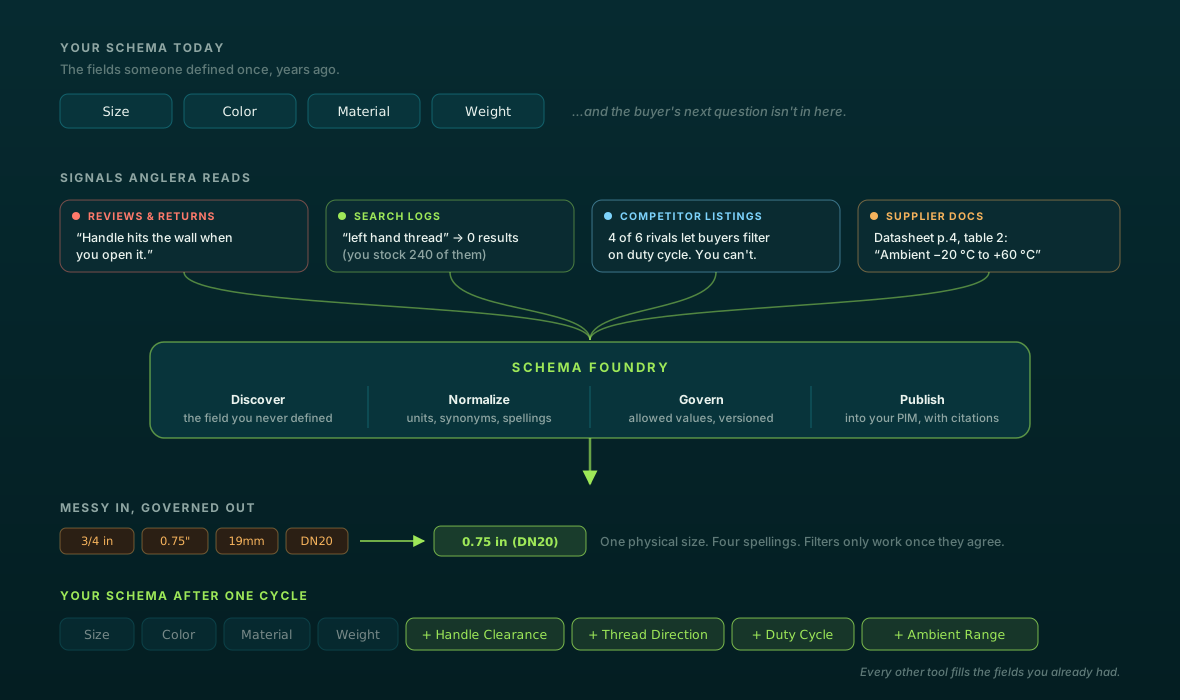
Filling the fields you defined has an invisible ceiling: a catalog can hit 100% complete and still miss the attribute that loses the sale, because completeness is measured against a schema someone drew years ago. Schema Foundry reads competitor listings, buyer searches, review complaints and your supplier docs, and proposes the fields you never defined — which is where Rithum (ChannelAdvisor / CommerceHub) stops.

How Schema Foundry works
Schema Foundry: signals from reviews, search logs, competitor listings and supplier documents reveal attributes missing from your schema; the Foundry discovers, normalizes and governs them, so your schema ends the cycle with more fields than it started with.

What Rithum (ChannelAdvisor / CommerceHub) does

Rithum (the 2023 merger of CommerceHub, ChannelAdvisor, and Dsco) is a commerce operations platform that syndicates product listings, manages feeds, and automates order/inventory workflows across 420+ marketplace and retail channels for 40,000+ brands and retailers. Its core job is getting products listed and fulfilled everywhere — not enriching them to win the buyer.

Pricing: Not publicly listed; custom enterprise pricing based on GMV and channel usage.

Rithum (ChannelAdvisor / CommerceHub) website

When Rithum (ChannelAdvisor / CommerceHub) is the right call

Brands and retailers selling across many marketplaces that need category mapping, feed sync, and order/inventory automation at scale — Rithum's Magic Mapper and 420+ channel reach are the strength.

We'd rather tell you here than in month three of an implementation.

Capability verdicts reviewed against Rithum (ChannelAdvisor / CommerceHub)'s public documentation on July 14, 2026. Vendors ship quickly — if something here is out of date, tell us and we'll correct it.

See it on your own SKUs.

Bring one category and your supplier files. In 30 minutes you'll see it enriched — complete, structured, and consistent enough to launch on — plus the attributes your schema didn't have yet.

Book a demo