EnterWorks vs Rithum (ChannelAdvisor / CommerceHub): PIM Governance or Channel Distribution?
These two platforms are not natural competitors. EnterWorks (now Precisely EnterWorks) is an enterprise PIM/MDM and DAM — its job is to be the governed source of truth for your product catalog, with role-based workflows, business rules, and integrations that keep complex attribute sets consistent across teams and systems. Rithum — the 2023 merger of CommerceHub, ChannelAdvisor, and Dsco — is a commerce operations platform whose job is to syndicate that catalog to 420+ marketplace and retail channels, automate order routing, and manage drop-ship fulfillment at scale.
A buyer genuinely comparing these two tools is typically asking one of two questions. The first: "We don't have a governed PIM — should we invest in EnterWorks or skip straight to Rithum and start distributing what we have?" The second: "We have both PIM and channel operations needs — which platform deserves the next budget dollar?" The answer in both cases depends on where your catalog pain actually lives. If your product data is ungoverned, inconsistent, or siloed across systems, that problem follows you into every channel Rithum touches. If your data is already well-governed but you are missing marketplace reach and operational automation, adding EnterWorks will not help.
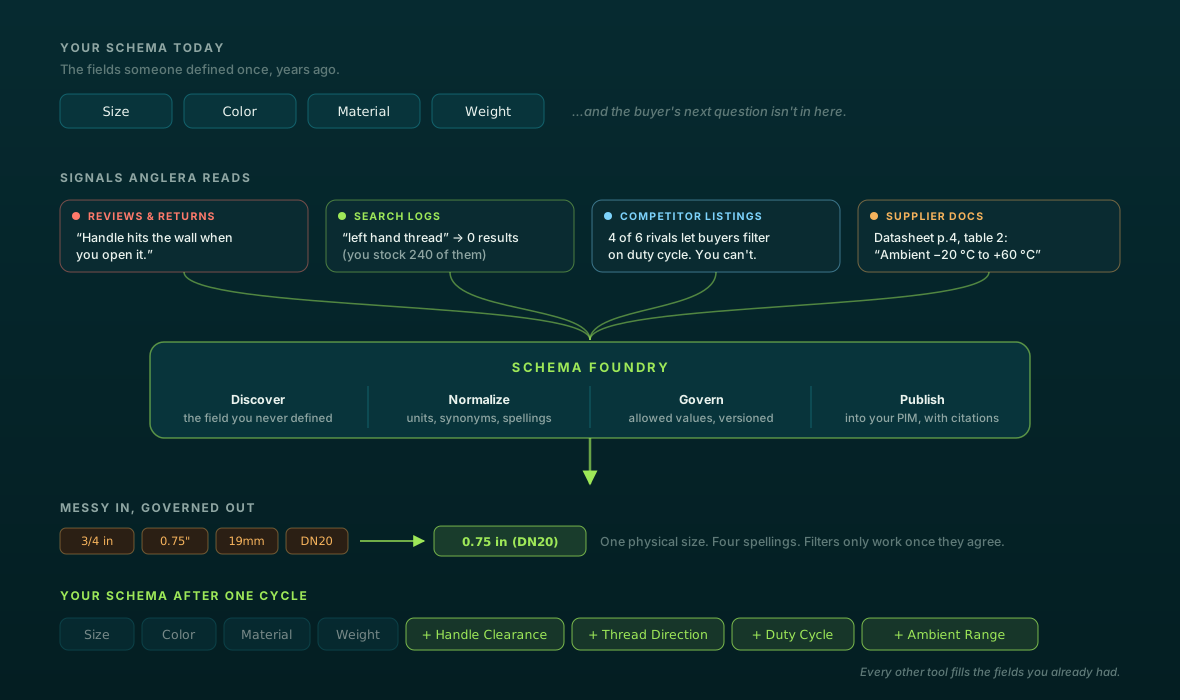
Both tools share a critical assumption: the product data flowing through them is already reasonably complete and buyer-ready. EnterWorks provides governance workflows that help teams manage and steward data — but it does not automatically research missing specifications or enrich content against what buyers actually search. Rithum distributes whatever feeds you provide across its channel network — if the content is thin or inaccurate going in, it amplifies that at scale. That upstream gap is where enrichment has to happen before governance and distribution can do their jobs.
| EnterWorks | Rithum (ChannelAdvisor / CommerceHub) | Anglera | |
|---|---|---|---|
| Primary function | Enterprise PIM/MDM and DAM that centralizes product information as a governed single source of truth, with role-based workflows, business rules, complex relationships, and integration to ERP, e-commerce, and syndication systems | Commerce operations platform that syndicates product listings, manages feeds, and automates order and inventory workflows across 420+ marketplace and retail channels for 40,000+ brands and retailers | Enrichment layer that fills the content gap before data enters either system — gathering, cleaning, scoring, and writing enriched records back to your existing source of truth |
| Data governance and workflow | Role-based workflows, configurable business rules, and data stewardship controls that keep large, complex catalogs consistent across teams and systems; designed for multi-department governance at enterprise scale | Feed management workflows, rules-based product mapping, and fulfillment automation focused on channel compliance and order operations — not catalog governance or data quality management | Feeds enriched, scored data back to your system of record so that what goes through governance workflows or channel feeds is already complete — not just organized or distributed |
| Channel reach and distribution | Integrates with ERP, e-commerce platforms, and downstream syndication channels; serves as the hub from which data is pushed — does not operate its own marketplace channel network | Direct connections to 420+ marketplace and retail channels including Amazon, Walmart, eBay, and hundreds of regional platforms; built-in drop-ship and order routing automation at scale | Reads from and writes back to your existing PIM or data store; downstream channel reach is handled by Rithum or your existing integrations — Anglera improves what flows through them |
| Content enrichment | Provides completeness tracking and workflow tools that help teams identify and prioritize gaps; does not automatically research or fill missing attributes from external sources | Syndicates the content it receives; optimizes for channel format compliance and feed mapping, not for content quality or buyer-signal alignment | Purpose-built for this: gathers missing attributes from supplier sites and external sources, normalizes values, scores every SKU against buyer signals, and writes enriched records back automatically |
| Implementation complexity | Enterprise PIM/MDM deployment; data modeling, catalog migration, workflow configuration, and integration to ERP and commerce systems typically take several months with implementation partners | Complex due to the breadth of channel integrations, feed mapping, and fulfillment workflow setup; timeline varies by channel footprint and drop-ship program scope | ~30 days; connects to your existing system of record without replacing it — no platform migration, no rip-and-replace |
| Pricing | Custom enterprise licensing, quote-based; reported base around $150,000 with cost scaling by user count and implementation complexity; no free tier | Custom enterprise pricing not publicly listed; based on GMV and channel usage; requires a sales conversation | Priced per SKU enriched; designed to work alongside your existing PIM investment rather than replacing it |
| Ideal buyer | Mid-market to large retailers, manufacturers, and wholesale distributors — such as Orgill, US Foods, Johnstone Supply, and Fender — that need a governed, enterprise-grade source of truth for complex product catalogs with multi-department data stewardship | Brands and retailers whose primary challenge is listing, syncing, and fulfilling products across many marketplace and retail channels at scale; especially strong for drop-ship programs, marketplace operations, and high-volume multichannel commerce | B2B distributors, retailers, and manufacturers on either platform who receive incomplete supplier data and need enriched, buyer-ready content without adding manual catalog work |
How to choose between EnterWorks and Rithum (ChannelAdvisor / CommerceHub)
Choose EnterWorks if data governance is your core problem. If you are managing a large, complex catalog across multiple departments, ERP systems, and commerce channels — with inconsistent data, no single source of truth, and workflows that break down when a new product is introduced — EnterWorks is purpose-built for that. Its 20+ years in B2B and B2C catalog management, its enterprise customer base (Orgill, US Foods, Johnstone Supply), and its MDM-grade data hub make it a strong fit for organizations where catalog governance is a strategic initiative, not a one-time project.
Choose Rithum if channel reach and operational automation are your core problem. If your catalog data is reasonably organized and your priority is getting products live on Amazon, Walmart marketplace, and hundreds of other channels — along with automating drop-ship fulfillment and order routing — Rithum's commerce operations platform is built for exactly that. Its ChannelAdvisor marketplace intelligence, CommerceHub drop-ship network, and Dsco supplier connectivity give it a channel breadth that a PIM cannot replicate.
Consider running both if your catalog is complex enough to require governed stewardship and broad enough to need multichannel distribution at scale. Many enterprise distributors and manufacturers use a PIM as the internal source of truth and a commerce operations platform to push that content outward. These are sequential investments, not competing ones — EnterWorks governs, Rithum distributes.
One thing to verify before either decision: how complete and buyer-ready is the underlying product data? If your catalog has missing attributes, thin descriptions, or supplier copy that does not match how buyers actually search, that problem will follow you into any governance or distribution platform you choose.
Whichever you pick, the data still has to get done
Neither EnterWorks nor Rithum enriches your product content.
EnterWorks governs and distributes whatever your teams put in. It offers completeness workflows and data stewardship tools, but the catalog is only as good as the content that gets entered. Missing specifications, thin supplier descriptions, and attributes that do not align with buyer search behavior all pass through governance workflows cleanly — they just do not convert.
Rithum distributes whatever feeds it receives. When a SKU lands on 400+ channels with weak content, Rithum makes sure it appears on every one of them. Channel reach amplifies content problems, not content quality.
Anglera works upstream of both. It connects to your existing system of record — your EnterWorks PIM, your ERP, your data feed — enriches every SKU against buyer signals (how your customers actually search, compare, and decide), fills attribute gaps from supplier sites and external sources, cleans inconsistencies, and writes the improved content back before it enters governance workflows or channel distribution.
The result: what EnterWorks governs and distributes is complete, buyer-ready content — not just organized content. What Rithum pushes to 420+ channels converts rather than merely appearing. Implementation takes approximately 30 days and does not require changes to your existing platform setup. Your PIM stores the data. Anglera does the work. Then Rithum carries it where it needs to go.
Frequently asked questions
Are EnterWorks and Rithum direct competitors?
No. EnterWorks is a PIM/MDM that governs product data as an internal system of record; Rithum is a commerce operations platform that distributes product listings and manages order fulfillment across 420+ channels. They solve different problems at different points in the catalog lifecycle. Many enterprise retailers and distributors run both in sequence: EnterWorks as the governed source of truth and Rithum as the distribution layer downstream.
Can Rithum replace a PIM like EnterWorks?
Rithum is not designed to govern product data — it does not provide MDM-grade business rules, role-based editorial workflows, or complex product relationship management. It is optimized for channel feed management and operational automation. If your catalog is ungoverned and inconsistent, that problem will show up in every Rithum-connected channel. A PIM like EnterWorks is built to solve the governance problem that Rithum assumes is already handled.
Is EnterWorks part of Syndigo?
No. EnterWorks was acquired by Winshuttle in 2019 and became part of Precisely in 2021. It is not affiliated with Syndigo. The confusion sometimes arises because both companies operate in the product content space, but they are separate organizations with different ownership and different platform capabilities.
Does Rithum do content enrichment?
Rithum handles feed mapping, channel compliance, and operational workflows — its strength is distribution breadth and fulfillment automation, not content quality. It syndicates the product data you provide; it does not gather missing attributes, fill specification gaps, or score content against buyer search behavior. Enrichment has to happen upstream, before Rithum receives the feed, or the content gaps get distributed at scale rather than fixed.
Where does Anglera fit if I already have both EnterWorks and Rithum?
Anglera connects to EnterWorks as the source of truth, enriches SKUs with missing or thin attributes based on buyer signals, and writes the improved data back. Your existing EnterWorks-to-Rithum feed then carries clean, complete, buyer-ready records into the distribution layer — improving listing quality and conversion across every channel Rithum reaches, without changing your platform stack.