Channable vs Rithum (ChannelAdvisor / CommerceHub): Which Feed Platform Fits Your Business?
Both Channable and Rithum (ChannelAdvisor / CommerceHub) solve the same surface-level problem: getting your product catalog listed across the channels where buyers shop. But they serve fundamentally different buyers, at different scales, with different depth of capability beyond the feed.
Channable is a self-serve feed management and syndication tool built for SMB and mid-market e-commerce merchants. Its rule-based automation handles transformation and distribution across 2,500+ channels and ad networks, with pricing that starts around €59 per month and adds PPC and repricing modules a la carte. Speed to value is the proposition — you can connect, configure, and go live without enterprise contracts or implementation teams.
Rithum is the 2023 merger of ChannelAdvisor, CommerceHub, and Dsco into a single commerce operations platform serving 40,000+ enterprise brands, retailers, and suppliers. Its 420+ channel integrations go deeper than simple feed syndication: Rithum handles drop-ship supplier networks, marketplace order routing, and EDI at scale. For an enterprise retailer managing a supplier ecosystem, that operational depth is the point. The tradeoff is that Rithum's pricing and implementation complexity are both enterprise-tier. Neither platform, however, enriches the product data before it goes out the door — they distribute what you give them.
| Channable | Rithum (ChannelAdvisor / CommerceHub) | Anglera | |
|---|---|---|---|
| Primary job to be done | Feed transformation and distribution — rule-based if/then automation that reformats your catalog for 2,500+ marketplaces, ad channels, and retailers; PPC campaign management available as an add-on | End-to-end commerce operations — syndicates listings, automates order routing, manages drop-ship supplier networks, and handles fulfillment workflows across 420+ channels at enterprise scale | Enrichment layer — cleans and enriches SKU data against buyer signals before it reaches either platform, then writes the improved content back to the source of record |
| Channel and marketplace reach | 2,500+ channels including marketplaces, comparison engines, social ad networks, and affiliate platforms; strongest in Europe and mid-market e-commerce | 420+ channels with deeper integrations into major retail and marketplace programs; historically strongest in the US enterprise market through the ChannelAdvisor heritage | Upstream of channel selection — enriches the data that either platform then distributes; not a channel in itself |
| Pricing and contract model | Transparent, modular pricing starting at ~€59/month for 5,000 items; PPC, repricing, and marketplace order management are separate add-ons at €30–71/month each | Custom enterprise pricing only; no public rates; structured around GMV and channel usage; requires a sales conversation before you see a number | Per-SKU enrichment pricing; layers onto existing investments without replacing either platform |
| Order management and fulfillment | Marketplace order routing available as an add-on; not a core fulfillment or drop-ship orchestration tool | Core drop-ship and fulfillment automation inherited from CommerceHub and Dsco; suited to retailers managing large supplier networks with EDI workflows | Does not manage orders or fulfillment; focused on making SKU content richer before it reaches any channel |
| Target buyer | SMB and mid-market e-commerce merchants who need fast, affordable multichannel distribution without enterprise overhead | Enterprise brands, retailers, and manufacturers managing large-scale marketplace operations, supplier networks, and drop-ship programs | B2B distributors, retailers, and manufacturers using either platform whose product data arrives from suppliers raw, incomplete, or poorly structured |
| Implementation timeline | Self-serve onboarding; most merchants can connect sources and configure feeds in days to a few weeks without vendor implementation support | Enterprise onboarding typically spans weeks to months; dedicated implementation support and custom integration work are common at scale | ~30 days from kickoff to enriched SKUs written back to the source of record; no platform migration required |
| Product data enrichment | None — transforms and distributes the data you provide; rule-based automation reformats content but does not research or generate buyer-ready attributes | None — syndicates listings at scale but relies on the seller or brand to supply complete, compelling content; no enrichment layer is built in | Core capability — gathers missing specs, writes buyer-signal-optimized descriptions and titles, scores completeness, and writes results back to the PIM or source feed; the work both platforms assume already happened |
How to choose between Channable and Rithum (ChannelAdvisor / CommerceHub)
Choose Channable if you are an SMB or mid-market e-commerce merchant whose core need is getting a clean, rule-transformed product feed to a large number of channels quickly and affordably. The transparent pricing, self-serve setup, and 2,500+ channel integrations make it a practical choice if you want to move fast without enterprise contracts. It is also the stronger option if paid search and shopping ad automation (PPC) is part of your workflow — that module is a Channable-native add-on with no direct Rithum equivalent.
Choose Rithum if you are an enterprise brand, large retailer, or supplier managing complex marketplace operations, drop-ship programs, or EDI fulfillment across major retail accounts. The ChannelAdvisor heritage gives Rithum deep integration into US marketplace programs; the CommerceHub and Dsco lineage adds supplier network and drop-ship capability that Channable does not attempt. If your problem is commerce operations at scale — not just feed transformation — Rithum's depth justifies the enterprise investment and implementation timeline.
A few signals that clarify the choice:
- If you need GMV-based enterprise contracts with account management and SLA guarantees, Channable's self-serve model may not be the right fit.
- If pricing transparency and fast time-to-value are priorities, Rithum's quote-only model and longer onboarding cycle are real friction points.
- If drop-ship supplier automation and retailer EDI are core to your operations, Rithum is the only option of the two that addresses them.
- If you are distributing to European channels, price-comparison engines, and ad networks at mid-market scale, Channable's breadth and modular pricing tend to win.
Whichever you pick, the data still has to get done
Both Channable and Rithum are distributors of product data, not improvers of it. Channable transforms your feed format with rules; Rithum pushes those listings to 420+ channels with operational depth. What neither platform does is look at a raw SKU from a supplier, research what buyers actually search for, fill missing attributes, write a title that converts, and score the result against completeness benchmarks.
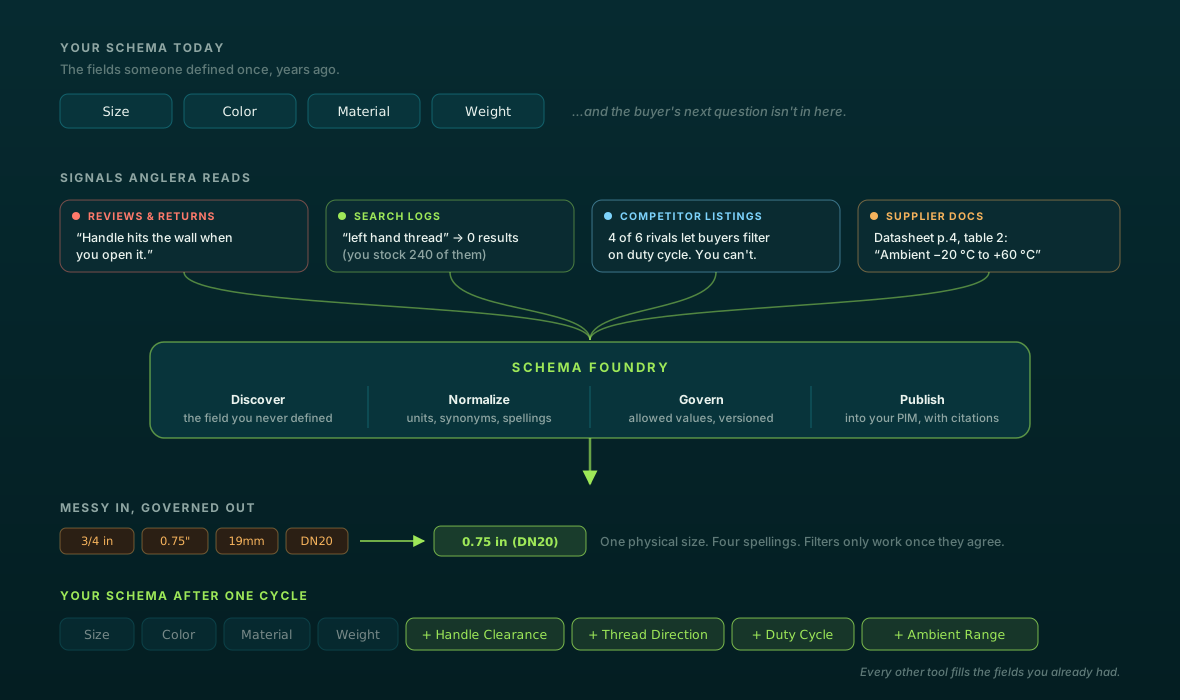
That work is what Anglera does — and it happens upstream of whichever syndication platform you pick. Anglera connects to your PIM or product data source via API, enriches every SKU against buyer signals, and writes the improved content back before Channable or Rithum ever touches it. The feed going out is buyer-ready from the start, not just well-formatted.
Implementation is ~30 days, no platform migration required, and it layers onto your existing Channable or Rithum subscription without replacing either. Your system of record stays in place. The content both platforms then distribute is simply better.
Frequently asked questions
What is the main difference between Channable and Rithum?
Channable is a self-serve feed management platform for SMB and mid-market merchants, offering rule-based transformation across 2,500+ channels with transparent, modular pricing from ~€59/month. Rithum (the 2023 merger of ChannelAdvisor, CommerceHub, and Dsco) is an enterprise commerce operations platform with deeper integrations, drop-ship and fulfillment automation, and custom GMV-based pricing. Channable prioritizes breadth and ease of use; Rithum prioritizes operational depth at enterprise scale.
Can Channable replace ChannelAdvisor (Rithum) for enterprise brands?
For large brands needing deep marketplace integrations, drop-ship supplier network management, or EDI workflows, Channable's capabilities are unlikely to match Rithum's operational depth. Channable is well-suited to merchants who need broad channel coverage quickly; Rithum serves enterprise operations that require more than feed transformation.
Does Rithum enrich product data, or just distribute it?
Rithum distributes product listings at scale — it syndicates what you provide across its channel network. It does not research missing specifications, generate buyer-signal-optimized content, or score catalog completeness. That enrichment work has to happen before the data reaches Rithum, which is where a tool like Anglera fits.
How does Anglera connect to Channable or Rithum?
Anglera connects to your upstream PIM or product data source — not to Channable or Rithum directly. It enriches your SKU data at the source, then writes the improved content back before your feed management platform picks it up. Both Channable and Rithum then distribute higher-quality, buyer-ready content without any workflow changes on their end.
Is Channable available outside Europe?
Yes. Channable supports global channels including Amazon, Google Shopping, Meta, and others. Its strongest customer base is European mid-market merchants, but the platform is not Europe-only. Channel coverage, add-on availability, and support depth may vary by region.