Feedonomics vs Rithum (ChannelAdvisor / CommerceHub): Which Feed Syndication Platform Fits Your Stack?
Feedonomics and Rithum solve a real problem: getting your products listed across the channels and marketplaces where buyers actually shop. Both are mature, enterprise-grade platforms with hundreds of channel integrations and large customer bases. If your primary question is "how do I get my catalog in front of more buyers across more destinations," either one is a credible answer — and the real decision is about fit, not quality.
The meaningful differences are in service model, operational depth, and where each platform's roots sit. Feedonomics (owned by BigCommerce) was built around performance marketing feeds — shopping ads, comparison engines, paid social — and wraps a managed-service team around that distribution work. Rithum is the 2023 combination of CommerceHub, ChannelAdvisor, and Dsco, which means it carries both marketplace management DNA (ChannelAdvisor) and drop-ship/supplier network DNA (CommerceHub). If you need order routing, drop-ship automation, or end-to-end marketplace operations alongside feed syndication, that history matters.
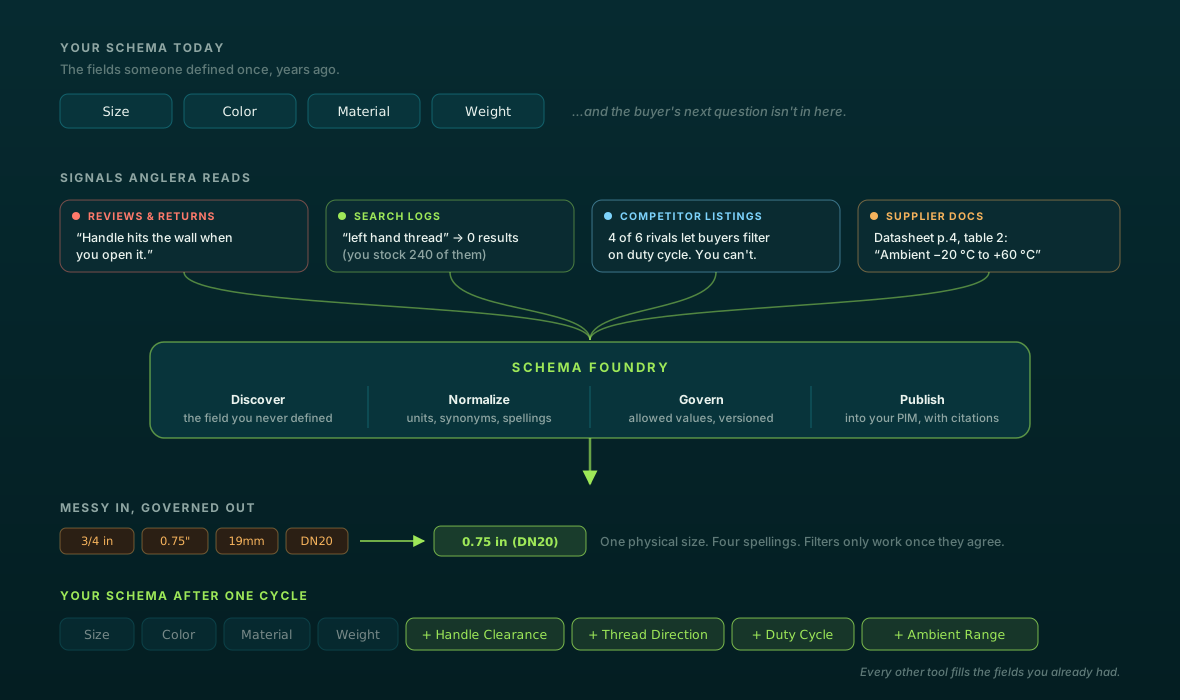
What neither platform does is enrich your product data. Both assume your catalog arrives complete — accurate attributes, filled specs, channel-ready content. In practice, most catalogs are not in that shape, and thin or inconsistent product data travels through both platforms unchanged. That gap is where Anglera operates: upstream of syndication, enriching every SKU and writing it back to your PIM before either platform touches it.
| Feedonomics | Rithum (ChannelAdvisor / CommerceHub) | Anglera | |
|---|---|---|---|
| Channel and destination breadth | 300+ ad channels and marketplaces — Google Shopping, Amazon, Microsoft Ads, Walmart, Facebook, comparison shopping engines, and more. Strong emphasis on performance marketing destinations. | 420+ marketplace and retail channels, including deep integrations with drop-ship supplier networks (CommerceHub heritage) and marketplace operations (ChannelAdvisor heritage). | Channel-agnostic. Anglera enriches and scores your product data before it reaches any channel, so listings arrive ready to convert regardless of which destinations you use. |
| Service model | Managed service first. Dedicated feed specialists own setup, ongoing optimization, and error resolution on your behalf. Minimal self-serve expectation — the team does the work. | Platform-first automation with professional services available. Teams comfortable operating the tooling can move independently; enterprise support is available but not the default delivery model. | Works alongside either model. Enrichment runs before syndication, so whether Feedonomics specialists or your Rithum-connected ops team touches the feed, the underlying data is already clean and complete. |
| Fulfillment and commerce operations | Feed syndication only. Feedonomics does not manage orders, inventory sync, or drop-ship workflows — it gets products listed, not fulfilled. | End-to-end commerce operations: listing, order routing, inventory sync, and drop-ship automation are core capabilities built across the ChannelAdvisor, CommerceHub, and Dsco foundations. | Not an ops platform. Anglera writes enriched, scored product content back to your PIM, which then feeds your syndication and fulfillment layer — whichever that is. |
| Product data enrichment | Transforms and maps your existing feed data to meet channel specifications. Does not generate missing attributes, fill content gaps, or score product completeness against buyer signals. | Normalizes and maps data across channel templates. Built for distribution efficiency, not for identifying what is missing from a product record or generating richer content. | This is Anglera's core job. Anglera scrapes source data, fills missing attributes, writes channel-ready content, scores every SKU against buyer signals, and pushes enriched records back to your PIM — before syndication begins. |
| Pricing model | Custom quote only — based on SKU volume, number of channels, and service tier. No revenue-share model. No public pricing. | Custom enterprise pricing based on GMV and channel usage. No public pricing. Costs scale with the breadth of operations managed on the platform. | A separate enrichment layer with its own pricing — sized to catalog volume and enrichment scope. Typically added alongside syndication spend, not in place of it. |
| Ideal buyer profile | Brands and retailers who want a managed partner to own feed operations across ad channels and shopping destinations — particularly teams that run large-scale shopping ads and do not want to staff a dedicated feed ops function. | Larger brands and retailers who need end-to-end channel operations: marketplace selling, drop-ship programs, supplier management, and order routing — not just feed delivery. | Any team whose catalog has gaps — missing specs, inconsistent attributes, thin descriptions, low content scores. Anglera fixes the data problem that neither syndication platform resolves. |
| Implementation timeline | Specialist-led onboarding; timeline depends on channel count, feed complexity, and data state. The managed model means Feedonomics drives the timeline. | Enterprise implementation that can be complex given the operational breadth — especially when order routing and drop-ship are in scope alongside feed syndication. | Approximately 30 days to connect to your PIM, run enrichment across the catalog, and begin writing back. Runs in parallel with your syndication implementation, not sequentially after it. |
How to choose between Feedonomics and Rithum (ChannelAdvisor / CommerceHub)
Choose Feedonomics if your primary need is performance marketing feed distribution — Google Shopping, paid social, comparison shopping engines — and you want a managed-service team to own feed quality and optimization on your behalf. It is the stronger fit when shopping ads are a major acquisition channel and you do not want to staff a dedicated feed operations function internally. The specialist model also suits teams that have struggled with feed errors and want someone accountable for resolution.
Choose Rithum if you need end-to-end marketplace operations, not just feed delivery. Rithum's combined heritage (ChannelAdvisor for marketplace management, CommerceHub for drop-ship supplier networks, Dsco for supply chain) makes it the right call when listing, order routing, drop-ship automation, and inventory sync need to live in a single connected platform. Retailers running large drop-ship programs or brands managing a complex marketplace presence across 100+ channels will find capabilities in Rithum that Feedonomics does not offer.
A note on data quality: If your catalog already has high-quality, complete product data — accurate attributes, filled specs, strong content — either platform will distribute it well. If your data has gaps, those gaps follow you into either platform. Thin content that syndicates widely still underperforms. That is the problem to solve before choosing between these two.
Whichever you pick, the data still has to get done
Both Feedonomics and Rithum are distribution platforms. They assume your product data is ready — complete attributes, accurate specs, channel-appropriate content. In most catalogs, it is not. Missing attributes cause feed rejections. Thin descriptions lower relevance scores. Inconsistent specs create mismatched listings. Neither platform is designed to fix this; their job begins where data quality is assumed to end.
Anglera sits upstream of that assumption. It connects to your PIM as the single source of truth, scrapes and enriches every SKU against buyer signals, fills content gaps, generates missing attributes, and writes clean, scored product data back before your syndication layer ever touches it. The result is fewer feed errors in Feedonomics, better channel match rates in Rithum, and listings that convert at a higher rate across every destination either platform serves.
You do not change your syndication choice to use Anglera. You add it so whichever platform you choose performs the way it is supposed to. With a roughly 30-day implementation that connects directly to your existing PIM, Anglera can be running before your syndication onboarding is complete — meaning the first feed you push is already the best version of your catalog.
Frequently asked questions
Is Rithum the same as ChannelAdvisor or CommerceHub?
Rithum is the combined company formed from the 2023 merger of CommerceHub, ChannelAdvisor, and Dsco. If you used ChannelAdvisor for marketplace management or CommerceHub for drop-ship operations, Rithum is now the entity behind those products. The merger brought together complementary capabilities — marketplace selling, supplier networks, and supply chain automation — under one brand.
Does Feedonomics do data enrichment, or does it only handle feed transformation?
Feedonomics transforms and maps your existing product data to meet channel specifications — remapping fields, reformatting values, and resolving feed errors. It does not generate missing attributes, fill content gaps, or score product completeness against buyer signals. If your source data is thin, those gaps will be present in the distributed listings as well.
Can I use Anglera without switching or replacing my syndication platform?
Yes. Anglera connects to your PIM as the source of truth, enriches records, and writes back to it. Your syndication platform — Feedonomics, Rithum, or any other — continues pulling from the same PIM source. No migration, no platform change, and no disruption to your existing feed workflows.
Which platform handles Amazon better?
Both syndicate to Amazon. Feedonomics is particularly strong for Amazon as a shopping ad and product listing destination. Rithum (ChannelAdvisor) has long-standing Amazon marketplace capabilities including Buy Box monitoring, fulfillment method management, and seller analytics. For Amazon specifically, the more important variable is often product content completeness — A+ content readiness, attribute accuracy, keyword coverage — which is where Anglera applies before either platform distributes the listing.
How do I know if my catalog needs enrichment before I syndicate?
Common signals: high feed rejection rates, listings missing required attributes on specific channels, product descriptions that are copied directly from supplier data, attribute fields that are blank or inconsistently formatted across SKUs, and content completeness scores below platform thresholds. If any of these are familiar, the problem will persist into Feedonomics or Rithum — syndication distributes what is there, it does not fix what is missing.