1WorldSync vs Unilog CX1 / CIMM2: An Honest Comparison
1WorldSync and Unilog CX1 / CIMM2 are not competing for the same job. 1WorldSync is the world's largest GDSN data pool — infrastructure that CPG brands and manufacturers use to push GS1-structured, regulator-grade product data to hundreds of retail trading partners. Unilog CX1 is an all-in-one B2B digital commerce platform bundling a storefront, a built-in PIM, CMS, site search, and ERP/POS integration — purpose-built for mid-market distributors who want to launch and grow an eCommerce channel without assembling a best-of-breed stack.
If you are comparing these two tools directly, it is worth asking whether the question is really "which platform manages my eCommerce site" (Unilog CX1) or "how do I get compliant product data to retail trading partners" (1WorldSync). The two missions rarely collide. That said, both platforms share the same silent assumption: that your product data is already clean, attributed, and ready to use. For most catalogs, that assumption is the gap where deals slow down and digital shelf performance suffers.
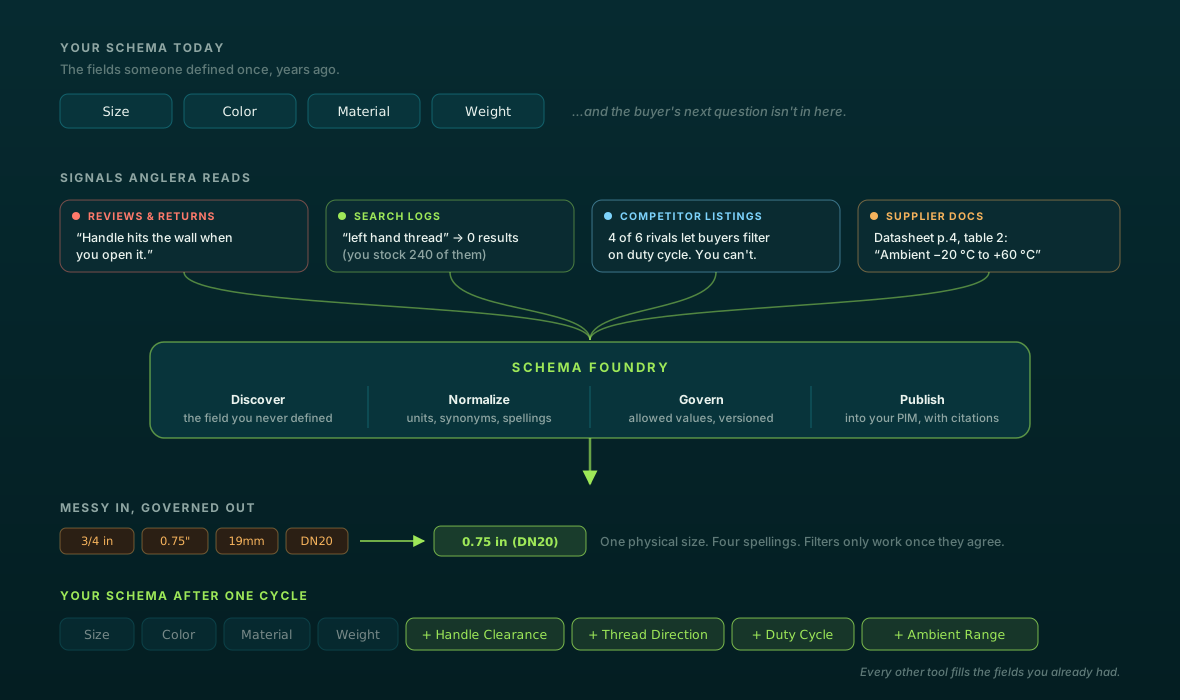
That gap is where Anglera operates. Anglera is not a PIM and not a syndicator — it is the enrichment layer that cleans, fills, normalizes, and scores your SKU data against buyer signals, then writes it back to whichever platform stores or distributes it. Whichever tool you choose, Anglera does the work those tools assume already happened.
| 1WorldSync | Unilog CX1 / CIMM2 | Anglera | |
|---|---|---|---|
| Primary function | GDSN data pool and product content syndication platform — validates GS1-structured attributes and distributes them to 14,000+ brand and retail trading partners across 60+ countries. | All-in-one B2B eCommerce suite — storefront, built-in PIM, CMS, site search, and ERP/POS integration (CX1 Connect) in a single platform, plus a managed content library of 10M+ SKUs. | AI enrichment layer — ingests raw catalog data, fills attribute gaps, normalizes inconsistencies, generates missing specs, and writes enriched records back to the source of truth before they reach either platform. |
| Who it is built for | CPG brands and manufacturers who must push compliant product data to major retail chains (especially US grocery). Also regulated industries where GDSN compliance is non-negotiable. | Mid-market B2B distributors, manufacturers, and wholesalers — particularly in electrical, industrial, plumbing, and HVAC. Over 50 AD member companies run on the platform. | Any brand, distributor, or manufacturer whose catalog has missing attributes, inconsistent descriptions, or coverage gaps — regardless of which commerce or syndication platform they use. |
| Product content and coverage | GS1-structured attributes validated against retailer and regulatory specifications. Validation is rigorous; data that does not meet spec is rejected and returned for remediation. | Managed content library covering 10M+ SKUs from approximately 2,000 manufacturers; sold as content subscriptions. Custom enrichment, taxonomy normalization, and gap-fill services available for SKUs outside the library. | Fills attribute gaps and generates missing specs for any SKU — especially proprietary or long-tail items outside managed libraries. Cleans and normalizes before data enters validation or goes live on a storefront. |
| eCommerce storefront | Not included. 1WorldSync is a content orchestration and syndication platform, not a buyer-facing commerce tool. Brands typically pair it with a separate eCommerce platform or PIM. | Core offering. CX1 bundles a full B2B storefront with site search, CMS, and account-based pricing — the eCommerce site is the primary product, with PIM and content services supporting it. | Not a storefront. Enriches the product data that the storefront displays, directly improving search relevance, filter accuracy, and conversion on whatever eCommerce layer is in place. |
| Trading-partner syndication | Core strength. The de facto GDSN data pool for major US grocery chains and global retailers. 14,000+ brands use it to meet retailer data requirements they cannot opt out of. | Not a syndication network. CX1 Connect integrates with ERP and POS systems but does not provide broad retail trading-partner syndication. Distribution is direct to the buyer via the storefront. | Enriches and structures product records before they enter 1WorldSync, reducing validation rejections and manual remediation. Has no syndication function of its own. |
| Pricing | Not publicly listed. Industry estimates: $500–$2,000/month for mid-market; $25,000–$90,000+/year for enterprise; $10,000–$100,000+ implementation. Large enterprise contracts can reach ~$1M/year. | Quote-based SaaS, scoped by catalog size, modules selected, and content services consumed. Third-party listings cite entry pricing in the low hundreds per month, but real deployments are higher once content and implementation are included. | Usage-based pricing tied to SKU volume and enrichment depth. Approximately 30-day implementation. No long-term platform lock-in. |
| Implementation and complexity | Multi-month onboarding; significant data preparation and GS1 compliance work required before go-live. Implementation fees are substantial at mid-market and above. | Multi-month project scoped around storefront configuration, ERP integration, and catalog migration or content subscription setup. Complexity scales with catalog size and number of integrated systems. | ~30-day implementation. Connects to the existing PIM or data source, runs enrichment workflows, and writes back — no storefront or syndication infrastructure to configure. |
How to choose between 1WorldSync and Unilog CX1 / CIMM2
Choose 1WorldSync if your primary problem is getting GS1-compliant product data to major retail trading partners — especially US grocery chains, mass merchants, or any retailer that mandates GDSN compliance. If a retail buyer has told you that your data must flow through a certified GDSN data pool, 1WorldSync is effectively the infrastructure requirement, not a discretionary choice. It is also the right fit for large CPG brands and manufacturers managing complex attribute sets across regulated categories (food, beverage, health, beauty) where regulator-grade data accuracy is not optional.
Choose Unilog CX1 / CIMM2 if you are a mid-market B2B distributor — particularly in electrical, industrial, HVAC, or plumbing — who needs to launch or grow an eCommerce channel and wants storefront, PIM, content, and ERP integration in one platform rather than assembled from separate tools. If you are an AD member company or operate in a vertical where Unilog already has deep content coverage, the managed SKU library can meaningfully accelerate catalog readiness.
If you need both: A manufacturer selling into retail while also running a direct B2B eCommerce site could reasonably use both tools simultaneously — 1WorldSync for outbound retail syndication, and Unilog CX1 for the buyer-facing channel. They are complementary in that scenario, not redundant.
The honest caveat for both: Neither platform solves the upstream problem of incomplete or inconsistent raw catalog data. 1WorldSync rejects data that fails GS1 validation — which means your team remediates it manually. Unilog's managed content library covers roughly 2,000 manufacturers, leaving proprietary and long-tail SKUs under-attributed. Both situations create the same bottleneck: catalog quality work that falls back on internal teams.
Whichever you pick, the data still has to get done
Both 1WorldSync and Unilog CX1 are downstream of the same problem: product data quality. 1WorldSync returns data that fails GS1 validation. Unilog's managed library has coverage limits. In both cases, someone has to do the attribute work — and that work typically lands on a small team managing thousands or tens of thousands of SKUs manually.
Anglera sits upstream of that bottleneck. It connects to your existing PIM or data source, identifies attribute gaps and inconsistencies across every SKU, runs AI-driven enrichment against buyer signals and category specs, and writes the cleaned records back to your source of truth — typically in about 30 days. The data that reaches 1WorldSync passes validation the first time. The data that goes live on your Unilog CX1 storefront is complete, consistent, and search-ready.
Anglera does not replace either platform. It does the work both platforms assume already happened.
Frequently asked questions
Is 1WorldSync a PIM?
No. 1WorldSync validates and distributes product content to trading partners via the GDSN but is not designed to serve as a brand's internal catalog management system. Most users maintain a separate PIM for day-to-day product data operations and push content to 1WorldSync for syndication.
Does Unilog CX1 replace a standalone PIM?
For many mid-market distributors, yes — CX1's built-in PIM handles catalog management, and the managed content library can fill a meaningful portion of attribute gaps. Whether it fully replaces a dedicated PIM depends on catalog complexity, the number of proprietary SKUs, and how much custom workflow the team needs. Companies with large, complex, or highly proprietary catalogs sometimes find the built-in PIM limiting.
Can a company use 1WorldSync and Unilog CX1 at the same time?
Yes. They solve different problems. A manufacturer could use 1WorldSync to push GS1-compliant data to retail trading partners while also running a Unilog CX1 storefront for direct B2B sales. The two platforms do not overlap in function and are not mutually exclusive.
Where does Anglera fit if I already use 1WorldSync?
1WorldSync requires fully attributed, GS1-compliant data to pass validation. Anglera enriches and structures your catalog before it enters 1WorldSync, reducing the rejection rate and the manual remediation work that follows. The cleaner the data going in, the faster it flows to trading partners.
Where does Anglera fit if I use Unilog CX1?
Unilog's managed content library covers roughly 2,000 manufacturers. For SKUs outside that library — proprietary products, private label, or suppliers not in the network — attribute gaps fall on your team. Anglera fills those gaps, normalizes inconsistent records, and writes enriched data into the CX1 PIM so your entire catalog, not just the covered portion, meets the same quality standard.