All comparisons
Works with Unilog CX1 / CIMM2PIM platforms

Anglera + Unilog CX1 / CIMM2

The bottom line

Keep CX1 for the B2B storefront, PIM, CMS, and ERP connectivity, and Unilog's 10M-SKU library for standard vendor content. Add Anglera for the custom enrichment that library doesn't cover, without a per-SKU services queue.

Unilog CX1 / CIMM2 and Anglera solve different halves of the problem — this page is about the seam between them.

The frame for this comparison

Product data is a practice, not a project.

Unilog runs the whole B2B channel — CX1 eCommerce, CX1 PIM, CX1 Connect, and a subscription library of vendor-managed SKU content Unilog says is sourced from direct manufacturer relationships — so the real comparison isn't platform against platform: it's what happens to the SKUs that library doesn't cover, and whether completing them is a services project you scope each time or a practice that runs every week alongside the CX1 PIM you already own.

01

Ground it

Mine every spec from every source.

Every value traced to a document you can open. The catalog is only as honest as what it was built from.

02

Align it

Aim the catalog at the buyer who actually buys.

Grounded data still loses if it answers questions nobody asked. Alignment is what turns specs into conversion.

03

Keep it alive

Product data is a practice, not a project.

Markets move, suppliers reissue, buyers change what they ask for. A catalog that is right in March is wrong by August unless something is watching.
Capability by capability

Where Unilog CX1 / CIMM2 stops.

Scored against public documentation. Grouped by the three acts — so you can see which ones Unilog CX1 / CIMM2 leaves on your desk.

01

Ground it

Mine every spec from every source.
Source mining
Where does it get specs from?
Unilog CX1 / CIMM2Limited

Vendor-managed feeds and manufacturer relationships; services fill gaps

AngleraYes

PDFs, spec tables, drawings, manuals, images, sites

Schema discovery
Does it find attributes that aren't in your schema yet?
Unilog CX1 / CIMM2No

Enriches against your existing schema; no new-attribute proposals

AngleraYes

Proposes fields your schema never had

Governed vocabulary
Does it turn messy free-text into a governed pick list?
Unilog CX1 / CIMM2Yes

DQM add-on converts, validates data into uniform values

AngleraYes

Normalizes and governs allowed values, versioned

Taxonomy & classification
Can it classify every SKU into your hierarchy?
Unilog CX1 / CIMM2Limited

Multi-taxonomy management; category attribution via services team

AngleraYes

Auto-classifies; channel and marketplace mapping

Citations & provenance
Can you see where any given value came from?
Unilog CX1 / CIMM2Limited

Workflow approvals and audit; no per-value source citations

AngleraYes

Every value cites its source doc and page

02

Align it

Aim the catalog at the buyer who actually buys.
Buyer personas
Is the content written for your buyer, or generically?
Unilog CX1 / CIMM2No

No persona-tailored attributes or language variants found

AngleraYes

B2B specifier and B2C shopper enriched differently

Review, search & social signals
Does it learn what buyers ask from the live market?
Unilog CX1 / CIMM2Limited

Synonym Agent reads site search; competitive SKU analysis

AngleraYes

Reviews, search, competitor rails, social — fed back

Copy & SEO
Does it write original, channel-ready copy?
Unilog CX1 / CIMM2Yes

Writing Agent drafts descriptions, keywords; Blog Agent posts

AngleraYes

Original copy per persona and channel

Product imagery
Can it produce usable images for SKUs that lack them?
Unilog CX1 / CIMM2No

Hosts 10M+ vendor image assets; no generation

AngleraYes

Generates studio-grade imagery for photoless SKUs

03

Keep it alive

Product data is a practice, not a project.
Continuous re-enrichment
What happens when the market moves after go-live?
Unilog CX1 / CIMM2Limited

Agents run scheduled; never publish without human approval

AngleraYes

Re-enriches on its own after go-live

Quality scoring
Does it score its own output and track catalog health?
Unilog CX1 / CIMM2Limited

DQM add-on monitors quality; agents flag missing descriptions

AngleraYes

Scored against your standards; nothing publishes below bar

Write-back
Does enriched data land back in your system of record?
Unilog CX1 / CIMM2Yes

CX1 Connect and PIM APIs push to ERP, DAM

AngleraYes

Writes back to PIM, ERP, warehouse, commerce

API, MCP & webhooks
Can your own tools and agents drive it headlessly?
Unilog CX1 / CIMM2Limited

REST API sold as add-on; no webhooks or MCP found

AngleraYes

API, webhooks, and MCP servers

Who does the work
Does it do the work, or help your team do it?
Unilog CX1 / CIMM2Limited

Platform team-operated; Unilog content services staff enrich on request

AngleraYes

Anglera owns the work; review is a guardrail

KeyYesships itLimitedlimited or gatedYour teamyour team still does itNodoesn't do itAnglera differentiator
What “buyer signals” actually means

Six signals sitting in your market right now.

“Buyer signals” is the emptiest phrase in this category, so here is the literal thing. Each of these is an observation from a live market, the gap it exposes, and the field that gets created as a result.

Review signal·Reviews left on storefront product pages

On a case of blue nitrile exam gloves: "These are the 5-mil shop gloves, not the 3-mil the photo shows. Fine for our parts washer, but our infusion room can't use them — nothing on the page says whether they're chemo-tested."

Thickness and chemo-drug permeation testing live in the marketing paragraph, not in a field. The branded line inherits both from the vendor feed; the house-brand equivalent sitting next to it on the same category page has neither, so the thickness filter returns a partial shelf and buyers stop trusting it.

Field createdglove_thickness_mil (numeric) plus chemo_drug_tested (boolean) and tested_drug_list where trueThickness normalised to mils at the finger, single-wall, from the vendor's stated test method; chemo_drug_tested asserted only against ASTM D6978 evidence, otherwise left null — never defaulted to false
Search signal·Internal site search logs and the zero-result report

Steady zero-result traffic on "raintight", "wet location EMT", and "raintight compression connector 3/4" — the SKUs exist and sell, but the words only appear inside a PDF spec sheet linked from the page.

Location rating was never modelled as an attribute, so there is nothing to search, facet, or syndicate on. Electricians who type the word they use on the jobsite get nothing back and go to the marketplace listing that does answer, and the usual fix is a synonym mapping rather than a field that carries the rating out to every channel.

Field createdlocation_rating (enumerated, per UL listing) with wet_location_listed as a derived boolean for facetingDry | Damp | Wet (Raintight) | Wet (Submersible), taken from the UL listing card rather than catalog copy; "raintight", "weatherproof" and "outdoor rated" map to Wet (Raintight) only where the listing supports it
Supplier signal·A regional manufacturer's PDF spec sheet, emailed in against a line the subscription library doesn't carry

The sheet for a farm-gate hinge and post line reads "hot-dip galvanized per ASTM A123, 2.0 oz/ft² minimum." The SKU record in the PIM says "galvanized." The pre-galv T-post three rows down also says "galvanized."

One word is doing the work of a standard, a process, and a coating weight. A contractor buying for coastal fence line and a hobby farmer buying for a paddock see the same value and can't tell the two apart — and that collapsed value is what gets syndicated out to affiliates and buying-group members as though it were a real spec.

Field createdcoating_standard (enumerated), coating_process (enumerated), zinc_coating_weight_oz_ft2 (numeric, minimum)coating_standard: ASTM A123 | ASTM A153 | ASTM A653 G60 | ASTM A653 G90 | ASTM B633 | None. coating_process: Hot-dip after fabrication | Pre-galvanized (mill) | Electro-galvanized | Mechanically galvanized | Painted over bare steel. Bare "galvanized" is rejected at intake and routed for sourcing, not silently mapped
Why catalogs rot

A CX1 catalog rots unevenly — and it rots where the library ends

A CX1 catalog rots unevenly. The subscription library keeps vendor-managed SKUs current: Unilog says it sources real-time updates from direct relationships with manufacturers and lets you subscribe by vendor or by SKU. The rot collects elsewhere — private label, the regional vendor who emails a PDF, the SKU where the manufacturer's sheet stops at thread pitch and never mentions voltage rating, GTIN or finish. CX1 PIM is built to model that data and feed it out: data layers tailor attributes per audience, custom data sets syndicate to affiliates and members. It stores what it's given. Unilog sells the filling-in as CX1 Content Services — build, enrich, gap-fill, normalize — a project you scope. Six months on, the filter on a category page is populated for the subscribed half and thin for yours, and the thin half is your margin.

Messy in, governed out.

Values are normalized into a governed, versioned set of allowed values — so a filter works, and keeps working after the next import.

Nominal Size
3/4 in0.75"3/4"19mm3/4 inchDN20
0.75 in (DN20)

Six suppliers, six spellings, one physical size. Filters only work once they agree.

Finish
BlkblackBLACK MATTEMatte BlkRAL 9005
Black — Matte

Free text makes a colour filter useless. A governed value makes it a facet.

Material
SS316316 StainlessStainless Steel 316A4 Stainless
Stainless Steel — 316 / A4

Same alloy, four vocabularies, plus a trade name. Buyers search all of them.

And the part nobody else does

We don't just fill the template you handed us.

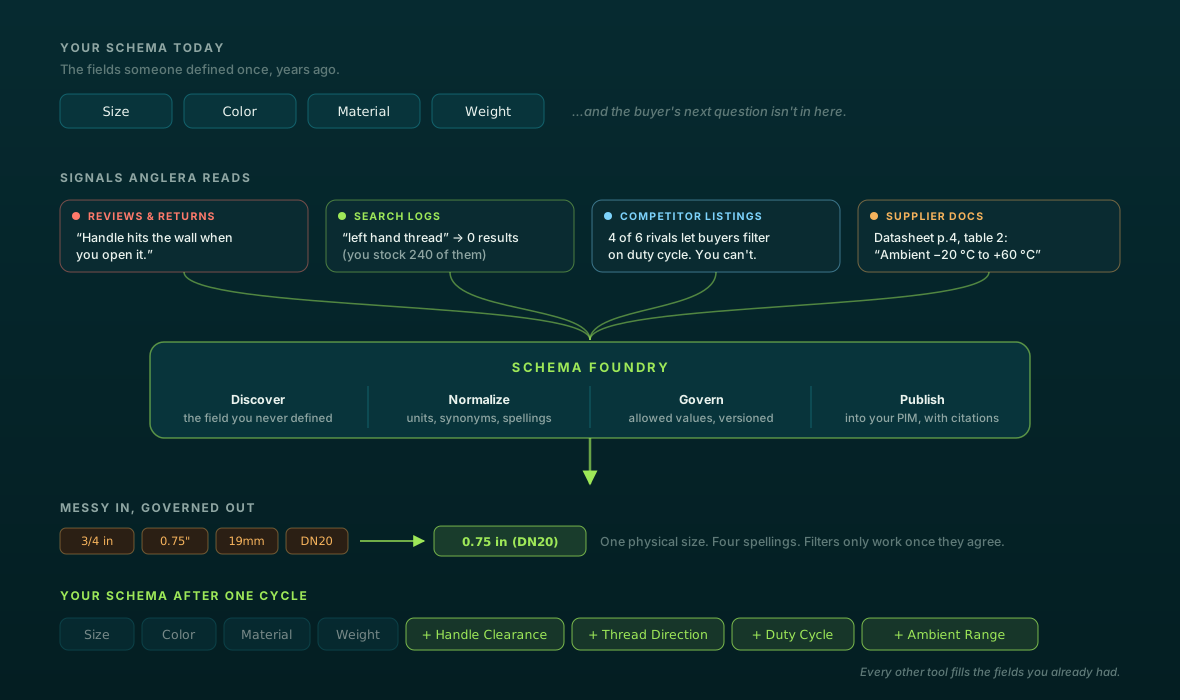
Filling the fields you defined has an invisible ceiling: a catalog can hit 100% complete and still miss the attribute that loses the sale, because completeness is measured against a schema someone drew years ago. Schema Foundry reads competitor listings, buyer searches, review complaints and your supplier docs, and proposes the fields you never defined — which is where Unilog CX1 / CIMM2 stops.

How Schema Foundry works
Schema Foundry: signals from reviews, search logs, competitor listings and supplier documents reveal attributes missing from your schema; the Foundry discovers, normalizes and governs them, so your schema ends the cycle with more fields than it started with.

What Unilog CX1 / CIMM2 does

Unilog is a B2B digital commerce vendor for mid-market distributors, manufacturers, and wholesalers. Its CX1 Platform (the successor branding to CIMM2) bundles an eCommerce storefront, a built-in PIM, a CMS/site builder, site search, and the CX1 Connect integration layer to ERP/POS systems. Alongside the software, Unilog runs a large product-content business: a managed library of 10M+ vendor SKUs from ~2,000 manufacturers, plus custom SKU enrichment, taxonomy, gap-fill, and normalization services sold as content subscriptions. It is especially common in electrical, industrial, plumbing, and HVAC distribution (50+ AD member companies).

Pricing: Subscription/SaaS, quote-based and not self-serve; sold as platform plus optional product-content subscriptions and managed enrichment services. Third-party listings cite entry pricing in the low hundreds of dollars per month, but real deployments are scoped by catalog size, modules, and content services. Implementation is a multi-month project.

Unilog CX1 / CIMM2 website

When Unilog CX1 / CIMM2 is the right call

Mid-market distributors in electrical, industrial, plumbing, or HVAC who want storefront, PIM, site search, and ERP integration from one vendor, plus managed vendor content across 2,000 manufacturers.

We'd rather tell you here than in month three of an implementation.

Capability verdicts reviewed against Unilog CX1 / CIMM2's public documentation on July 14, 2026. Vendors ship quickly — if something here is out of date, tell us and we'll correct it.

See it on your own SKUs.

Bring one category and your supplier files. In 30 minutes you'll see it enriched — complete, structured, and consistent enough to launch on — plus the attributes your schema didn't have yet.

Book a demo