Akeneo vs Unilog CX1 / CIMM2: Which Fits Your B2B Operation?
These two platforms solve adjacent but different problems. Akeneo is a best-of-breed PIM — it centralizes and organizes product content so you can push it to any downstream channel. Unilog CX1 is an all-in-one B2B commerce suite that bundles a PIM, a storefront, a CMS, and managed content services under one vendor. The right choice depends less on which is "better" and more on whether you need a dedicated system of record for product data or a single platform to cover your entire digital commerce operation.
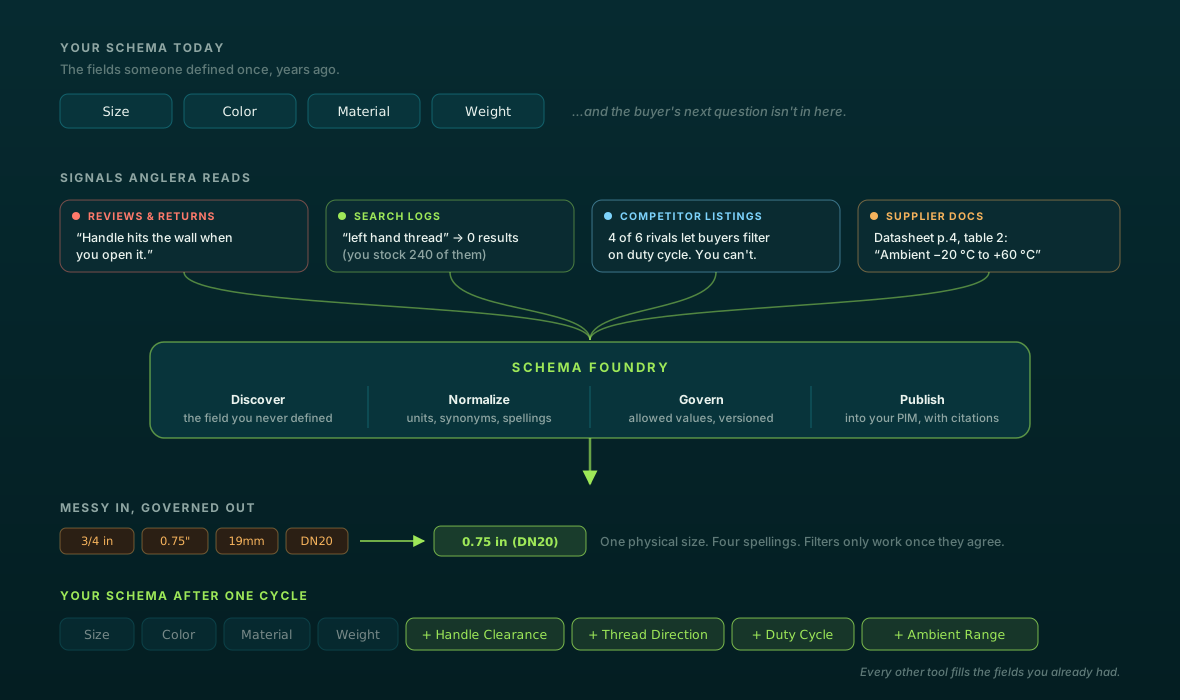
Both platforms assume your product data arrives clean, complete, and structured. In practice, it rarely does — especially in distribution verticals where content comes from hundreds of manufacturers in inconsistent formats, with missing attributes, non-standard units, and taxonomy mismatches. Neither Akeneo nor Unilog CX1 solves that problem automatically. That gap is where Anglera operates, regardless of which system you choose.
| Akeneo | Unilog CX1 / CIMM2 | Anglera | |
|---|---|---|---|
| Core purpose | Best-of-breed PIM. Centralizes product content, manages enrichment workflows, and distributes data to any downstream channel. No native storefront or order management. | All-in-one B2B commerce suite. Bundles a PIM, eCommerce storefront, CMS, site search, and ERP/POS integration (CX1 Connect) in one platform from a single vendor. | Not a PIM or commerce platform. Sits upstream of whichever you choose — automatically gathers, cleans, and enriches SKU data, then writes it back to Akeneo or CX1's PIM layer via API. |
| eCommerce / storefront | No native storefront. Integrates with Shopify, Salesforce Commerce Cloud, SAP Commerce, and others through its 250+ connector app store. You bring the commerce layer. | Native B2B storefront is the primary product: punchout, account-based pricing, ERP-connected catalog, and self-service buyer portal are all built in. | No storefront. Enriches the underlying product records so whichever storefront — Akeneo-connected or CX1 native — serves richer, more complete content to buyers. |
| Product content and enrichment | AI-assisted enrichment tools, completeness scoring, and a supplier onboarding module (Onboarder). Akeneo helps your team organize and complete content through structured workflows — you still need to source the content. | Managed library of 10M+ SKUs from roughly 2,000 manufacturers, plus paid content subscriptions for custom enrichment, taxonomy, gap-fill, and normalization. Coverage is strong where your catalog overlaps the library; gaps remain for proprietary or house-brand SKUs. | Automatically gathers attributes from manufacturer sites, supplier feeds, and spec sheets; normalizes them to your taxonomy; scores records against buyer signals; and pushes finished data back to your PIM. Works on your actual catalog, not a prebuilt library. |
| Target buyer and vertical | Mid-market to enterprise companies managing large, complex catalogs across multiple channels, brands, or locales — retail, consumer goods, and manufacturing are core verticals. Strong fit when you already have or plan to add a separate commerce platform. | Mid-market B2B distributors, manufacturers, and wholesalers, with particularly deep penetration in electrical, industrial, plumbing, and HVAC (50+ AD member companies). Purpose-built for distribution; less common outside that sector. | Any company on either platform whose product data arrives from suppliers in inconsistent or incomplete formats. Especially useful in distribution verticals where SKU counts are large and manual enrichment is not scalable. |
| Pricing model | Starts at roughly $45,000 per year (Growth package). Advanced and Premium tiers add collaboration workflows, analytics, asset management, SSO, and supplier data tools. Not self-serve; requires a sales conversation. | Quote-based SaaS. Third-party sources cite entry pricing in the low hundreds per month, but real deployments are scoped by catalog size, modules, and content subscriptions. Implementation is a multi-month project. | Separate SaaS subscription priced on catalog volume and enrichment scope. Runs alongside either platform; roughly 30-day implementation with no renegotiation of your existing PIM or commerce contract. |
| Integration ecosystem | 250+ connectors via the Akeneo app store. API-first and headless-friendly, with strong coverage for retail, e-commerce, and enterprise ERP/MDM systems. Broad ecosystem is a deliberate strength. | CX1 Connect handles ERP and POS integration for common systems in distribution verticals. The platform is more self-contained than Akeneo; fewer third-party app options outside the core suite. | Integrates with both. Reads from and writes to Akeneo's PIM or Unilog CX1's PIM layer via API. Does not require replacing or reconfiguring your existing integrations. |
| Implementation time and complexity | Enterprise-grade implementation; typically 3–6+ months depending on catalog complexity, workflow design, and integration scope. Usually requires internal resources or a certified system integrator. | Multi-month implementation scoped around storefront launch, ERP connection, and content migration. Unilog provides managed services to ease the transition, which is a meaningful differentiator for teams without deep technical resources. | Approximately 30 days, running in parallel with whichever platform is already in place or currently being deployed. No structural changes to your data model required. |
How to choose between Akeneo and Unilog CX1 / CIMM2
Choose Akeneo if you need a dedicated, best-of-breed PIM that will serve as the central product data record across multiple channels, systems, brands, or locales. It is the stronger choice for mid-market to enterprise companies that already have a commerce platform — or plan to add one — and want deep enrichment workflow control, team collaboration tooling, and a large integration ecosystem. Budget $45,000 per year and up, plus implementation costs and a system integrator if your team is not already fluent in PIM deployments.
Akeneo also fits well when product experience is a strategic differentiator — for example, if you are managing product content across dozens of locales, multiple brands, or a headless commerce architecture where the PIM needs to feed several downstream systems simultaneously.
Choose Unilog CX1 if you are a B2B distributor, manufacturer, or wholesaler — especially in electrical, industrial, plumbing, or HVAC — that wants a single vendor to cover your entire digital commerce stack. The native storefront, built-in PIM, ERP integration, and managed content library make it practical for mid-market companies that cannot afford to evaluate, integrate, and maintain best-of-breed tools separately. If your catalog overlaps significantly with Unilog's 10M+ managed SKUs from roughly 2,000 manufacturers, the content subscriptions can meaningfully reduce your initial data prep burden.
The decision usually comes down to one question: do you need a storefront? If yes, and you operate in a B2B distribution vertical, Unilog CX1 is the more pragmatic choice. If you already have a commerce platform — or you operate in a sector where Unilog's content library has limited coverage — Akeneo's flexibility and ecosystem depth are worth the higher baseline cost.
Whichever you pick, the data still has to get done
Both Akeneo and Unilog CX1 are built around the assumption that product data is already complete and well-structured when it enters the system. Neither platform automatically gathers attributes from manufacturer websites, normalizes inconsistent supplier content, or scores every SKU against what buyers actually search for. That work is still expected to happen — Akeneo provides team workflows to help you do it manually, and Unilog offers a managed content library that covers part of your catalog. Neither makes it automatic across your full SKU range.
That is the specific job Anglera does. Anglera connects to Akeneo's PIM layer or to Unilog CX1 via API. Once connected, it monitors your catalog, identifies attribute gaps, pulls enriched content from authoritative sources, normalizes it to your taxonomy, and writes the finished records back to your system of record — without your team doing it row by row. Whichever platform you choose at the end of this evaluation, the enrichment work still needs to happen before that data can drive conversion. Anglera makes it automatic, in about 30 days, without displacing the PIM or commerce platform you just selected.
Frequently asked questions
Is Akeneo a direct competitor to Unilog CX1?
Not exactly. Akeneo is a standalone PIM; Unilog CX1 is a full B2B commerce suite that includes a PIM as one component. If you only need product data management, the PIM modules overlap. If you need a storefront, ERP integration, and site search under one contract, Unilog CX1 covers far more ground than Akeneo alone.
Can I use Akeneo and Unilog CX1 together?
Technically possible — you could run Akeneo as the upstream PIM and feed enriched data into Unilog CX1's commerce layer — but most buyers choose one or the other. Since CX1 includes its own PIM, running Akeneo alongside it adds cost and integration complexity that is rarely justified.
Does Unilog's managed content library replace the need for product enrichment?
Partially. If your catalog overlaps with Unilog's 10M+ SKUs from roughly 2,000 manufacturers, the managed library reduces the work of populating baseline attributes. It does not cover proprietary SKUs, house-brand items, long-tail catalog additions, or content that falls outside that manufacturer set — which is where automated enrichment still adds significant value.
What does Anglera add if I already have Akeneo's AI enrichment tools?
Akeneo's AI tools assist your team in completing records faster through workflow-driven suggestions. Anglera works differently: it automatically gathers attributes from external sources — manufacturer websites, distributor feeds, spec sheets — normalizes them, and pushes finished records back to Akeneo without waiting for a team member to act. The two are complementary rather than redundant.
How long does it take to add Anglera to an existing Akeneo or Unilog CX1 deployment?
About 30 days. Anglera connects to your existing PIM via API, so there is no need to restructure your data model, pause an ongoing rollout, or run a separate implementation project in parallel.