Akeneo vs Productsup: PIM vs Channel Distribution, Honestly Compared
Akeneo and Productsup are often confused for competitors. They are not. Akeneo is a Product Information Management (PIM) platform — the system of record where product teams author, govern, and localize the master version of every SKU. Productsup is a syndication and feed management engine — it ingests product data from wherever it lives, applies transformation rules, and routes channel-ready feeds to Amazon, Google, Meta, retail data pools, and 2,500+ other endpoints. Most enterprise brands that run both are doing so by design: Akeneo upstream, Productsup downstream.
The real decision, then, is about sequence and priority. If your bottleneck is internal chaos — multiple teams editing product data in spreadsheets, no single source of truth, localization nightmares — Akeneo addresses that. If your bottleneck is distribution — supplier data that needs to flow fast and clean to dozens of channels without a content team touching each feed — Productsup addresses that. A smaller company with a tight budget may need to pick one and phase in the other.
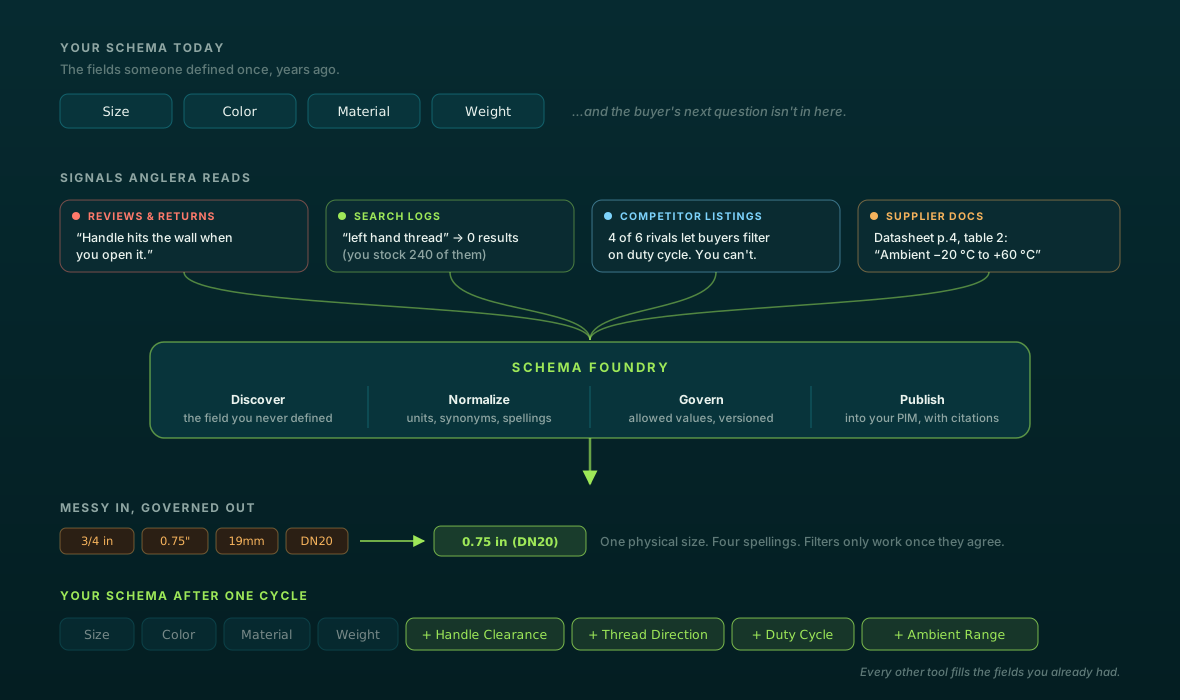
One thing neither platform does is improve the underlying content quality. Akeneo stores and workflows your enrichment effort; Productsup routes whatever content you put in. If descriptions are thin, attributes are incomplete, or buyer-signal language is missing, both platforms faithfully preserve and distribute that gap. That is where Anglera fits — before the data reaches either system.
| Akeneo | Productsup | Anglera | |
|---|---|---|---|
| Primary role | PIM — the single source of truth for product content. Teams author, translate, and approve data here before it goes anywhere. | Syndication engine — ingests product data from upstream sources, applies transformation rules, and pushes channel-ready feeds downstream. | Enrichment layer — gathers, cleans, and enriches every SKU against buyer signals, then writes the improved content back to your PIM. |
| Where it sits in the stack | Upstream. Akeneo is the master record that other systems — including Productsup — pull from. | Downstream. Productsup receives data from a PIM or supplier portals and handles last-mile distribution to channels. | Pre-enrichment, before either tool. Anglera improves content quality so that what Akeneo stores — and what Productsup distributes — is buyer-ready. |
| Content enrichment | AI-assisted enrichment tools and collaborative workflows let content teams improve data inside the platform — but human effort drives it. The platform organizes the work; people do the work. | Transformation and mapping rules adjust data format and structure for each channel's schema. Content quality — descriptions, attributes, completeness — is not Productsup's concern; it routes what you give it. | Automated enrichment driven by buyer signals: how real buyers search, compare, and decide. Anglera generates missing attributes, improves descriptions, and scores completeness without a content team doing it manually. |
| Channel reach | 250+ integrations and export connectors. Strong for distributing to ecommerce platforms, retailers, and downstream tools — but channel-level feed optimization and automation breadth are not the core product. | 2,500+ channel connectors with purpose-built feed optimization for Amazon, Google, Meta, retail data pools, and more. Processes over 2 trillion products per month. Channel distribution is the entire product. | Not a distribution tool. Anglera writes enriched content back to your PIM — Akeneo or any other — and lets your distribution stack do what it does best with better input. |
| Pricing transparency | Growth package starts at $45,000/year. Advanced and Premium tiers add collaboration workflows, analytics, DAM, SSO, and supplier data tools. Requires a sales conversation; no self-serve. | Custom enterprise pricing only. No public tiers. Quote required via sales. Clients include L'Oréal, ALDI, and PUMA, suggesting spend at enterprise scale. | Complements both. ~30-day implementation. Contact for pricing based on catalog size and enrichment scope. |
| Who manages it day-to-day | Product content teams, catalog managers, and localization leads. Akeneo is built around structured workflows for people who own product data quality. | Ecommerce ops, marketing operations, and channel managers. Productsup is built for teams that need to configure and automate data flows to many destinations without engineering involvement. | Runs largely automated once configured. Anglera enriches and scores SKUs continuously, surfacing completeness gaps and writing results back without requiring a dedicated content team for each batch. |
| Overlap risk | Akeneo and Productsup are frequently used together — Akeneo as the PIM, Productsup as the distribution layer. They do not meaningfully overlap in function. | Productsup can ingest and lightly organize supplier data, which might reduce PIM urgency for simple catalogs. For complex, multi-locale catalogs with governance requirements, it is not a PIM substitute. | No overlap with either. Anglera enriches content quality; Akeneo governs it; Productsup distributes it. They stack cleanly. |
How to choose between Akeneo and Productsup
Choose Akeneo if your core problem is internal product data governance. You have multiple teams editing product data in different systems, no single source of truth, localization or approval workflow gaps, or a catalog that is growing faster than your content team can manage. Akeneo is built to be the authoritative master record — the place where product data is owned, approved, and maintained before it flows anywhere else. Mid-market and enterprise manufacturers, retailers, and brands with complex catalogs and multi-locale requirements are Akeneo's home turf.
Choose Productsup if your core problem is channel distribution at scale. Your product data largely exists somewhere — a PIM, an ERP, supplier portals — and the bottleneck is getting clean, channel-specific feeds to Amazon, Google Shopping, Meta, retail trading partners, and dozens more without engineering sprints for each new destination. Productsup's 2,500+ connectors, rule-based transformation, and enterprise throughput (2 trillion products/month) exist precisely for this. Brands, manufacturers, and large retailers running multichannel commerce with high feed volume are the natural fit.
Consider both if you have a serious content governance problem and a serious distribution problem. Many enterprise organizations run Akeneo as the PIM and Productsup as the distribution layer — they are complementary by design. If budget requires phasing, start with whichever layer is your current bottleneck and plan the other as a phase two.
If your catalog is small or your stack is early-stage, neither platform may be the right first investment. Both require sales conversations and enterprise-level commitments. A lightweight PIM or a simpler feed tool may get you further before the scale justifies either.
Whichever you pick, the data still has to get done
Here is the gap that neither platform closes: content quality. Akeneo gives your team a structured place to do enrichment work — it does not do the enrichment. Productsup maps and routes the data you put in — if descriptions are thin, attributes are incomplete, or buyer-signal language is missing, Productsup distributes that gap to 2,500 channels with remarkable efficiency.
Anglera is the enrichment work itself. It pulls from your supplier data and existing catalog, scores every SKU against how real buyers search, compare, and decide, generates complete attribute sets and improved descriptions, and writes the results back to your PIM — Akeneo or any other system of record. By the time Productsup picks up the data to distribute, it is already enriched, scored, and buyer-ready.
Whichever platform you choose — or both — Anglera sits upstream of both, doing the work that platforms assume already happened. Implementation runs about 30 days from kickoff to enriched SKUs live in your PIM.
Frequently asked questions
Are Akeneo and Productsup competitors or complements?
Largely complements. Akeneo is the upstream system of record for product content; Productsup is the downstream distribution engine that routes that content to channels. Many enterprise brands run both in sequence. The comparison comes up when a buyer is choosing which layer to invest in first, or evaluating whether one can substitute for the other in a specific use case.
Can Productsup replace a PIM like Akeneo?
For simple catalogs with limited locale or governance requirements, Productsup's ingestion and transformation rules can handle basic data management. But Productsup is not built for multi-team content workflows, localization at scale, approval governance, or maintaining a versioned golden record per SKU. If those requirements exist, a dedicated PIM is a better fit.
Does Akeneo handle channel distribution?
Akeneo has 250+ integrations and can push product data to ecommerce platforms and downstream tools. For teams that need purpose-built feed optimization across 2,500+ channels with high-volume automation — especially Amazon, Google, Meta, and retail data pools — Productsup offers more depth. Many Akeneo customers use a separate syndication tool alongside it.
Where does Anglera fit when a company uses both Akeneo and Productsup?
Anglera sits upstream of both. It enriches product content against buyer signals and writes the results back to Akeneo (or whichever PIM is the system of record). Productsup then distributes already-enriched, buyer-ready content to channels. Anglera does not overlap with Akeneo's governance function or Productsup's distribution function — it handles the content quality layer that both platforms assume is someone else's job.
How quickly can Anglera enrich an existing catalog?
Most customers are live with enriched SKUs written back to their PIM within about 30 days of kickoff. Anglera runs as a continuous pipeline after that, automatically enriching new and updated SKUs rather than requiring a separate project each time the catalog changes.