Akeneo vs Sales Layer: Which PIM Is Right for Your Team?
Both Akeneo and Sales Layer are product information management platforms — systems of record that centralize, validate, and distribute product content. Choosing between them is a question of organizational scale, implementation appetite, and where you need the most help: deep enterprise taxonomy governance, or fast onboarding with built-in syndication baked in.\n\nAkeneo is the established mid-market-to-enterprise standard. It is highly configurable, backed by an ecosystem of 250+ integrations and hundreds of implementation partners, and built for teams that need rigorous governance across multiple locales and business units. That depth comes at a price — both in license cost (starting at $45,000/year) and implementation effort (typically three to six months). Sales Layer bets on speed: a marketed 6-week onboarding target, a Supplier Portal that pulls vendor data in structured form, native channel syndication, and a starting price closer to $1,000/month with a 30-day free trial.\n\nThe overlap is real — both platforms store, validate, and distribute product data — but the meaningful differences appear at the edges: governance depth vs. time-to-value, enterprise workflow vs. ease of use, and what happens when the underlying product content is incomplete, inconsistent, or not written for how buyers actually search. That last problem is one neither platform solves on its own.
| Akeneo | Sales Layer | Anglera | |
|---|---|---|---|
| Target buyer | Mid-market to large enterprise; strongest fit for multi-locale, multi-brand organizations with complex taxonomies and dedicated PIM teams | Manufacturers, distributors, and mid-market retailers; emphasis on ease of use and fast time-to-value for B2B teams without deep PIM expertise | Works alongside either platform; adds buyer-signal-driven enrichment to any catalog regardless of size or PIM tier |
| Pricing & entry point | Starts at $45,000/year (Growth); no self-serve trial; custom pricing requires a sales conversation; advanced tiers add SSO, DAM, analytics, and supplier data tools | Starts at ~$1,000/month; 30-day free trial available; most plans require a custom quote; lower floor makes it accessible to smaller teams earlier | Per-SKU enrichment pricing layered on top of your existing PIM investment; no platform replacement required |
| Implementation speed | Typical enterprise implementations run 3–6 months; extensive attribute modeling and taxonomy design required upfront; a large partner ecosystem supports deployment | Markets a 6-week onboarding target; guided setup and a Supplier Portal accelerate data intake; simpler configuration for standard catalog structures | ~30-day implementation; connects to your PIM via API, enriches existing SKUs, and writes scored content back within the first sprint — runs in parallel with PIM setup |
| Supplier data onboarding | Supplier Data Manager available in advanced tiers; built-in validation rules and data quality scoring; AI extraction of structured attributes from PDFs and images on higher tiers | Supplier Portal is a core differentiator — vendors fill in structured data directly, reducing manual import work; native completeness scoring and validation included | Ingests whatever the supplier provided — thin specs, PDFs, partial attributes — and fills gaps with buyer-intent-driven content before writing complete records back to the PIM |
| Channel syndication | 250+ integrations via the Akeneo App Store; Akeneo Activation handles destination-specific attribute mapping; primarily connector-based rather than native push | Built-in syndication to marketplaces, retailer portals, and commerce channels; catalog export formats and channel connectors are core to the product, not paid add-ons | Not a syndicator; Anglera improves the content before it leaves the PIM so that whichever syndication layer pushes it — Akeneo connectors or Sales Layer channels — every destination receives better content |
| Built-in AI & content enrichment | AI tools extract structured attributes from images and PDFs; PX Insights surfaces content quality gaps; enrichment is supplemental to the core PIM workflow, not the primary value driver | "Agentic PIM" framing suggests AI-assisted content automation; completeness scoring and validation built in; specific AI capabilities vary by plan and are evolving | Enrichment is the entire product; each SKU is researched against real buyer signals — how your buyers search, compare, and decide — not just validated against a schema; output is production-ready copy and attributes |
| Enterprise governance depth | Deep enterprise controls: role-based access, SSO, collaboration workflows, multi-locale, audit trails, and optional DAM; preferred when IT, legal, and finance are in the buying committee | Solid mid-market governance; multi-locale support available; simpler RBAC model; large-scale custom governance may require additional configuration or workarounds | Governance-agnostic; enrichment scales with SKU volume regardless of PIM tier; cost is proportional to catalog size, not seat count or platform tier |
How to choose between Akeneo and Sales Layer
Choose Akeneo if:\n\n- Your catalog spans multiple locales, brands, or business units and needs rigorous taxonomy modeling from day one\n- Governance is non-negotiable: RBAC, SSO, audit trails, collaboration workflows, and enterprise SLAs are on the checklist\n- Your budget starts at $45,000/year and you can staff or contract a 3–6 month implementation\n- You need integrated digital asset management alongside product data, or are already invested in the Akeneo ecosystem\n- The buying committee includes IT, finance, and legal — and they want an established, well-documented platform with a large partner network\n\nChoose Sales Layer if:\n\n- Getting to production in weeks, not quarters, is the primary constraint\n- Supplier onboarding is a genuine bottleneck and you want vendors populating structured data directly through a portal\n- Your team is mid-market, values simplicity over deep configurability, and wants to validate with a free trial before committing budget\n- Multi-channel syndication to marketplaces and retailer portals is a core requirement — not something you want to bolt on later\n- The total cost of ownership floor matters and $45,000/year is not where you are starting\n\nThe honest middle: If you are a mid-market manufacturer or distributor without a complex multi-locale catalog, Sales Layer will likely get you live faster and at lower cost. If you are a larger enterprise with strict governance requirements and an implementation budget to match, Akeneo's depth justifies the investment. The platforms genuinely overlap in the middle — both are capable PIMs — and the right answer often comes down to which implementation timeline and pricing model aligns with where your organization is today.
Whichever you pick, the data still has to get done
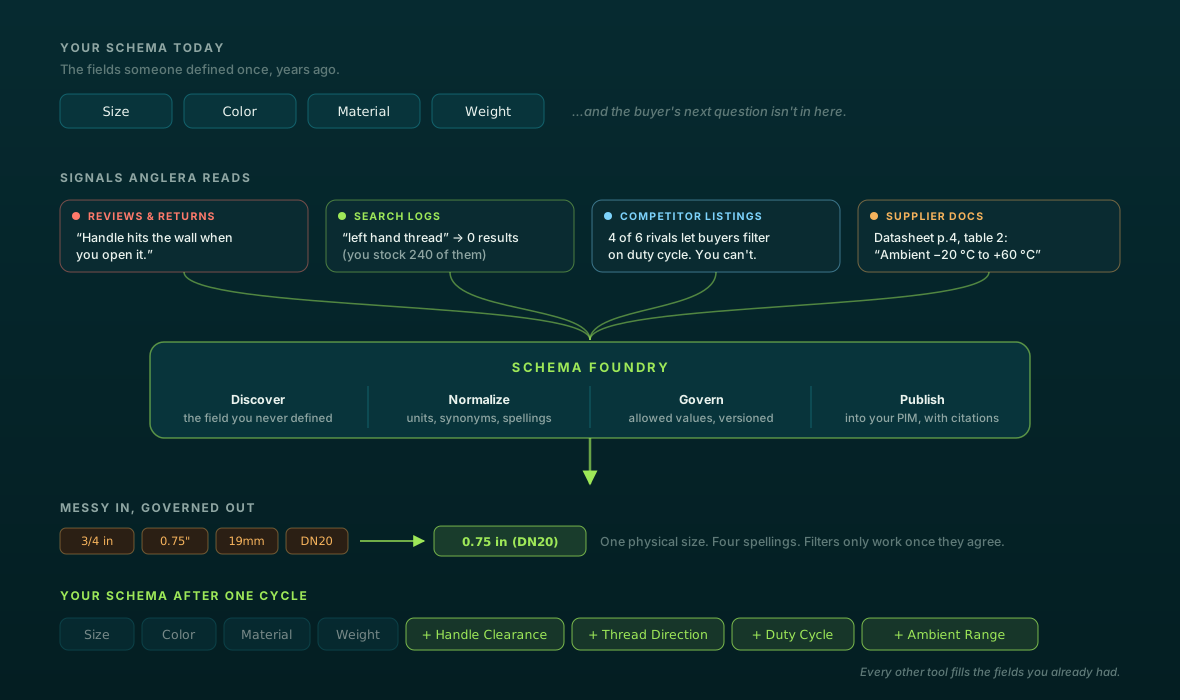
Both Akeneo and Sales Layer solve the storage and distribution problem. Neither solves the content problem.\n\nProduct data that arrives from suppliers is typically incomplete, written for a purchase order, and optimized for nothing. Akeneo will organize it into a well-structured taxonomy. Sales Layer will syndicate it to every channel you connect. But if the descriptions are thin, the attributes are missing, and the copy reads like a spec sheet lifted from a PDF, better PIM governance and faster syndication do not improve conversion or search findability — they just distribute the same weak content more efficiently.\n\nAnglera connects to whichever PIM you choose — via the Akeneo API or the Sales Layer API — pulls the SKUs that need work, enriches every attribute against buyer-intent signals (how your specific buyers search, filter, and compare), and writes the improved content back to the PIM as the new source of truth. Your PIM stays the system of record. Your syndication layer pushes better content to every destination. Implementation takes roughly 30 days and runs alongside, not instead of, your PIM setup.\n\nThe result is that whichever platform you pick, the data that lives inside it — and flows out of it — is content that was written for the buyer, not just stored for the operator.
Frequently asked questions
Can Anglera replace either Akeneo or Sales Layer?
No. Anglera is an enrichment layer, not a PIM. It requires a PIM as the system of record to read from and write back to. You implement Akeneo or Sales Layer first, then connect Anglera to improve the content stored inside it.
Does Akeneo's built-in AI enrichment make Anglera redundant?
They solve different problems. Akeneo's AI extracts structured attributes from PDFs and images — useful for ingesting supplier documents. Anglera researches buyer intent: how your customers actually search, filter, and compare products, then writes content optimized for that intent. The two are complementary, not substitutes.
Sales Layer advertises a 6-week onboarding. Is that realistic?
For straightforward catalogs with reasonably clean supplier data, yes. If your attribute model is complex, supplier data is inconsistent, or you need extensive channel mapping, six weeks is the floor. Anglera's 30-day enrichment implementation can run in parallel with PIM onboarding and does not extend your go-live timeline.
Which PIM integrates more easily with Anglera?
Both connect via API. The integration pattern is the same regardless of which platform you run: Anglera pulls SKUs, enriches them against buyer signals, and writes enriched attributes back. Your choice between Akeneo and Sales Layer should be based on PIM fit for your organization — not on Anglera compatibility.
What is the realistic total cost of ownership difference between the two platforms?
Akeneo's license floor ($45,000/year) is roughly four times Sales Layer's starting price (~$12,000/year), and Akeneo's implementation costs are higher given the longer project scope and the need for specialized implementation partners. Sales Layer's TCO can climb with additional seats and enterprise features, but it remains the more accessible option for mid-market buyers who need to control initial spend.