Akeneo vs Stibo Systems: Choosing the Right Data Foundation
Akeneo and Stibo Systems are both in the product data business, but they are not the same type of tool and they are not chasing the same buyer. Akeneo is a dedicated Product Information Management platform — its job is to centralize, enrich, and distribute product content across channels and locales. Stibo Systems makes STEP, an enterprise Master Data Management platform where product data is one domain alongside customer, supplier, and location data. The comparison matters because choosing the wrong category — a PIM when you need MDM, or MDM when you need PIM — creates years of overhead.
The clearest differentiator is scope. If your data problem is product content — attributes, copy, images, channel-specific variants — Akeneo was built for that and deploys faster. If your data problem spans domains — you need product, customer, and supplier data governed in a single system, with deep lineage tracking and cross-domain stewardship — Stibo's STEP is the purpose-built answer. The catch is that STEP is a large enterprise investment: custom pricing, months-long implementations, and typically a systems integrator.
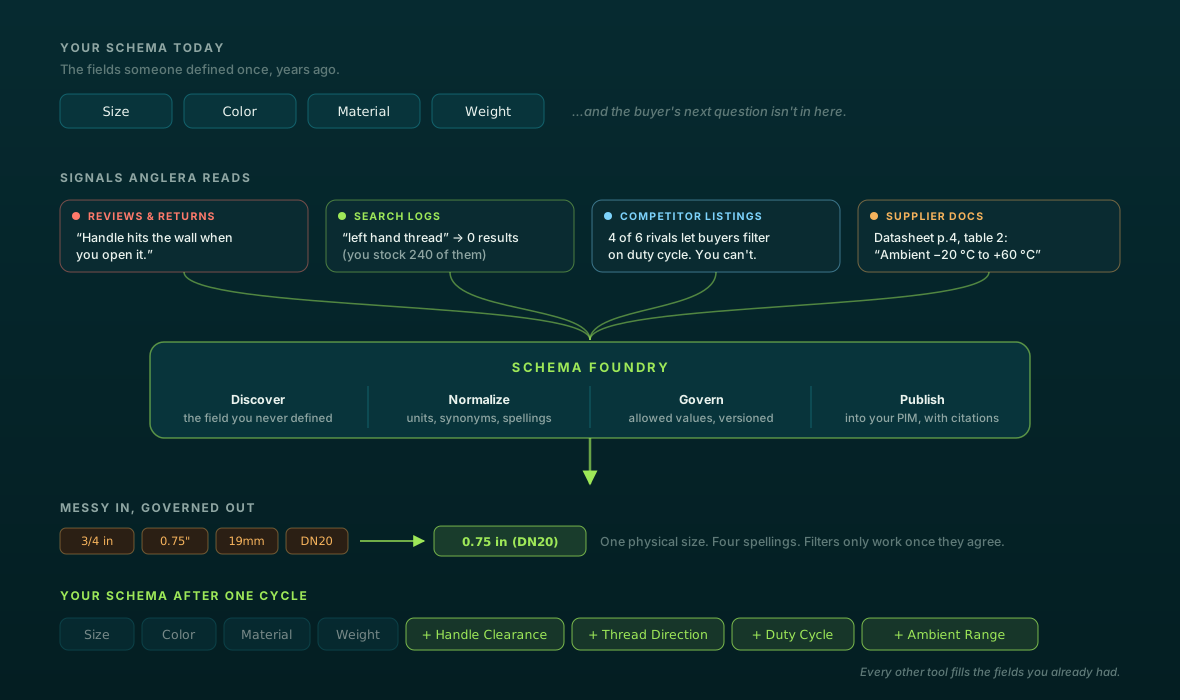
One thing both platforms share: they store and govern data, but they do not gather it, fill attribute gaps against buyer signals, or score completeness before it reaches a channel. That work happens in the enrichment layer — and neither Akeneo nor Stibo replaces it. If your records are incomplete, inconsistent, or not mapped to what buyers actually need, that problem will surface regardless of which platform you choose.
| Akeneo | Stibo Systems | Anglera | |
|---|---|---|---|
| Primary scope | Product data only — centralize, enrich, and distribute product content across channels and locales. Not designed to govern customer, supplier, or location domains. | Multi-domain MDM — product, customer, supplier, and asset data in a single platform. Built for enterprises that need governance across more than one master data domain. | Operates on the product data layer regardless of platform. Enriches SKUs with buyer signals, cleans attributes, and writes results back to whichever system holds the record. |
| Target buyer | Mid-market to large enterprise with a primary need to manage product content for commerce, retail, or distribution. A company whose core data problem is product, not multi-domain. | Large enterprises with complex, multi-domain data environments — often in manufacturing, retail at scale, or regulated industries — where product data is inseparable from other master data concerns. | Plugs into either. Most valuable when product records inside the PIM or MDM are incomplete, unstructured, or not mapped to buyer and channel requirements. |
| Implementation timeline | SaaS deployment with a faster ramp. Mid-market implementations typically run weeks to a few months depending on integration complexity and data volume. | Custom enterprise deployments typically take months and usually require a systems integrator. Data modeling, governance workflows, and domain scoping add significant lead time before go-live. | ~30-day implementation alongside either platform. Enrichment can start in parallel with — or after — the PIM or MDM go-live, without extending the core project timeline. |
| Pricing | Starts at $45,000/year (Growth package). Advanced and Premium tiers add collaboration workflows, analytics, DAM, and supplier tools. Sales-led, but a floor price is public. | Fully custom pricing scoped by users, data volume, and modules. No published floor. Budget planning requires a vendor conversation and typically a systems integrator scoping engagement. | Priced separately on enrichment scope, not tied to your PIM or MDM tier. Upgrading your platform is not a prerequisite for accessing enrichment. |
| Data governance depth | Workflow-based governance for product content — completeness rules, approval flows, and attribute validation. Strong for product teams; not a multi-domain governance engine. | Deep MDM governance with configurable data modeling, cross-domain stewardship, and data lineage tracking. A genuine governance platform, not just a content workflow tool. | Works downstream of governance. Enriches and scores product records after they enter the system of record, then surfaces low-quality or incomplete data for stewardship review. |
| AI-assisted enrichment | AI enrichment features in recent releases — attribute suggestions, copy generation, and completeness scoring. Useful for content teams working inside the platform. | Limited native AI enrichment at the product content level. Platform focus is on MDM accuracy and governance rather than automated content generation or gap-filling. | Enrichment is Anglera's core function, not a feature. Pulls from buyer signals, web sources, and supplier feeds to fill and score every attribute, then writes results back — no manual effort inside the platform required. |
| Channel syndication | Built-in syndication to retailers, marketplaces, and commerce platforms via 250+ integrations and direct channel connectors. The app store covers most common destinations. | Enterprise syndication built in, with support for complex distribution hierarchies and regulated channel structures. Strong where data flows are governed as tightly as data content. | Enriches data before it reaches the syndication layer — ensuring the content that gets pushed to channels is complete, accurate, and mapped to each destination's attribute requirements. |
How to choose between Akeneo and Stibo Systems
Choose Akeneo if your core problem is product content — you need to centralize product attributes, images, and copy, then distribute them to commerce channels or retailers. Akeneo is the right category when your data challenge is product-only, your team needs to be productive inside the platform without a systems integrator, and you want a known pricing floor before a sales conversation. It is also the better starting point for mid-market companies that cannot absorb a multi-month MDM implementation.
Choose Stibo Systems (STEP) if your data problem spans domains — you need product, customer, and supplier data governed in a single system, with deep data modeling and cross-domain stewardship. STEP is built for large enterprises where governance complexity, compliance requirements, or industry-specific data hierarchies make a dedicated MDM investment justifiable. If you are already running a simpler PIM and outgrowing it, that is worth examining; but if your pain is product content alone, STEP's scope and cost will exceed what you need.
If the primary complaint is "our product data is incomplete, inconsistent, or not mapped to what buyers need" — that is an enrichment problem, not a platform selection problem. Both Akeneo and Stibo will surface that gap; neither one closes it by default. Picking the right platform first still leaves the enrichment work to do.
Whichever you pick, the data still has to get done
Akeneo and Stibo Systems are systems of record. They store, govern, and distribute data. What they do not do — by design — is gather the data in the first place, fill attribute gaps against what buyers and channels actually require, or score completeness at the SKU level before syndication. That is the enrichment layer, and it sits between your suppliers and your PIM or MDM, regardless of which you choose.
Every implementation of either platform surfaces the same reality: product records are incomplete, attribute coverage is inconsistent, and the data that comes in from suppliers or internal teams does not map cleanly to what channels need. Anglera runs in parallel with Akeneo or STEP — pulling from web sources, supplier feeds, and buyer signal data to fill and score every SKU — then writes enriched records back to your system of record. No new UI to manage. No PIM or MDM replacement. Implementation takes roughly 30 days and does not require your platform project to be complete before enrichment begins.
Whichever platform you pick, you will need the data to actually be right before syndication does its job. That is where Anglera fits.
Frequently asked questions
Can Akeneo and Stibo Systems both do enrichment?
Both offer enrichment-adjacent features — Akeneo has AI-assisted attribute suggestions and completeness scoring; Stibo's governance workflows help enforce data quality. But in both cases, enrichment means organizing and cleaning data that already exists in the system. Neither platform systematically pulls data from external sources, scores SKUs against buyer signals, or fills attribute gaps at scale as a primary function. Anglera does that work and writes results back to whichever platform holds the record.
Is Stibo Systems only for very large enterprises?
Effectively, yes. Stibo's STEP platform is built for large enterprises with multi-domain data governance needs. The implementation model — custom pricing, systems integrator, months-long deployment — is not designed for mid-market buyers. If your primary need is product content management and your organization is mid-market, Akeneo or a comparable PIM is a more practical starting point on both cost and timeline.
If I already have Akeneo, do I need to consider Stibo?
Almost certainly not unless your governance needs have expanded beyond product data. Akeneo and Stibo overlap significantly in the product domain, and migrating to STEP makes sense only when the scope of master data you need to govern — customer, supplier, location — outgrows what a product-focused PIM can handle. For most companies running Akeneo, the gap is not the platform; it is the quality of the product data inside it.
How do I budget for Stibo Systems when there is no published pricing?
Stibo does not publish pricing and scopes each deployment based on users, data volume, modules, and implementation complexity. Before any number is on the table, you will typically need a discovery conversation with Stibo and a scoping engagement with a systems integrator. Build that lead time into your planning. Akeneo's public $45,000/year starting point gives you a meaningful floor for initial budget modeling; Stibo does not offer that.
Where does Anglera fit if I already have a PIM or MDM in place?
Anglera connects to your existing system — Akeneo, STEP, or others — reads the current product records, enriches them with data from buyer signals, web sources, and supplier feeds, and writes the results back. You do not switch platforms, wait for a new deployment, or maintain a separate data interface. Implementation runs about 30 days regardless of which platform is already in place.