Akeneo vs Syndigo: Which Platform Fits Your Product Data Strategy?
Akeneo and Syndigo solve adjacent but distinct problems. Akeneo is a PIM — the system of record where product teams centralize, organize, and govern content before it goes anywhere. Syndigo is a product experience cloud that bundles PIM, DAM, MDM, and a native content syndication network into one platform, with direct connections to 2,500+ retail and GDSN recipients. The decision between them usually comes down to a single question: is your primary challenge organizing internal product data, or pushing it to retail partners at scale?
That distinction matters more than it sounds. An Akeneo customer typically manages product data as a flexible, integration-rich hub — distributing through third-party connectors across their channels. A Syndigo customer is usually a brand or manufacturer for whom retailer compliance and network reach are the core use case, and who wants fewer integration decisions to make. Both serve the overlapping middle ground of companies that need both a governed PIM and distribution at scale — which is partly why the two platforms often appear on the same shortlist.
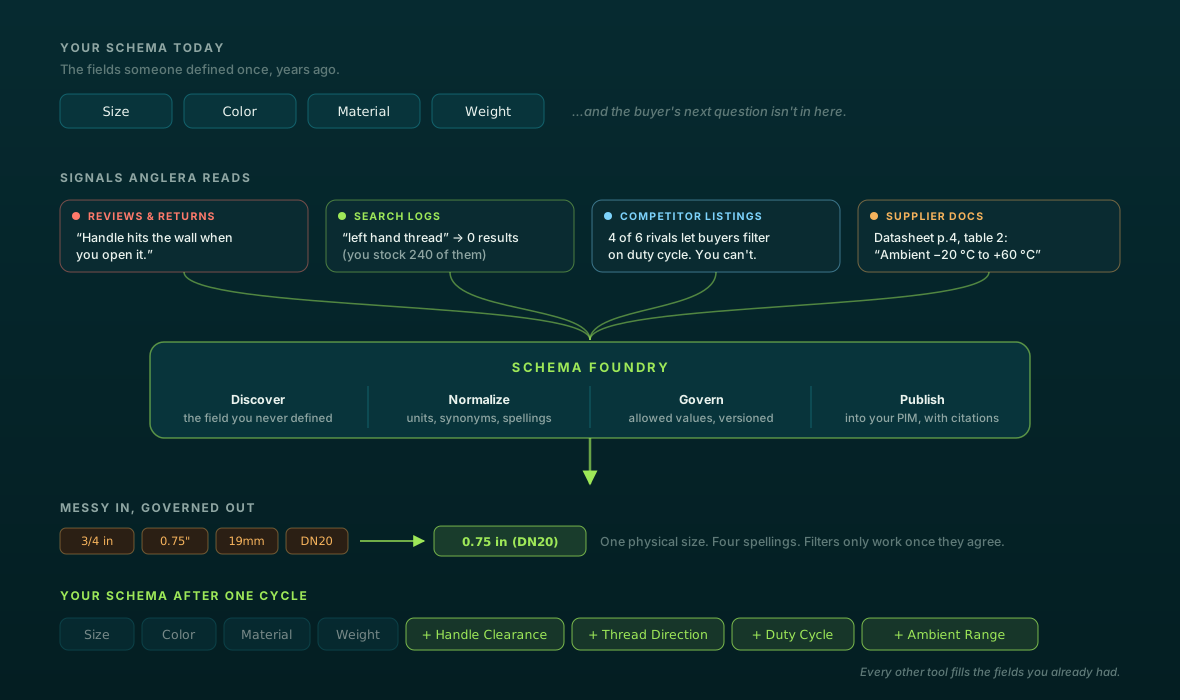
What neither platform solves on its own — and what buyers often discover after go-live — is that the underlying product content needs work before either platform delivers its full value. Thin descriptions, missing attributes, and supplier copy that does not match how buyers search are baked into most catalogs. That is where Anglera fits: not as a replacement for either tool, but as the enrichment layer that makes the data in whichever system you choose buyer-ready before it goes anywhere.
| Akeneo | Syndigo | Anglera | |
|---|---|---|---|
| Core function | PIM — the system of record for product content; centralizes, governs, and distributes data across channels via integrations | Product Experience Cloud (PXM) — combines PIM, DAM, MDM, and a native retail syndication network in one platform | Enrichment layer — gathers, cleans, enriches, and scores every SKU against buyer signals, then writes improved content back to whichever system stores it |
| Best fit | Mid-market and enterprise companies needing a flexible, integration-rich PIM as their hub; strong for omnichannel retailers, multi-locale distributors, and brands managing complex data models | Brands and manufacturers whose primary need is pushing validated, compliant content to hundreds of retail and GDSN trading partners; especially suited for CPG and retail supply chains | Any organization whose catalog has incomplete attributes, thin descriptions, or content that was written for suppliers rather than buyers — regardless of which platform stores and distributes it |
| Syndication network | 250+ app-store integrations for channel distribution; relies on third-party connectors for retailer syndication — not a native content network | One of the largest product content networks globally: 2,500+ retail and GDSN recipients, 23,000 unique retailer requirements, 10,000 data validations out of the box | Not a syndication layer; operates upstream so the content flowing through Syndigo's network or Akeneo's integrations is buyer-ready before it leaves your system |
| Content enrichment | AI-assisted enrichment tools and collaboration workflows help internal teams improve data; enrichment quality depends on team effort and supplier input | Validates and formats content for retailer compliance requirements; some analytics on content performance across the network; enrichment is largely compliance-driven, not buyer-signal-driven | Automated enrichment driven by how buyers actually search, compare, and decide — filling attribute gaps and improving descriptions at catalog scale, not one field at a time |
| Pricing / TCO | Starts at $45,000/year (Growth package); Advanced and Premium tiers add analytics, asset management, SSO, and supplier tools; no self-serve pricing — requires a sales conversation | Custom-quoted subscription; no public tiers; third-party estimates place TCO $10,000–$30,000 higher per year than smaller PIM alternatives for mid-market buyers | Separate subscription layered on your existing PIM investment; no migration cost, no rip-and-replace; ~30-day implementation |
| Implementation timeline | Typically 3–6 months for enterprise deployments; requires data model design, integration setup, and team onboarding; strong partner ecosystem for implementation support | Higher complexity due to platform breadth (PIM + DAM + MDM + syndication); retailer requirement mapping and network onboarding add time beyond a standalone PIM rollout | ~30 days; reads from and writes back to the existing PIM with no parallel system to maintain; SKUs start enriching against buyer signals within weeks of kickoff |
| Data governance / MDM | PIM-level governance: product data model, workflow approvals, completeness scoring, role-based access; no MDM capability for enterprise master data management | Includes MDM for master data governance across business units and brands; stronger for enterprises managing data across multiple internal systems or acquired brands | Complements governance by ensuring the underlying attribute content is complete and buyer-ready before governance rules and syndication workflows run |
How to choose between Akeneo and Syndigo
Choose Akeneo if:
- You need a flexible, channel-agnostic PIM as your system of record, with strong collaboration workflows and an open integration ecosystem you control
- Your team manages product data across multiple brands, locales, or business units and needs fine-grained governance without locking into a proprietary distribution network
- You plan to syndicate through a mix of channels — your own storefront, marketplaces, retail partners — using third-party connectors rather than one managed network
- You have a budget of $45,000/year and up, and want a named PIM vendor with a deep implementation partner ecosystem
Choose Syndigo if:
- You are a brand or manufacturer whose primary need is pushing validated, compliant content to hundreds of retail and GDSN trading partners, and network breadth is the core use case
- Your retail partners already require Syndigo or 1WorldSync, or your category operates in a sector (CPG, grocery, mass retail) where the network is effectively standard
- You want MDM capabilities alongside content management and prefer fewer vendor relationships over maximum flexibility
- You need 23,000+ retailer-specific validation rules handled automatically rather than managing retailer requirements manually or through connectors
The middle ground: A meaningful number of companies use Akeneo as their internal PIM for governance and workflow, then publish to the Syndigo/1WorldSync network for retail distribution. If you have both a complex internal data model and a large retail trading partner set, that two-platform approach is worth evaluating — but it also means two implementations and two contracts to manage.
Whichever you pick, the data still has to get done
Both Akeneo and Syndigo assume you arrive with good product content. Akeneo's AI enrichment features and collaboration workflows help product teams improve data from within the platform — but the quality of the output still depends on what someone puts in, whether that is an internal editor or a supplier data feed. Syndigo validates content against 10,000 retailer requirements, but validation is not enrichment: a thin description that passes compliance still will not convert a buyer who is comparing five similar SKUs.
Anglera is the upstream enrichment layer that runs before content reaches either platform. It reads your existing product data — from your PIM, your supplier feeds, or both — enriches every SKU against buyer signals (the attributes, language, and completeness that drive real-world search and purchase decisions), then writes the improved content back to your system of record. In approximately 30 days, your catalog is ready to run through Akeneo's governance workflows or Syndigo's retail network with content that was built for buyers, not just formatted for compliance.
Whichever platform you choose, the data still has to be good before the platform can do its job. Anglera handles that part.
Frequently asked questions
Does Syndigo replace Akeneo, or do companies use both?
Some companies use both — Akeneo as the internal PIM for governance and workflow, and Syndigo (or its 1WorldSync network) for retail syndication. Others use Syndigo's PIM module in place of a standalone PIM. Which approach makes sense depends on whether your team needs Akeneo's flexibility and open integrations more than it needs Syndigo's managed retail network — or vice versa.
Akeneo says it has AI enrichment built in — why would I still need Anglera?
Akeneo's AI features help teams generate or improve content inside the PIM workflow, usually one product or attribute at a time with human review. Anglera is different: it enriches every SKU across a full catalog against external buyer signals — how customers actually search, compare, and decide in the real world — not just what the supplier provided. The two are complementary. Anglera raises the content quality floor across the catalog; Akeneo's tools help teams refine and govern it.
Is Syndigo only for CPG and grocery?
Syndigo has strong roots in CPG and grocery through its 1WorldSync acquisition, but the platform serves broader retail and manufacturing verticals. Buyers outside those sectors should verify that Syndigo's retail network includes their specific trading partners — network coverage is deep in grocery and mass retail but varies elsewhere.
Can Anglera connect to both Akeneo and Syndigo?
Yes. Anglera reads from and writes back to your existing system of record — including Akeneo PIM and Syndigo's platform. It does not replace either system; it enriches the product data that lives in them so what your team governs and what your network distributes is buyer-ready content.
What does a ~30-day Anglera implementation involve?
Anglera connects to your existing PIM, maps your attribute model, and begins enriching SKUs against buyer signals — all without a migration or a parallel system to maintain. Most customers are enriching production data within 30 days of kickoff. The enriched content writes back directly to Akeneo or Syndigo, so your existing governance and syndication workflows carry on unchanged.