Channable vs inriver: Feed Management vs PIM — Which Belongs in Your Stack?
These two tools solve adjacent but distinct problems. Channable is a feed management and syndication hub: it takes the catalog data you already have and distributes it to 2,500+ marketplaces and ad channels using rule-based automation. inriver is a PIM: it is where you build, govern, and store that catalog data in the first place, then push it downstream through built-in syndication. Choosing between them often surfaces the real question — do you have a distribution problem, or a data-quality problem?
For many buyers the honest answer is that they eventually need both, in sequence: a PIM to manage authoritative product content and a feed tool to distribute it. The nuance is whether inriver's built-in syndication makes a standalone tool like Channable redundant — and at what catalog complexity and channel volume that trade-off tips one way or the other.
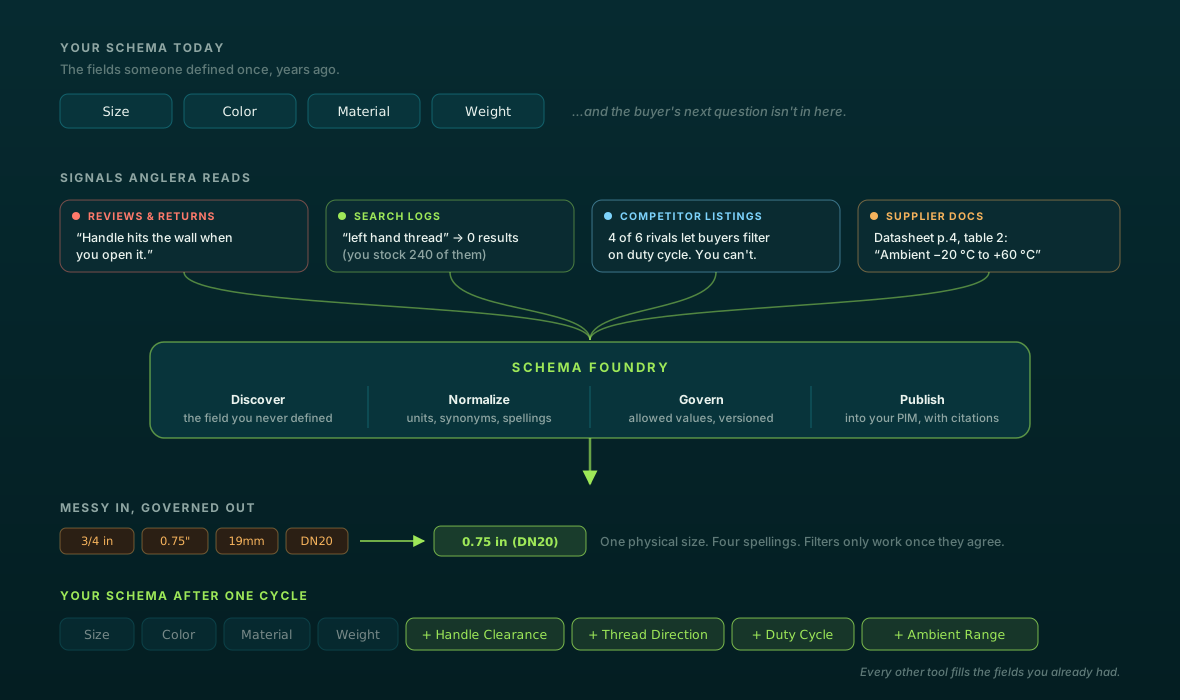
Neither platform, however, does the upstream enrichment work: crawling supplier sheets, filling missing attributes, cleaning inconsistent values, and scoring every SKU against what buyers actually search for. That gap is where Anglera sits, regardless of which platform you land on.
| Channable | inriver | Anglera | |
|---|---|---|---|
| Primary function | Feed transformation, rule-based automation, and real-time syndication to 2,500+ channels — marketplaces, shopping ads, and comparison engines. | Single source of truth for product content: consolidate, govern, enrich, and distribute from one PIM with built-in syndication and digital shelf analytics. | Neither stores nor distributes data. Anglera enriches what lives in your PIM or feed source — completing attributes, cleaning values, scoring SKUs — before distribution runs. |
| Data governance and enrichment | Rule-based field mapping and transformation. No structured PIM, taxonomy management, supplier onboarding, or enrichment workflow. Data quality depends entirely on what comes in. | Full PIM governance: data modeling, taxonomy, approval workflows, AI-assisted enrichment, and completeness scoring within the platform. | Adds a buyer-signal enrichment layer upstream of both platforms — pulling live market signals to complete and score attributes before they enter governance or feed rules. |
| Syndication breadth | 2,500+ channel integrations built specifically for high-volume feed distribution, including long-tail marketplaces and ad networks most PIMs do not reach natively. | Built-in syndication covers major omnichannel destinations. Channel coverage is narrower than a dedicated syndicator; buyers with extreme channel breadth sometimes supplement with a feed tool. | Channel-agnostic. Enriched data is written back to your source catalog so every downstream channel — through Channable, inriver syndication, or another path — receives better content without per-channel rework. |
| Target buyer | E-commerce merchants and retailers who have catalog data in reasonable shape and need to distribute it fast across many channels at a cost that scales with a mid-market catalog. | Complex B2B manufacturers, brands, and large retailers managing product content across regions, suppliers, and channels — organizations where governed master data is the business-critical problem. | Complements both. Any organization where attribute gaps, thin descriptions, or poor content scores are costing conversions, channel acceptance, or search placement. |
| Pricing and cost structure | Starts at ~€59/month for 5,000 items. AI features, PPC automation, repricing, and marketplace order management are separate add-ons at €30–71/month each. Predictable and public. | Custom quotes only across Core, Professional, and Enterprise tiers — pricing scales with users, modules, and data volume. Expect an enterprise-level investment; no self-serve pricing published. | Separate enrichment layer priced by catalog size and enrichment scope. ~30-day implementation. Contact for a quote. |
| Implementation complexity | Relatively fast to connect: link your data source, map fields with rules, publish. Weeks rather than months for most merchants. Low SI dependency. | Full PIM implementation — data modeling, content migration, workflow configuration, and team onboarding. Typically a multi-month project, often with SI or partner involvement. | ~30-day implementation regardless of which platform you are on. Connects to the existing data source, runs enrichment, and writes back without requiring changes to your PIM or feed tool. |
| Post-publication analytics | PPC reporting is available as an add-on. No shelf-level content quality scoring or completeness monitoring. | Built-in digital shelf analytics monitors content performance and completeness scores across channels after publication. | Scores every SKU against buyer signals before publication, so thin or incomplete attributes are caught and fixed upstream — not reported as a problem after the fact. |
How to choose between Channable and inriver
Choose Channable if your primary pain is distribution, not data quality. If your catalog is in reasonable shape and you need to reach 2,500+ channels — including long-tail marketplaces and ad networks — at a cost that scales with a mid-market business, Channable is purpose-built for that. It will not govern your content, manage supplier data, or fill missing attributes. But as a syndication engine at its price point, it is hard to beat for merchants who already have usable product data and a distribution bottleneck.
Choose inriver if you are managing complex product content across multiple regions, supplier relationships, and channels, and you need a governed single source of truth. inriver is a serious enterprise PIM — implementation is heavier and pricing reflects that investment. For manufacturers, large brands, and retailers with deep content operations, product hierarchies that span multiple markets, or ongoing supplier onboarding, inriver is designed for that level of complexity. Its built-in syndication may reduce or eliminate the need for a separate feed tool, though buyers with extreme channel breadth occasionally run both.
You may need both if your problem is simultaneously a distribution problem and a data-quality-and-governance problem. Some organizations use inriver as the PIM and Channable for extended channel coverage the built-in syndication does not reach.
Whichever you pick, the data still has to get done
Anglera does not compete with either platform. It fills the enrichment gap that both assume is already solved.
Before your data reaches inriver's governance workflows or Channable's feed transformation rules, the attributes need to be complete, accurate, and tuned to what buyers actually search for. In practice, they rarely are — supplier sheets are thin, descriptions are inconsistent, and category-specific attributes are missing or wrong. Neither platform fixes that upstream.
Anglera crawls your catalog, enriches missing and thin attributes against live market signals, scores every SKU for content quality, and writes the results back to your source of truth — in about 30 days. If you are on inriver, your PIM's single source of truth contains better data and inriver's syndication distributes stronger content. If you are on Channable, your feed rules run against a cleaner, more complete catalog and your channel listings improve across all 2,500+ destinations automatically.
Pick Channable for distribution. Pick inriver for PIM governance. Anglera does the enrichment work that makes both perform better — and it writes the results back so you own the improved data, regardless of which platform you are on.
Frequently asked questions
Is Channable a PIM?
No. Channable is a feed management and syndication tool. It can transform and map fields for channel delivery, but it does not store a governed master catalog, manage taxonomies, handle supplier onboarding, or provide content approval workflows. If you need PIM functionality, you will need a separate system — inriver or a comparable platform — feeding into Channable.
Does inriver replace Channable?
For many buyers, inriver's built-in syndication handles enough channels to make a standalone feed tool unnecessary. But if you need coverage across 2,500+ channels, including long-tail marketplaces and ad networks, Channable's dedicated integration library is broader. Evaluate your specific channel list against both before assuming inriver's syndication is sufficient.
How does Anglera fit with inriver specifically?
inriver manages and governs product content; Anglera enriches it. Anglera connects to your catalog, fills attribute gaps using buyer signals and live market data, scores each SKU, and writes enriched data back into inriver before downstream distribution runs. Your PIM's single source of truth ends up with better data — and inriver's syndication, or any feed tool downstream, distributes stronger content automatically.
Which tool is right for a mid-market e-commerce retailer?
If the primary need is multichannel distribution and the catalog is already reasonably complete, Channable is likely the more practical choice — it is faster to implement, publicly priced, and built specifically for distribution volume. inriver is designed for larger-scale content operations with more governance complexity; the investment makes more sense when you have supplier relationships, complex product hierarchies, or regional content variations to manage.
What does Anglera's 30-day implementation involve?
Anglera connects to your existing catalog or PIM, runs enrichment against buyer signals and market data, and writes the improved data back to your source of truth. It does not require you to change your PIM, your feed tool, or your distribution workflow. Most implementations are complete in about 30 days.