Channable vs Plytix: Which Belongs in Your Stack?
Channable and Plytix are not direct substitutes — they solve adjacent problems. Channable is a feed management and syndication engine: it takes your existing product data, applies rule-based transformations, and pushes it live across 2,500+ channels and marketplaces, keeping prices and inventory in sync automatically. If your catalog is reasonably complete and your pain is distribution complexity, Channable addresses that directly.
Plytix is a Product Information Management platform built for small and mid-sized teams. It centralizes product data and digital assets in a single repository, generates and translates copy with built-in AI, and includes feed syndication so teams can publish from the same tool they use to build content. The unlimited-user model makes it a practical fit for organizations where merchandising, marketing, and operations all need access without a seat-count conversation.
The choice comes down to where your actual friction lives. If your catalog is already clean and structured and you need it everywhere at once, Channable is the stronger fit. If your team is still building and managing product content — filling attributes, writing descriptions, organizing assets — Plytix provides the structure to do that well before anything gets syndicated. A segment of mid-market retailers run both.
| Channable | Plytix | Anglera | |
|---|---|---|---|
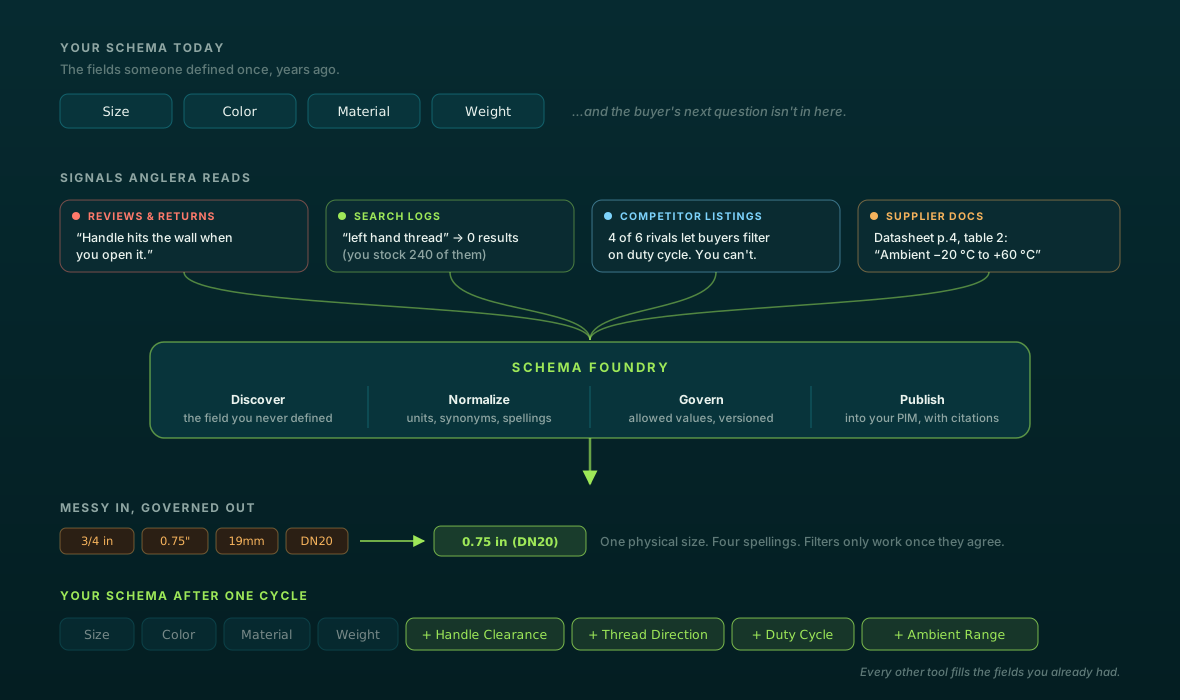
| Primary purpose | Feed management and multichannel syndication. Transforms product data into channel-ready formats and keeps pricing and inventory synced in real time across 2,500+ integrations. | PIM, DAM, and feed syndication in one platform. Build and manage product content centrally — including AI-generated copy — then publish outward to ecommerce channels. | Neither stores nor syndicates. Anglera enriches the product data upstream — filling attribute gaps, standardizing values, scoring completeness — then writes results back to whichever tool holds your catalog. |
| Channel breadth | 2,500+ marketplace and ad channel connectors. Real-time sync for pricing and inventory; PPC automation and marketplace order management available as add-ons. | Built-in feed syndication to ecommerce channels and marketplaces. Channel library is narrower than Channable's; strong enough for most SMB distribution needs. | Channel-agnostic. Anglera improves content quality before it reaches any channel, so every connector — whether in Channable or Plytix — receives richer, more complete data. |
| AI and content generation | Rule-based (if/then) data transformation is the core mechanism. AI features exist but are paid add-ons, not built into base plans. | AI description generation and translation are built into paid plans, with credit-based usage. Designed to help small teams produce content at catalog scale without outsourcing copywriting. | Buyer-signal-driven enrichment: Anglera gathers missing attributes from external sources, normalizes values against category standards, and scores each SKU against what buyers actually search for — then writes those enriched fields back. |
| Pricing structure | Starts at ~€59/month for up to 5,000 items (Core Standard). AI features, PPC automation, repricing, and individual marketplace integrations are each separate add-ons at €30–71/month — costs stack as you add functionality. | Freemium tier available with limited functionality. Paid plans start at ~$733/month; tiers scale with catalog size. AI credits and extra distribution channels are add-ons. Unlimited users on all plans. | Priced by catalog size and enrichment volume. Runs alongside either platform with no seat fees or per-channel charges. |
| User and team access | Access scales with plan; not positioned around unlimited seats. Best suited to smaller channel operations teams rather than large cross-functional groups. | Unlimited users on every plan — a genuine structural advantage for SMBs where marketers, merchandisers, and ops staff all need to touch product records. | No user limits. Enrichment runs automatically against your catalog on a defined schedule; the output writes back to your source of truth without requiring a separate login workflow. |
| Data quality and attribute completeness | Assumes incoming data is already complete and correct. Channable maps and transforms what you give it but does not fill missing values or source attributes from outside your catalog. | Provides the structure and tooling to build complete records, but teams still manually fill attribute gaps or prompt the AI to generate copy — the accuracy of enrichment depends on what the team already knows. | Purpose-built for this gap. Anglera scrapes, cross-references, and enriches missing attributes at SKU level from external signals, then scores quality before any content reaches a channel or marketplace. |
| Implementation timeline | Feed setup for standard channels can move in days to weeks. Complex multi-channel rule logic, custom field mappings, and add-on configurations extend that timeline. | Cloud-based with no installation. Initial setup involves data import, attribute schema mapping, and team onboarding — typically a few weeks to reach a working state. | ~30-day implementation. Anglera connects to your existing PIM or catalog tool, begins enriching SKUs against buyer signals, and writes results back. No migration or platform switch required. |
How to choose between Channable and Plytix
Choose Channable if distribution is your primary bottleneck. You have a reasonably clean, structured catalog and need it live across a large and varied set of channels — marketplaces, comparison engines, ad networks — with automated pricing and inventory sync. Channable's 2,500+ connector library and real-time sync engine are purpose-built for that job. The modular add-on model lets you layer in PPC automation and order management as your operation grows, though per-feature pricing means costs rise as you expand. It is not the right tool for teams whose bigger problem is incomplete or inconsistent product data.
Choose Plytix if content management is your primary bottleneck. Your team needs a structured single source of truth for product attributes and digital assets, multiple stakeholders need access without a seat-count tax, and you want AI-assisted copy generation and translation built into the same tool rather than bolted on. The freemium tier makes it low-risk to evaluate. Be aware that Plytix's channel distribution breadth is narrower than Channable's; if you have complex multi-channel syndication requirements, you may eventually need a dedicated feed tool alongside it.
Consider running both if you need structured content management (Plytix) and broad, high-frequency channel distribution (Channable). Some mid-market retailers run this combination: Plytix as the content hub, Channable as the distribution engine. It introduces operational overhead, but it is a deliberate trade-off rather than a gap in either product.
Whichever you pick, the data still has to get done
Anglera fits the same way regardless of which platform you select: as the enrichment layer that runs before your data reaches syndication. Channable assumes your product data arrives channel-ready. Plytix gives your team the structure to build it. Neither tool is designed to gather missing attributes from external sources, normalize values against category and channel standards, or score SKU completeness against real buyer search behavior.
Alongside Channable, Anglera ensures that what flows into your feed rules is already complete — fewer suppressed listings from missing required fields, richer ad copy, better search relevance on marketplace channels. Alongside Plytix, Anglera brings every record in your PIM up to a higher baseline before your team starts writing and publishing, so time is spent on refinement rather than sourcing specs.
Either way, implementation takes around 30 days. Anglera connects to your existing catalog or PIM, enriches SKUs against buyer signals, and writes the results directly back to your source of truth. There is no new UI to train your team on, no migration, and no dependency on which distribution platform you have chosen or may choose later.
Frequently asked questions
Can Channable act as a PIM?
No. Channable transforms and distributes the data you feed into it. It does not provide a structured repository for managing product attributes, digital assets, or team workflows around content creation. If you need those capabilities, you need a PIM alongside it.
Does Plytix replace Channable for feed syndication?
Partially. Plytix includes built-in feed syndication, but its channel library is narrower than Channable's 2,500+ integrations. For standard ecommerce and marketplace distribution, Plytix may be sufficient. Teams with complex per-channel rule logic, PPC automation, or real-time inventory sync across many channels often add Channable for distribution.
Where does data enrichment fit when I am evaluating these two tools?
Neither Channable nor Plytix is built to fill missing product attributes by gathering data from external sources. Channable maps what you give it; Plytix gives your team a structure to fill records manually or with AI. If your catalog has incomplete specs, inaccurate values, or unscored content quality, that problem sits upstream of both tools — and is what Anglera is built to solve.
Is Plytix's free plan actually usable for a real catalog?
The freemium tier gives you access to the platform to evaluate structure and workflows, but paid plans starting at around $733/month are where full PIM functionality, AI content generation, and feed distribution become available. Treat the free tier as a hands-on trial rather than a production option for most catalogs.
How quickly can Anglera connect to Channable or Plytix?
Around 30 days. Anglera integrates with your existing catalog tool or PIM, enriches SKUs against buyer signals, and writes enriched attributes back directly — without requiring you to migrate data or change your existing stack.