Contentserv vs Pimberly: Which PIM Fits Your Catalog?
Both Contentserv and Pimberly solve the same surface-level problem — scattered product data, inconsistent content, and the operational drag of publishing to multiple channels. What they are built for, and who they are built for, diverges significantly from there.\n\nContentserv (now rebranded Centric PXM) is an enterprise PXM suite designed for companies in fashion, lifestyle, luxury, and consumer goods where rich media, localized content, and digital shelf performance are non-negotiable. It bundles PIM, DAM, syndication, and digital shelf analytics under one roof — the pitch is that you should not need separate vendors for any part of the product content supply chain. Pimberly is a cloud SaaS PIM and DAM aimed at mid-market e-commerce and retail teams that need a fast-to-deploy single source of truth for large SKU catalogs, with automated validation and channel publishing built in. It is priced lower, deploys faster, and does not try to be a full PXM suite.\n\nThe right choice depends less on feature lists and more on where your company sits today: your vertical, your scale, your localization complexity, and your implementation runway. Neither platform, however, solves the upstream problem both share — the product data going into them is rarely buyer-ready to begin with.
| Contentserv | Pimberly | Anglera | |
|---|---|---|---|
| Primary orientation | Enterprise PXM suite (now Centric PXM) for fashion, lifestyle, luxury, and consumer goods — bundles PIM, DAM, syndication, and digital shelf analytics as a single system of record and experience layer | Cloud SaaS PIM + DAM for mid-market e-commerce and retail teams — centralizes product data, enforces validation rules, and automates channel publishing; does not try to be a full PXM suite | Enrichment layer — reads from whichever PIM you run, enriches every SKU against buyer signals, and writes results back; not a PIM, DAM, or syndication platform |
| Built-in DAM | Enterprise-grade DAM is native to the suite — covers asset ingestion, rights management, rendition management, and media delivery; built for media-heavy verticals where rich content governance is core | Built-in DAM handles product imagery, documents, and files tied directly to SKU records; well-suited for e-commerce catalog publishing but oriented toward channel output rather than enterprise media governance | Does not manage assets — enriches the product attributes, descriptions, and copy that live alongside those assets in whichever PIM stores them |
| Channel syndication & localization | Claims 1,000+ channel integrations covering e-commerce, print, wholesale, and marketplace distribution; deep localization architecture for companies managing content across many languages, regions, and markets | Multi-channel publishing automation with configurable validation rules and feed management; strongest in English-first, UK- and US-centric retail markets; localization is supported but not a design-center strength | Does not syndicate — enriches the product content before it moves through either platform's distribution layer; works within the locale structure already defined in your PIM |
| Digital shelf analytics | Included in the suite — tracks how product content performs at the channel level and surfaces gaps in completeness or accuracy that need correction; a meaningful differentiator vs. standalone PIMs | Publishing-focused; does not natively include digital shelf analytics within the platform — performance data comes from downstream channels or separate analytics tools | Scores product completeness against buyer signals before publication, surfacing attribute gaps inside your PIM before content reaches any channel |
| Implementation timeline | Enterprise scope typically means 6–12 months for a full rollout across modules, integrations, and data migration; complexity scales with catalog depth and the number of markets served | SaaS deployment is meaningfully faster — mid-market teams commonly go live in 2–4 months depending on catalog size and integration scope; lower implementation overhead than a full PXM suite | ~30 days from kickoff to enriched SKUs written back to the PIM; runs in parallel with whichever platform implementation is underway |
| Pricing | No pricing disclosed publicly; Starter, Professional, and Enterprise tiers are referenced but require a direct quote; cost varies by modules selected, user count, and data volume — enterprise budgets apply | Starts at approximately $30,000/year; custom pricing based on SKU volume and channels; no fixed public tiers but a more accessible floor than most enterprise PXM platforms | Priced per SKU enriched — adds to your PIM investment rather than replacing any part of it |
| Best fit | Enterprise teams in fashion, luxury, lifestyle, or consumer goods that need a unified PIM + DAM + syndication + analytics platform and have the implementation runway to deploy it | Mid-market e-commerce and retail teams managing large SKU catalogs who need fast SaaS deployment, channel publishing automation, and a single source of truth without enterprise-level cost and complexity | Any team using either platform whose product data arrives from suppliers incomplete, inconsistent, or not written for how buyers actually search and compare |
How to choose between Contentserv and Pimberly
Choose Contentserv if you are an enterprise team in fashion, lifestyle, luxury, or consumer goods that needs a unified PXM suite — PIM, DAM, syndication, and digital shelf analytics under one vendor. The platform's value compounds when your catalog is media-rich, your content needs to be localized across many languages and markets, and you want a single system of record responsible for the entire content supply chain from asset storage to channel delivery. The built-in digital shelf analytics layer is a genuine differentiator if your teams actively monitor and optimize how product content performs across channels — that capability is not standard in standalone PIMs or SaaS alternatives like Pimberly.
Choose Pimberly if you are a mid-market e-commerce or retail team with large SKU volumes and the core problem is getting a single source of truth deployed quickly — one that enforces validation, automates channel publishing, and eliminates the manual work of keeping product data consistent across storefronts and marketplaces. Pimberly's SaaS model deploys in roughly half the time of a typical enterprise PXM rollout, and its ~$30,000/year starting price is a meaningful advantage when budget and speed-to-value both matter. It does less than Contentserv's full suite, but for teams that do not need enterprise DAM governance or digital shelf analytics, that is a feature rather than a gap.
A few signals that clarify the choice:
- If your catalog is media-heavy and you operate across multiple global markets with localization requirements, Contentserv is built for that complexity. Pimberly is not.
- If you are a mid-market retailer or e-commerce operator primarily serving English-first markets and your main need is centralization and automated publishing, Pimberly deploys faster and costs less.
- If digital shelf analytics and content performance tracking are requirements — not nice-to-haves — Contentserv includes them natively. Pimberly does not.
- If implementation timeline is a constraint, Pimberly's 2–4 month window is substantially shorter than Contentserv's 6–12 month enterprise norm.
Whichever you pick, the data still has to get done
Both Contentserv and Pimberly store, govern, and distribute your product content — and both assume the data arriving in the system is already complete, accurate, and written for how buyers actually search and decide. That assumption rarely holds. Supplier specs arrive as unstructured text, attribute fields are partially populated, and product copy is written for the factory floor rather than for a buyer comparing options on a category page or a search results listing.
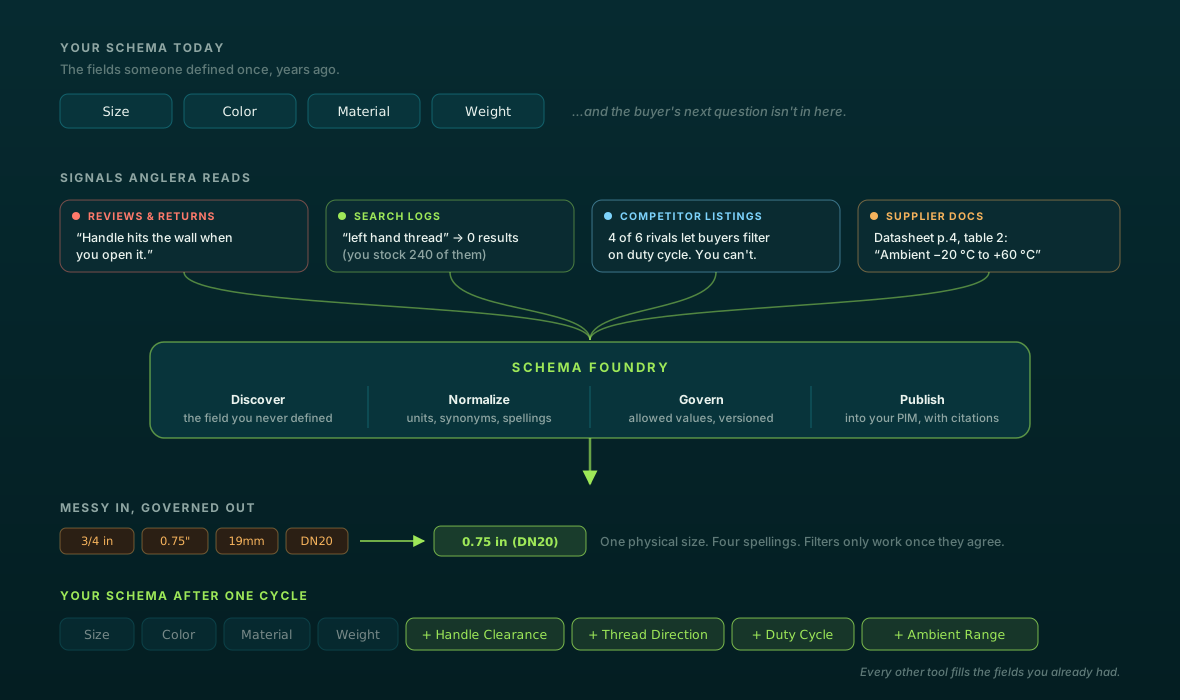
Anglera is the layer that fixes that before it reaches either platform. It connects to your PIM via API, reads every SKU, enriches missing attributes and descriptions against buyer signals — the specific terms, comparisons, and decision criteria your customers actually use — and writes the improved content back to the same record in Contentserv or Pimberly. Your system of record stays in place. Your publishing and syndication workflows run unchanged. The data the PIM stores and distributes is buyer-ready from the start, not just well-organized.
Implementation takes roughly 30 days and runs in parallel with whichever platform you are implementing or already running. Whichever platform you choose, Anglera does the enrichment work that platform assumes already happened.
Frequently asked questions
What is the main difference between Contentserv and Pimberly?
Contentserv (now Centric PXM) is an enterprise PXM suite for fashion, luxury, lifestyle, and consumer goods companies that need a unified platform covering PIM, DAM, syndication, and digital shelf analytics — with deep localization for global markets. Pimberly is a cloud SaaS PIM and DAM for mid-market e-commerce and retail teams that need fast deployment, large-SKU-catalog management, and automated channel publishing at a lower price point. Both store and distribute product data; the differences are in vertical fit, suite depth, implementation timeline, and cost.
Does Contentserv replace a standalone DAM?
For most companies in its target verticals, yes. Contentserv includes enterprise DAM capabilities natively — asset ingestion, rights management, rendition management, and media delivery — designed for the rich media demands of fashion and consumer goods. Whether it fully replaces a dedicated enterprise DAM depends on the depth of your media operations, but for the majority of Contentserv's target buyers, the native DAM is sufficient and the integration overhead of a separate DAM is avoided.
Can Pimberly handle enterprise-scale catalogs?
Pimberly is engineered for large SKU volumes and positions itself as enterprise-grade, but its design center is mid-market e-commerce and retail — channel publishing automation, validation, and centralization — rather than the complex global localization, deep media governance, and digital shelf analytics that define Contentserv's enterprise suite. Companies with heavy localization requirements across many languages and markets, or luxury-tier media governance needs, typically find Contentserv's architecture better matched to that complexity.
How does Anglera work alongside Contentserv or Pimberly?
Anglera connects to your PIM via API, reads your existing product records, runs enrichment against buyer signals — the attributes, descriptions, and comparisons that drive how customers actually search and decide — and writes the results back to the same PIM record. No migration, no new system of record: Contentserv or Pimberly stays in place as your source of truth, and the content it stores and distributes improves. Implementation takes roughly 30 days.
Which platform is faster to implement?
Pimberly is meaningfully faster: mid-market teams typically go live in 2–4 months. Contentserv's enterprise scope commonly requires 6–12 months for a full rollout across modules, integrations, and data migration. Both timelines extend based on catalog complexity and integration scope. Anglera's ~30-day implementation means enrichment can be live and improving data quality in parallel with whichever PIM rollout is underway.