Contentserv vs Stibo Systems: A Fair Comparison for Enterprise Buyers
Contentserv (now branded Centric PXM) and Stibo Systems both manage product data at enterprise scale, but they are solving different problems. Contentserv is built around product experience: it unifies PIM, DAM, syndication, and digital shelf analytics so brands can deliver rich, localized content across 1,000-plus channels. Stibo Systems builds STEP, a multi-domain Master Data Management platform where product is one domain among several — product, customer, supplier, and asset data all governed under a single authoritative system of record.
That distinction has real consequences for your buying decision. If your primary pain is getting product content to market accurately and consistently across retail channels, Contentserv is designed for that workflow and is especially strong in fashion, lifestyle, consumer goods, and luxury. If your challenge is governing master data across the entire enterprise — with complex data modeling, lineage, and regulatory compliance requirements — Stibo's MDM-first approach is built for that scope, and it shows up on Gartner's Magic Quadrant for MDM as a result.
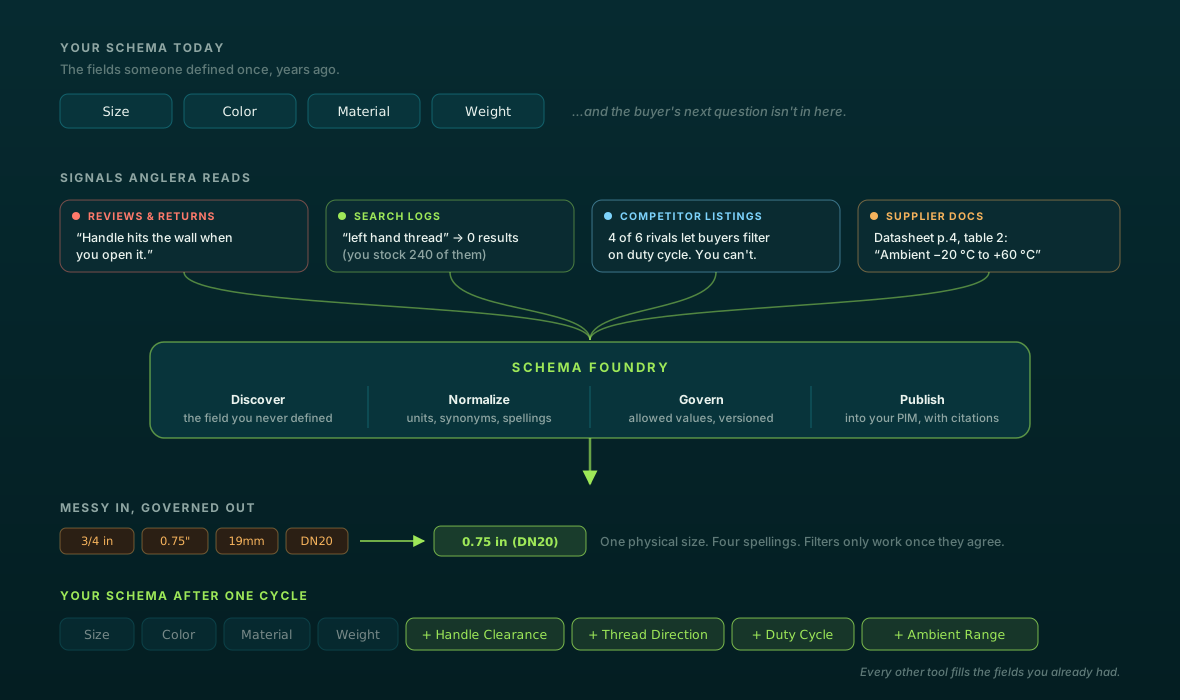
What neither platform does on its own is enrich the product data before it enters the system. Both assume your SKUs already arrive complete, attributed, and clean. In practice they rarely do. That is the gap Anglera fills: it gathers, cleans, scores, and enriches every SKU against buyer signals, then writes the results back to whichever platform you have selected — Contentserv, STEP, or anything else.
| Contentserv | Stibo Systems | Anglera | |
|---|---|---|---|
| Core platform type | PXM — product experience management. PIM, DAM, syndication, and digital shelf analytics in one suite. | Enterprise MDM — multi-domain master data governance. Product is one domain alongside customer, supplier, and asset. | Enrichment layer. Anglera is not a PIM or MDM; it prepares and scores the data those platforms store. |
| Data domains covered | Product-centric. Deep support for product attributes, rich media, and localized content variants. | Multi-domain. Governs product, customer, supplier, location, and asset data under unified governance workflows. | Works on the product domain: gathering missing attributes, cleaning descriptions, and scoring completeness against buyer signals before data enters either system. |
| Industry and buyer fit | Strong in fashion, lifestyle, consumer goods, and luxury — verticals where localized rich media and channel-specific content are core requirements. | Broadly suited to large enterprises with complex data hierarchies — manufacturing, distribution, retail, and regulated industries where data governance and lineage matter. | Fits any vertical where SKUs arrive incomplete or inconsistently attributed — which describes most B2B distributors, retailers, and manufacturers regardless of sector. |
| Digital asset management | Built-in DAM is a first-class module. Assets are linked directly to product records and distributed with them. | Asset data is supported as a domain within STEP, but DAM depth is not a primary differentiator; most customers integrate a separate DAM. | Does not replace a DAM. Anglera enriches structured product attributes and written content, then writes back to the system of record. |
| Syndication and channel reach | Syndication to 1,000-plus channels is core to the pitch, with digital shelf analytics to measure content performance post-distribution. | Syndication is supported as part of STEP's distribution capabilities, but digital shelf analytics is not a primary differentiator. | Sits upstream of syndication. Anglera ensures the data being syndicated is complete and optimized before it leaves the PIM or MDM. |
| Implementation complexity | Subscription tiers (Starter, Professional, Enterprise) suggest a range of entry points, but no public pricing. Complex deployments require scoping. | Custom enterprise pricing, no public rates. Implementation typically takes months and commonly requires a certified systems integrator. | Approximately 30-day implementation. Connects to the existing PIM or MDM via API and begins enriching without replacing the platform already in place. |
| Governance and data modeling | Governance is centered on product data quality, workflow approvals, and localization — sufficient for most PXM use cases. | Deep data modeling, lineage tracking, and cross-domain governance are STEP's core strengths. Purpose-built for enterprises where data quality is a compliance requirement. | Complements governance by delivering higher-quality, more complete data into whichever governance framework is already in place. |
How to choose between Contentserv and Stibo Systems
Choose Contentserv (Centric PXM) if:
- Your organization is in fashion, lifestyle, consumer goods, or luxury, and localized rich media content is central to how you sell.
- You want PIM, DAM, syndication, and digital shelf analytics under one roof rather than integrating separate tools.
- Your primary goal is improving product experience across retail and digital channels, not governing master data across multiple enterprise domains.
- You prefer a platform with tiered subscription options that can scale from a mid-market starting point toward enterprise needs.
Choose Stibo Systems STEP if:
- You are a large enterprise with multi-domain data complexity — product, customer, supplier, location — that needs to be governed from a single authoritative source.
- Data lineage, audit trails, and compliance-driven governance are requirements, not nice-to-haves.
- You are already running or planning an MDM initiative and need product data to coexist with customer and supplier master data under the same governance model.
- You are prepared to invest in a longer implementation, likely with a systems integrator, in exchange for an MDM platform that can serve as the enterprise backbone for years.
If you are still deciding: The clearest signal is scope. If the problem is product content quality and channel reach, Contentserv is the more focused tool. If the problem is enterprise data governance across domains, Stibo's MDM-first architecture is the right fit. Most organizations do not need both.
Whichever you pick, the data still has to get done
Both Contentserv and Stibo Systems are built on the assumption that the product data flowing into them is already reasonably complete. In practice, that assumption fails constantly: SKUs with missing attributes, product descriptions that do not match what buyers actually search for, competitor pricing gaps, and content that has never been scored against channel requirements.
That is the work Anglera does — and it does it regardless of which platform you have chosen. Anglera connects to Contentserv or STEP via API, pulls your product catalog, and runs enrichment across every SKU: gathering missing attribute values, cleaning and standardizing descriptions, scoring records against buyer signals, and flagging gaps that would suppress a product on a retailer's shelf. The enriched data then writes back directly to your system of record.
Anglera is not a PIM. It does not replace the governance, syndication, or DAM capabilities you are buying from Contentserv or Stibo. It is the layer that makes those platforms more effective from day one — so the data your team governs and distributes is actually worth governing and distributing. Implementation runs alongside your existing deployment in roughly 30 days, with no disruption to the platform already in place.
Frequently asked questions
What is the core difference between Contentserv and Stibo Systems?
Contentserv is a PXM platform built around product experience — rich media, localization, and multichannel distribution — with particular strength in fashion and consumer goods. Stibo Systems STEP is an enterprise MDM platform where product is one domain alongside customer, supplier, and asset data, with deep governance and data modeling capabilities. Contentserv optimizes for channel reach; Stibo optimizes for enterprise data governance.
Which platform takes longer to implement?
Both are enterprise deployments that require scoping and configuration. Stibo Systems implementations are commonly noted as taking months and often requiring a certified systems integrator. Contentserv offers tiered plans that can reduce scope for smaller deployments, but enterprise rollouts are similarly complex. Neither has a self-serve setup path.
Can either platform handle syndication to retail channels?
Yes. Contentserv treats multichannel syndication — to 1,000-plus channels — as a core product capability and pairs it with digital shelf analytics to measure content performance. Stibo STEP supports distribution as part of its platform, but digital shelf analytics and syndication depth are not primary differentiators; some enterprises add a dedicated syndication tool alongside STEP.
Where does Anglera fit if I already have one of these platforms?
Anglera sits upstream of your PIM or MDM. It connects via API, enriches your product data against buyer signals — filling missing attributes, cleaning descriptions, scoring completeness — and writes the results back to Contentserv or STEP. It does not replace either platform; it improves the quality of data those platforms govern and distribute. Implementation takes roughly 30 days alongside your existing setup.
Do I need both a PIM and an MDM, or will one cover my needs?
Most product-focused companies — retailers, brands, distributors — do not need a full MDM platform. A PIM like Contentserv handles product data governance and distribution well on its own. An MDM like Stibo STEP becomes valuable when multiple data domains (customer, supplier, location) need to be governed from the same system, typically in large enterprises with complex data environments or compliance requirements.