EnterWorks vs Pimberly: Which PIM Is Right for Your Team?
EnterWorks (now Precisely EnterWorks) and Pimberly both centralize product data and sit at the heart of a catalog operation — but they are built for meaningfully different buyers. EnterWorks has spent 20-plus years serving large manufacturers, wholesale distributors, and multi-division retailers that need governed master data, complex entity relationships, and tight ERP integration. Pimberly is a cloud-native SaaS platform aimed at mid-market e-commerce and retail teams that need to move product content across many sales channels quickly and without heavy IT overhead.
The core tension in this decision is enterprise depth versus SaaS speed. EnterWorks gives you MDM-grade governance, role-based workflows, and business rules at the data layer — the kind of control a $150K+ investment is meant to support. Pimberly gives you a faster path to live, automated channel publishing at a lower entry price, optimized for teams whose primary problem is getting content to market rather than governing master data across business units.
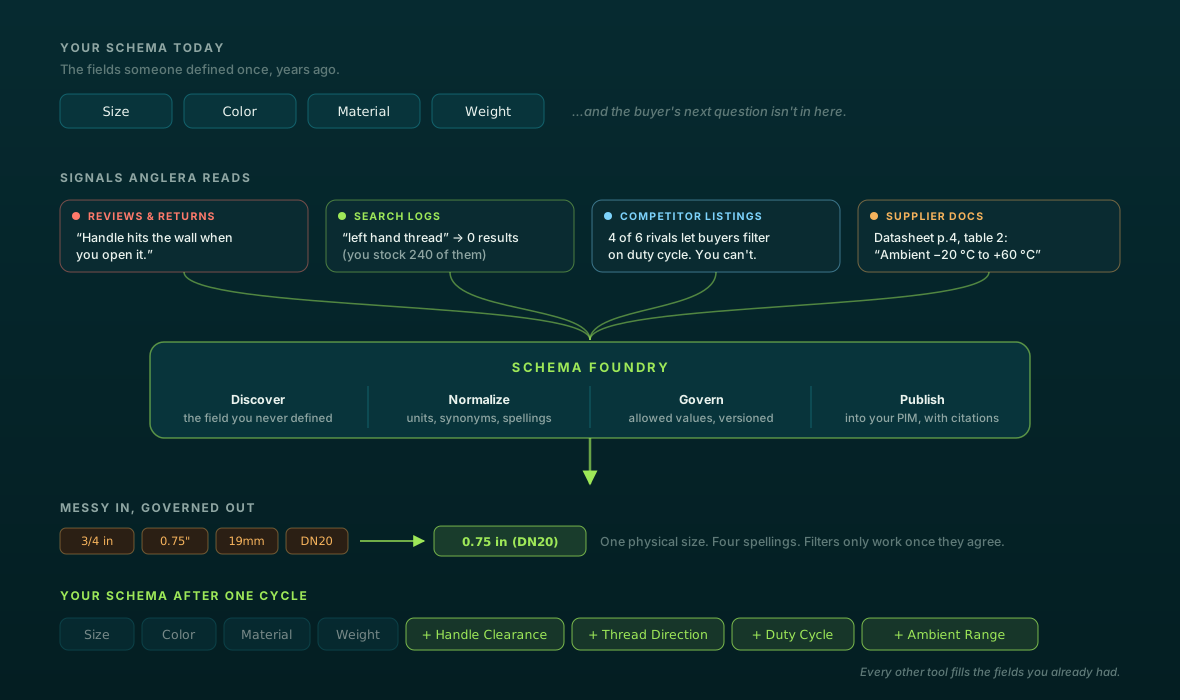
Neither platform enriches your product data. They store and govern what you bring them. If your attributes are incomplete, inconsistently formatted, or not calibrated to what buyers search and filter by, both systems will faithfully publish thin content. That is where Anglera fits — as the enrichment layer that runs before governance and before publishing, regardless of which PIM you choose.
| EnterWorks | Pimberly | Anglera | |
|---|---|---|---|
| Best-fit buyer | Large enterprise manufacturers, wholesale distributors, and multi-channel retailers with complex product hierarchies, MDM requirements, and ERP dependencies. Reference customers include Orgill, US Foods, Johnstone Supply, and Fender. | Mid-market retailers and e-commerce brands managing large SKU counts across multiple storefronts and marketplaces. Teams that prioritize speed-to-market and channel coverage over enterprise MDM. | Adds enrichment value to both profiles. B2B distributors on EnterWorks get buyer-signal scoring on complex catalogs; Pimberly customers get auto-filled, normalized attributes before the channel publishing workflow fires. |
| Deployment model | Enterprise platform under Precisely's umbrella. Deployment involves significant configuration, IT involvement, and integration work with existing ERP and data systems. | Cloud-native SaaS. No infrastructure to manage; onboarding is largely self-service with faster time-to-first-value than traditional enterprise PIMs. | SaaS; integrates via API or structured export/import with either PIM. Implementation runs approximately 30 days and does not require changes to your existing PIM architecture. |
| Data governance and MDM depth | Full MDM capabilities alongside PIM — master data governance, complex relationship modeling, role-based workflows, and business rules enforced at the data layer. Built for organizations that need a governed single source of truth spanning multiple data domains. | Validation rules and completeness scoring enforce product content quality before publishing. Focused on product content governance rather than enterprise-wide master data management. | Enriches the governed record. Fills attribute gaps, normalizes values, and scores every SKU against buyer-signal benchmarks — then writes the improved record back to the PIM so governance rules operate on complete data from the start. |
| Channel publishing and automation | Integrations to ERP, e-commerce platforms, and syndication channels via Precisely's integration layer. Channel automation is available but typically configured during implementation rather than out of the box. | Core differentiator. Automated feed management and channel publishing workflows designed to push product content to multiple storefronts and marketplaces simultaneously, with minimal manual intervention. | Runs upstream of publishing. Enriches and scores product data inside the PIM before any channel feed is generated, so every destination receives complete, buyer-ready content rather than whatever gaps existed at ingestion. |
| Pricing and total cost | Custom enterprise licensing, quote-based. Reported base around $150,000/year, scaling with users and implementation complexity. No free tier or self-serve trial. Budget for a multi-phase implementation on top of license cost. | Starts around $30,000/year; custom pricing based on SKU volume and number of channels. More accessible entry point than traditional enterprise PIMs, though costs rise with scale. | Separate SKU-volume subscription, priced independently of which PIM is in place. The enrichment ROI case — fewer listing errors, better search visibility, higher conversion — applies at both the $30K and $150K PIM tier. |
| Implementation timeline | Complex enterprise deployments typically run 6 to 18 months depending on data complexity, integration scope, and organizational change management requirements. | SaaS model enables faster onboarding. Mid-market teams commonly go live in 2 to 6 months. Simpler catalog structures shorten the timeline further. | Approximately 30 days to connect to an existing PIM, configure enrichment workflows, and begin scoring SKUs. Can run in parallel with a PIM implementation or be layered on after go-live. |
| DAM capabilities | Includes a DAM module for managing digital assets alongside product records, tightly coupled to the PIM data model. Suited to enterprise teams that need asset governance in the same governed environment as product data. | Built-in DAM stores and manages digital assets with direct linkage to product records. Strong for teams that need asset management and content publishing in a single SaaS platform. | Not a DAM. Anglera can ingest existing product images and assets to extract attributes (e.g., reading dimensions or materials from images), but asset storage and management stay in whichever DAM your PIM provides. |
How to choose between EnterWorks and Pimberly
Choose EnterWorks if your organization is a large enterprise — a manufacturer, wholesale distributor, or multi-division retailer — with complex product hierarchies, MDM requirements that span more than product content, and tight ERP dependencies. EnterWorks makes sense when data governance is a cross-functional mandate, when role-based workflows and business rules need to be enforced at the data layer, and when you have the budget ($150K+) and IT resources to support a multi-phase rollout. It is the right choice if you are already in — or integrating into — the Precisely ecosystem and need a platform that can serve as a governed master data hub beyond product catalogs alone.
Choose Pimberly if you are a mid-market retailer or e-commerce brand whose primary challenge is getting product content to market quickly across multiple channels. Pimberly is the stronger fit when speed-to-launch, feed automation, and lower implementation overhead matter more than enterprise MDM. If your team is commerce-focused rather than data-governance-focused, and you want a cloud SaaS solution with a more accessible price point and a realistic 2-to-6-month go-live, Pimberly is the more proportionate choice.
If you are somewhere in between — a mid-to-large distributor with complex B2B catalogs but limited internal IT capacity — it is worth evaluating both on current Precisely roadmap and support commitments alongside Pimberly's ability to handle your relationship complexity before committing.
Whichever you pick, the data still has to get done
EnterWorks governs the master record. Pimberly automates the channel feed. Neither one fills your product data.
Both platforms operate on the assumption that the attributes, descriptions, and content coming into the PIM are already complete and accurate. In practice, they rarely are. Distributor catalogs routinely arrive from manufacturers with missing specs, inconsistent units, thin descriptions, and no calibration to what buyers actually search and filter by. A governed empty field is still an empty field. An automated feed of thin content reaches every channel at the same time.
Anglera sits between data ingestion and PIM governance. It reads your existing product records, identifies attribute gaps and quality gaps, pulls structured data from manufacturer sources and web signals, and scores every SKU against real buyer behavior. The enriched, scored records write back to the PIM — EnterWorks or Pimberly — so that downstream workflows, validation rules, and channel feeds all operate on complete data from the start. Implementation is approximately 30 days and requires no changes to your existing PIM architecture or workflows. Whichever platform you choose to store and govern your data, Anglera does the work of making sure the data is worth storing.
Frequently asked questions
Is EnterWorks still an active product under Precisely?
Yes. EnterWorks was acquired by Winshuttle in 2019 and subsequently became part of Precisely in 2021. The Enable platform continues to be offered under the Precisely brand. If you are evaluating it today, contact Precisely directly for current roadmap details, support terms, and licensing structure, as the product's positioning within the Precisely portfolio may have evolved.
Can Pimberly handle the complexity of a B2B wholesale distributor catalog?
Pimberly handles large SKU counts and multi-channel publishing well, but its design center is retail and e-commerce rather than B2B distribution. If your catalog involves complex product relationships, contract-specific pricing, or deep ERP integration requirements, EnterWorks — with its MDM layer and documented track record at Orgill, US Foods, and Johnstone Supply — is typically the stronger fit for wholesale distribution.
Does Anglera replace EnterWorks or Pimberly?
No. Anglera is an enrichment layer, not a PIM. It does not store, govern, or publish product data. It connects to whichever PIM you already use, enriches the product records, and writes the improved data back. Your PIM remains the system of record; Anglera fills the content gaps that the PIM assumes were handled before ingestion.
How does Anglera integrate with these two platforms?
Anglera integrates via API or structured export/import. The connection works with EnterWorks and Pimberly without requiring changes to your existing PIM workflows or data model. Implementation typically takes approximately 30 days and can begin once your PIM is live — or run in parallel with a PIM implementation.
What is the biggest risk of choosing the wrong PIM here?
Over-buying and under-buying are both real risks. EnterWorks at $150K+ with an 18-month implementation is a significant commitment — if your actual problem is multi-channel publishing rather than enterprise MDM, you are paying for governance infrastructure you may not use. Conversely, Pimberly's SaaS simplicity can become a constraint if your catalog complexity or governance requirements outgrow it. The safest approach is to scope your specific integration, governance, and channel requirements before choosing, rather than defaulting to the tool that sounds most impressive.