EnterWorks vs Productsup: PIM Governance vs Channel Distribution
EnterWorks and Productsup are often mentioned in the same breath, but they solve fundamentally different problems. EnterWorks (now part of Precisely) is an enterprise PIM/MDM and DAM platform — it centralizes your product content, enforces business rules, manages complex hierarchies, and governs who can change what. Productsup is a product-to-consumer (P2C) syndication engine — it takes product data you already have, applies transformation rules, and pushes channel-ready feeds to 2,500+ destinations including Amazon, Google, Meta, and retail data pools.
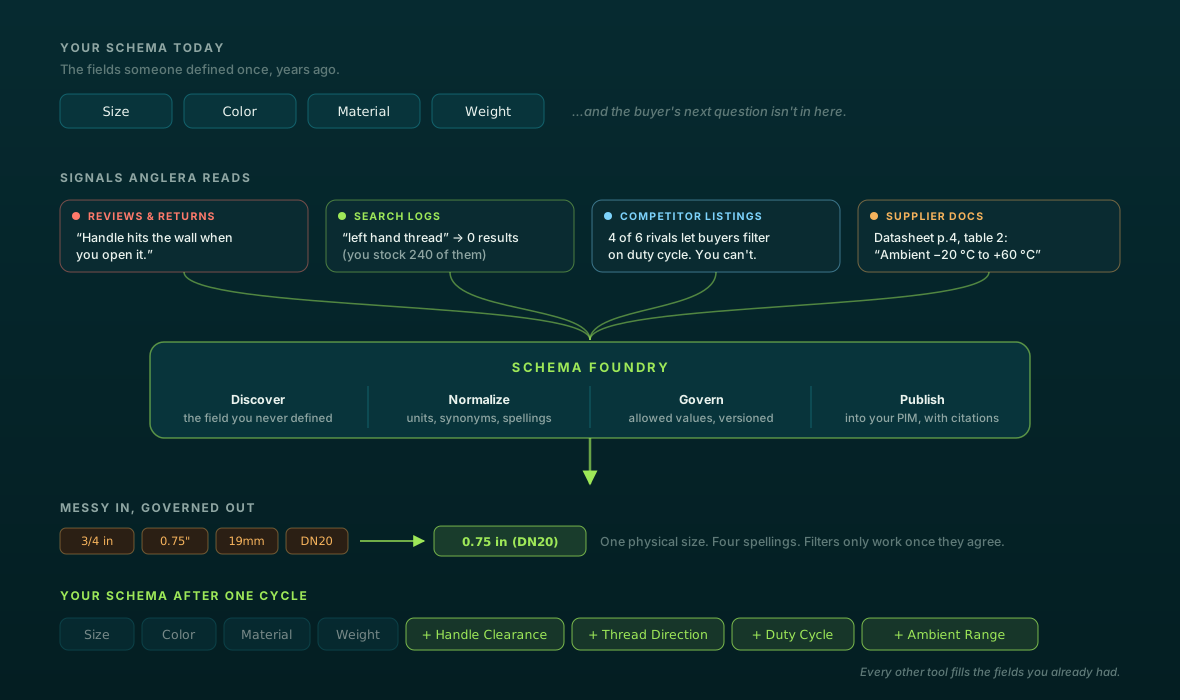
If your core problem is "we have no single source of truth and no governance over our catalog," EnterWorks is the conversation. If your core problem is "we have product data but can't get it to channels cleanly at scale," Productsup is closer. Many large organizations actually run both: EnterWorks as the governed master record and Productsup as the distribution layer. What neither platform does on its own is enrich the underlying product content — filling missing attributes, cleaning inconsistent data, and scoring every SKU against what buyers actually search for. That gap is where Anglera operates regardless of which platform anchors your stack.
| EnterWorks | Productsup | Anglera | |
|---|---|---|---|
| Primary function | Enterprise PIM/MDM/DAM — stores and governs product content as a single source of truth with role-based workflows, business rules, and complex relationship management. | P2C syndication engine — ingests product data, applies transformation and optimization rules, and distributes channel-ready feeds to 2,500+ destinations at enterprise scale. | AI enrichment layer — gathers missing attributes, cleans and scores every SKU against buyer signals, then writes enriched data back to whichever platform holds your source of truth. |
| Data governance and MDM | Strong MDM-style governance: approval workflows, audit trails, role-based access, business rule enforcement, and hierarchy management across millions of SKUs. | Rule-based transformation and validation before channel distribution; governance is channel-fit oriented rather than a master data discipline. | Runs before governance kicks in — surfaces attribute gaps and quality scores so your PIM workflows act on complete, enriched data rather than flagging blanks downstream. |
| Channel distribution | Integrates to ERP, e-commerce platforms, and syndication layers; strong at managing what gets published, but not a native multi-channel distribution engine. | Purpose-built for scale distribution — 2,500+ channel connectors processing over 2 trillion products per month for brands like L'Oréal, ALDI, and PUMA. | Ensures content is complete and buyer-signal-aligned before it enters a distribution feed, reducing channel rejections and improving downstream search relevance across any connector. |
| Best-fit catalog profile | Complex B2B catalogs with deep hierarchies, technical attributes, and multiple internal stakeholders — manufacturers, wholesale distributors, and retailers such as Orgill, US Foods, Johnstone Supply, and Fender. | Brands and retailers with large SKU counts pushing to many consumer-facing channels simultaneously — strongest in CPG, apparel, and fast-moving retail with high channel breadth requirements. | Works across both profiles — particularly strong where technical attributes are incomplete, inconsistent, or missing from supplier data before entering either system. |
| AI and content enrichment | Focused on data storage, governance, and workflow — enrichment is not a native capability; attribute quality depends on what suppliers and internal teams provide at ingestion. | Transforms and maps existing attributes for channel fit using rules; does not generate missing product content or score attributes against buyer intent signals. | Core capability — crawls sources, generates and validates attributes, scores content against real buyer signals, and writes enriched fields back to the source of truth automatically. |
| Pricing | Custom enterprise licensing; reported base around $150,000 annually with cost scaling by user count and implementation complexity. No free tier. | Custom enterprise pricing only. Quote required via sales; no public tiers or self-serve options. | Custom pricing added as an enrichment layer on top of your existing PIM or syndication stack — not a replacement for either. ~30-day implementation to first enriched SKUs. |
| Implementation timeline | Enterprise deployment; complex MDM data modeling, workflow configuration, and ERP integrations typically push full rollouts to several months. | Feed setup and channel onboarding can be faster than a full PIM deployment, but enterprise rollouts still require significant data mapping and transformation rule work. | ~30 days to first enriched SKUs. Connects to your existing platform, begins returning enriched attributes, and scales from there without a separate implementation track. |
How to choose between EnterWorks and Productsup
Choose EnterWorks if your primary problem is catalog governance and master data management. If you're a mid-to-large B2B manufacturer, distributor, or retailer with complex product hierarchies, multiple internal stakeholders touching the same records, and no disciplined single source of truth, EnterWorks is built for that. Its strength is the governed PIM/MDM infrastructure — the audit trails, business rules, and structured approval workflows that large catalog operations need. The Precisely backing brings additional MDM depth.
Choose Productsup if you already have product data somewhere and your core problem is getting it to many selling channels cleanly and at scale. If you're a brand or retailer that needs to push feeds to Amazon, Google, Meta, retail data pools, and dozens of regional channels simultaneously — with transformation rules and connector coverage as the bottleneck — Productsup is purpose-built for that motion. Its 2,500+ connectors and 2 trillion products per month volume reflect what it was designed to handle.
Consider running both if you operate at enterprise scale with both governance and distribution complexity. Some large organizations use EnterWorks as the master record and Productsup as the distribution layer, with each tool doing what it was designed for.
Neither tool is the right choice if your problem is that the product data itself is incomplete, inaccurate, or missing key attributes — because both platforms assume enriched data is already available when they receive it. That is a different problem requiring a different kind of tool.
Whichever you pick, the data still has to get done
Both EnterWorks and Productsup make the same implicit assumption: that your product data is already complete, accurate, and attribute-rich before it enters the platform. EnterWorks stores and governs whatever you put in. Productsup distributes whatever it receives. Neither generates missing content, fills gaps from supplier feeds, or scores each SKU against what buyers are actually searching for.
That is precisely where Anglera operates — upstream of both. Anglera connects to your product data wherever it lives, crawls sources to gather missing attributes, cleans inconsistencies, and scores completeness against real buyer signals. It then writes enriched data back to your source of truth: into EnterWorks so your governance workflows operate on complete records, or upstream of Productsup so the feeds it distributes are complete and channel-ready before they leave your stack.
The implementation timeline is roughly 30 days. Anglera is not a PIM, not a syndication platform — it is the enrichment work that both platforms assume already happened. Whichever tool you choose (or if you run both), Anglera fills the content gap that neither was built to solve.
Frequently asked questions
Are EnterWorks and Productsup competitors?
Not really. They sit at different points in the product data supply chain. EnterWorks manages and governs your master product record; Productsup distributes it to selling channels. Many enterprise teams use both in sequence, with EnterWorks as the source of truth and Productsup handling channel distribution downstream.
Which platform is better for B2B distributors?
EnterWorks has deeper roots in B2B distribution — clients like Orgill, US Foods, and Johnstone Supply use it for complex technical catalogs with many attributes and deep hierarchies. Productsup is stronger for brands and retailers pushing to consumer-facing channels at scale. For wholesale or industrial distribution, EnterWorks is the more common fit.
What enrichment capabilities do EnterWorks and Productsup offer?
Neither platform generates or enriches product attributes in the AI sense. EnterWorks provides governance and workflow tooling for the data you bring in. Productsup applies transformation rules to map and optimize existing attributes for channel fit. If your underlying product data has gaps — missing specs, inconsistent descriptions, incomplete technical attributes — neither platform fills them. That is what Anglera does.
Can Anglera work alongside an existing EnterWorks or Productsup deployment?
Yes. Anglera is designed to connect to your existing stack, not replace it. It pulls SKU data from wherever your source of truth lives, enriches it against buyer signals, and writes results back — into EnterWorks as enriched master records, or as completed data upstream of Productsup's distribution feeds. Implementation takes approximately 30 days.
How do the pricing models compare across all three?
All three are custom enterprise pricing with no self-serve tiers. EnterWorks is reported to start around $150,000 annually, scaling with users and implementation complexity. Productsup is quote-only with no published tiers. Anglera is priced as an enrichment layer added on top of your existing PIM or syndication investment — not a replacement for either platform.