EnterWorks vs Salsify: Enterprise PIM/MDM or Digital Shelf PXM?
EnterWorks and Salsify both store product data, which is why they show up in the same procurement shortlist. They are not solving the same problem. EnterWorks — now Precisely EnterWorks after a 2021 acquisition — is an enterprise PIM/MDM/DAM combination that treats product data as governed master data: one authoritative source that feeds ERP systems, e-commerce channels, and distribution partners through controlled workflows. Salsify is a Product Experience Management (PXM) platform oriented toward the opposite direction — it is built to push polished brand content outward to retail partners, marketplaces, and the digital shelf at scale. Buying the wrong one for your use case means paying for capability you will never use while missing the capability you actually need.
The practical split is this: EnterWorks is built for organizations that govern product data internally — large B2B distributors, manufacturers, and wholesalers where a single SKU might have dozens of attributes sourced from multiple ERP systems, supplier feeds, and engineering specs. Salsify is built for brands that need to manage how their products appear across hundreds of retail and marketplace destinations. Customers like Orgill, US Foods, and Johnstone Supply run EnterWorks; brands managing digital shelf presence at consumer retailers are more likely to be in Salsify. Some organizations need both; most need one.
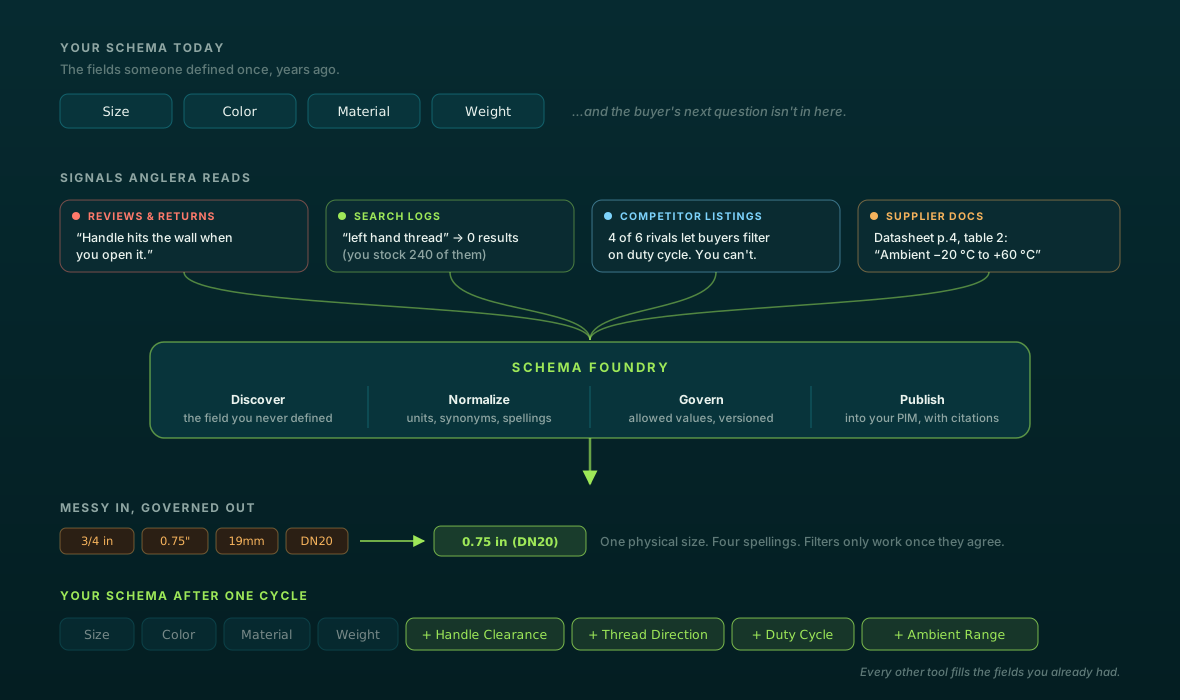
What neither platform provides is automatic enrichment. EnterWorks enforces business rules and governance on the data it receives — it does not fill missing attributes or research product specifications from external sources. Salsify tracks digital shelf readiness scores and offers some AI-assisted copy tools — but the content quality coming out is bounded by the content quality going in. That gap between raw supplier data and a distribution-ready catalog is where Anglera operates, regardless of which platform is in your stack.
| EnterWorks | Salsify | Anglera | |
|---|---|---|---|
| Primary function | Enterprise PIM/MDM/DAM hub: centralizes product data as governed master data with role-based workflows, business rules, complex product relationships, and integrations to ERP, e-commerce, and distribution systems | Product Experience Management (PXM): manages brand-side product content authoring and pushes it to retailers, marketplaces, and digital shelf destinations through a broad syndication network | Enrichment layer upstream of both: automatically gathers, fills, and scores SKU data against buyer signals before it reaches either platform's governance or syndication layer |
| Best-fit buyer | Mid-to-large B2B distributors, manufacturers, and wholesalers with complex multi-source data, strict governance requirements, and existing ERP dependencies — e.g., industrial, foodservice, electrical, HVAC distribution | Brands and manufacturers whose primary challenge is getting polished product content to retail partners and marketplaces quickly; especially useful when retailer-specific content requirements are a daily operational burden | Works for both profiles: B2B distributors use it to fill attribute gaps before enriching EnterWorks; brand teams use it to complete content before Salsify syndicates it outward |
| Data governance and MDM depth | One of the stronger PIM/MDM combinations on the market: hierarchy management, master data governance, configurable business rules, complex relationship management, and multi-source data consolidation across ERP inputs | Workflow-based content governance for brand teams; supports review and approval flows for digital content, but is not designed for enterprise MDM or multi-source master data consolidation across ERP systems | Complements governance in both: enriches attribute fields and scores completeness before records enter any governed workflow, reducing the volume of manual cleanup inside the PIM or PXM |
| Syndication and channel reach | Supports integrations to ERP systems, e-commerce platforms, and distribution channels; syndication is available as part of the platform but is not the primary differentiator or the reason most customers buy it | Broad syndication network to major retail and marketplace destinations is a core product strength — built-in connections to hundreds of trading partners with retailer-specific content templates and digital shelf scoring | Does not syndicate; enriches content quality upstream so that whatever syndication channel you use — Salsify's network, a separate feed, or EnterWorks' integrations — the data going out is complete and buyer-signal-optimized |
| Pricing and implementation cost | Custom enterprise licensing; reported base around $150,000, scaling with user count and implementation complexity. No free tier. Implementation timelines run months to over a year depending on data model and ERP integration scope. | Quote-based only; noted by reviewers as expensive relative to alternatives. Onboarding typically requires a third-party consulting engagement, with reported additional costs around $16,000. Timeline depends on catalog size and retailer connections. | Priced as an enrichment layer on top of your existing PIM investment — not a platform replacement. ~30-day implementation connects to your source of record without rip-and-replace. |
| ERP and back-office integration | Strong ERP and back-office integration story, amplified by the broader Precisely data integration ecosystem; designed for organizations where SAP, Oracle, or similar systems are the upstream source of product records | Integrates with common e-commerce and marketing systems (Shopify, Salesforce Commerce Cloud, Amazon, etc.); ERP integration is possible but not the platform's primary integration pattern or strength | Reads from and writes back to your existing system of record — ERP, PIM, or staging database — without requiring changes to your downstream integrations or channel connections |
| Built-in content enrichment | Stores and governs product content; does not automatically research missing attributes, generate copy, or score completeness against external buyer signals — content quality depends on what enters the system | Offers digital shelf readiness scoring and some AI-assisted copy tools; enrichment capability is oriented toward flagging gaps and assisting editors rather than automatically filling attributes at catalog scale | Purpose-built for enrichment: crawls supplier sites and external sources, fills missing attributes, normalizes values, generates buyer-signal-optimized copy, and writes complete records back to either platform as the system of record |
How to choose between EnterWorks and Salsify
Choose EnterWorks if your organization is a B2B distributor, manufacturer, or wholesaler with complex data governance requirements. EnterWorks earns its place when you have multi-source product data flowing from ERPs, supplier feeds, and engineering systems that need to be reconciled into a single authoritative record — and when role-based workflows, configurable business rules, and MDM depth matter more than digital shelf activation. Customers in industries like industrial distribution, foodservice, electrical supply, and HVAC are natural fits. If you are already in the Precisely ecosystem, the integration story is an added advantage.
Choose Salsify if your primary problem is getting brand content to retail partners and marketplaces quickly and accurately. Salsify's syndication network and retailer-specific content templates make the most sense when your team is managing digital shelf presence across dozens or hundreds of destination retailers — and when the publishing and activation workflow is the operational bottleneck, not the governance of underlying master data. It fits brands and manufacturers whose go-to-market motion runs through consumer retail channels more than internal B2B distribution.
Consider both only if you genuinely need enterprise MDM/governance internally (EnterWorks' strength) and broad retail syndication externally (Salsify's strength) and your catalog volume justifies two platform investments. More commonly, organizations in this position have EnterWorks as the governance layer and feed select channels via integration without a separate PXM platform.
A note on acquisition risk: EnterWorks has changed ownership twice — Winshuttle in 2019, then Precisely in 2021. Buyers doing long-term platform evaluations should assess roadmap continuity and support commitments directly with Precisely before committing.
Whichever you pick, the data still has to get done
Both EnterWorks and Salsify are built on the same assumption: the product data coming in is already reasonably complete and attribute-rich. That assumption is rarely true in practice.
EnterWorks enforces governance on what it receives. Its business rules validate and route records — they do not research missing specifications, generate missing copy, or score SKUs against what buyers are actually searching for. When attributes are incomplete, the record goes back to the team for manual research. At catalog scale, that creates a permanent backlog.
Salsify tracks digital shelf readiness and can flag thin content. But readiness scores cannot fill a missing voltage rating, UPC dimension, or product description. Retailers reject content that fails their attribute requirements regardless of how well the PXM workflow is configured — and the fixes land back on your team.
Anglera works in the gap between raw supplier data and distribution-ready content. It connects to your existing system of record — your EnterWorks deployment, your Salsify catalog, your ERP, your staging database — and runs enrichment automatically: crawling supplier sites and external sources, filling missing attributes, normalizing units and values, generating buyer-signal-optimized copy, and scoring every SKU for completeness. The enriched record writes back to your source of truth. EnterWorks continues to govern it; Salsify continues to syndicate it.
Implementation takes roughly 30 days. There is no rip-and-replace, no parallel system to maintain. Whichever platform you choose, the data flowing through it arrives complete — and stays complete as your catalog grows.
Frequently asked questions
Is EnterWorks still actively developed now that it is part of Precisely?
Precisely has continued to sell and support EnterWorks Enable as part of its data integrity portfolio since the 2021 acquisition. That said, any buyer considering a long-term commitment to EnterWorks should ask Precisely directly about the product roadmap, development investment, and support commitments — acquisition histories matter for platform longevity. Precisely also brings broader data integration and quality tooling that can complement an EnterWorks deployment.
Does Salsify work for B2B distributors, or is it mainly for consumer brands?
Salsify's heritage and primary strength is brand-side product authoring for consumer retail and marketplace channels. It has positioned itself for manufacturers and distributors as well, but its syndication network and digital shelf tooling are most valuable when retail partner content requirements are the core pain point. B2B distributors with complex internal data governance needs — multiple ERP sources, business rules, master data management — typically find EnterWorks or a dedicated enterprise PIM a closer fit.
Can Anglera replace EnterWorks or Salsify?
No. Anglera is an enrichment layer, not a PIM or syndication platform. It does not store your product catalog, manage workflows, enforce governance rules, or push content to retail partners. It connects to whichever system of record you already have and makes the data inside it more complete and buyer-signal-optimized. EnterWorks and Salsify handle governance and distribution; Anglera handles the enrichment work both platforms assume is already done.
What is the practical difference between a PIM, a PXM, and an MDM?
A PIM (Product Information Management) system is a central repository for product content — attributes, descriptions, images, pricing — used by internal teams to maintain a consistent catalog. A PXM (Product Experience Management) platform extends that to focus on how product content is experienced across specific channels, emphasizing digital shelf activation and retailer-specific publishing. MDM (Master Data Management) is the broader discipline of creating a single authoritative record for key business entities — products, customers, suppliers — often consolidating data from multiple ERP and operational systems. EnterWorks spans PIM and MDM; Salsify spans PIM and PXM. Many organizations need the MDM depth of EnterWorks or the syndication reach of Salsify, but not both.
We receive supplier flat files with missing specs across 80,000 SKUs. Which platform should we start with?
Neither platform is designed to fill those gaps automatically — both assume incoming data is reasonably complete. If you start with either platform before enriching the catalog, you are loading incomplete records into a governed system and then relying on manual research to close the gaps. The more effective sequence is to enrich first: run Anglera against your supplier files to fill missing attributes and score completeness, then load clean records into whichever PIM or PXM platform you choose. The platform operates on complete data from day one, and the ongoing enrichment cycle keeps pace as new SKUs arrive.