EnterWorks vs Syndigo: Governed PIM Hub or Content Distribution Network?
EnterWorks and Syndigo both carry the "product data platform" label, but they solve different problems at different points in the data lifecycle — and buying the wrong one, or paying for capabilities you do not need, is a recurring mistake among B2B distributors and manufacturers. This page gives you an honest read on what each platform actually does, who each one is genuinely built for, and how to think about the decision.
EnterWorks — now part of Precisely — is an enterprise PIM/MDM and DAM that has spent more than 20 years helping large B2B organizations govern their product data internally. It is the system of record: one governed hub where product teams define attribute models, enforce business rules, manage complex relationships, and integrate with ERPs, e-commerce platforms, and downstream syndication tools. Customers like Orgill, US Foods, and Johnstone Supply use it because B2B product catalogs are complex, data governance matters for internal operations, and they need a single authoritative source before data goes anywhere.
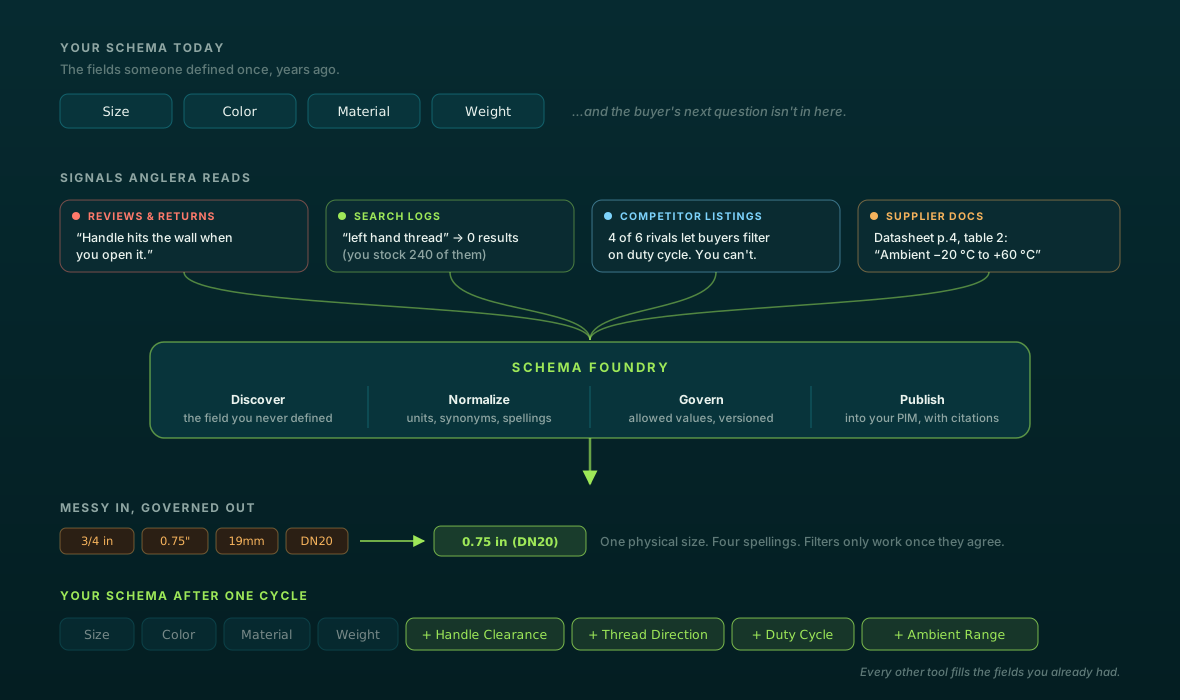
Syndigo is a Product Experience Management (PXM) platform built around its content distribution network. Following its acquisition of 1WorldSync, Syndigo now operates one of the largest product content networks in the world — 2,500+ retail and GDSN recipients, 10,000 data validations, and 23,000 unique retailer requirements baked into the platform. Its pitch is end-to-end: store your content, validate it against every retailer's spec, and push it out from a single hub. Both platforms share a critical assumption: that the product data going in is already reasonably complete. Neither was designed to research and fill missing attributes at scale. That is the gap Anglera was built for, regardless of which platform you choose.
| EnterWorks | Syndigo | Anglera | |
|---|---|---|---|
| Primary function | Enterprise PIM/MDM/DAM that governs product data as a single internal source of truth — attribute modeling, business rules, role-based workflows, complex hierarchies, and integrations to ERP and e-commerce systems | End-to-end Product Experience Cloud combining PIM, content syndication, DAM, and MDM with a built-in retail distribution network — the goal is storing and pushing content to every endpoint from one hub | Enrichment layer that runs before data reaches either platform — gathers missing attributes, normalizes values, and scores every SKU against buyer signals so the content going into EnterWorks or Syndigo is already complete |
| Distribution and syndication reach | No built-in syndication network; EnterWorks integrates with third-party syndication tools and retailer connectors via its API and partner ecosystem — content distribution is handled outside the platform | 2,500+ retail and GDSN recipients built-in following the 1WorldSync acquisition; one of the largest product content networks globally; 23,000 unique retailer requirements enforced natively | Channel-agnostic; enriches data in your PIM or source catalog and writes it back, so whatever flows into Syndigo's distribution network or through EnterWorks' integrations is already accurate and complete |
| Data governance and MDM depth | 20+ years of enterprise MDM capability: configurable business rules, role-based workflows, complex product relationships, and master data management across large B2B catalogs — built for organizations where internal governance is the core requirement | MDM capabilities exist but are oriented toward content compliance rather than deep internal governance; primary strength is validating outbound content against 10,000 retailer data validations, not managing complex internal data hierarchies | Adds attribute-level completeness scoring so governance teams can see exactly what is missing or inconsistent before records enter any workflow or distribution step |
| Ideal buyer | Mid-market to large B2B manufacturers, wholesale distributors, and retailers with complex internal catalog governance needs — organizations like industrial distributors, foodservice distributors, and specialty wholesale where internal operations drive the data model | Brands and manufacturers that need to push product content to large numbers of retail endpoints — especially CPG, consumer electronics, and hardlines brands for whom GDSN compliance and multi-retailer syndication are the primary pain point | Works alongside both profiles; any organization that receives incomplete supplier data or maintains a catalog where attributes are thin, inconsistent, or unscored against buyer intent benefits from Anglera upstream of either platform |
| Validation and compliance | Configurable business rules and validation logic defined by your team against your internal attribute model; validation is as strong as the rules you build and maintain — no pre-built retailer requirement library | 10,000 pre-built data validations covering 23,000 unique retailer requirements out of the box; if a record fails a retailer's spec, Syndigo flags it before syndication — reducing manual back-and-forth with trading partners | Reduces validation failures at source — enriched, normalized records pass retailer spec checks at a higher rate because the attributes are complete before they hit any validation gate |
| Pricing | Custom enterprise licensing, quote-based; reported base around $150,000 with cost scaling by user count and implementation complexity; no free tier or published tiers | Custom subscription pricing based on data volume, users, and feature tier; third-party estimates place TCO $10,000–$30,000 higher per year than smaller PIM alternatives for mid-market buyers; no public pricing | Separate enrichment subscription, priced independently of your platform choice; sits alongside either investment rather than adding another platform license |
How to choose between EnterWorks and Syndigo
Choose EnterWorks if your primary requirement is internal governance of a complex B2B product catalog. EnterWorks is the right fit when your organization needs a single, enterprise-grade master data hub — one where attribute models are tightly controlled, business rules enforce data quality across internal teams, and integration with ERP and operational systems is as important as any outbound channel. It has a long track record with wholesale distributors, industrial distributors, and specialty manufacturers where catalog complexity and internal process are the governing constraints. If you are already inside the Precisely ecosystem, the MDM alignment is an additional consideration. Note that EnterWorks does not include a built-in syndication network, so outbound distribution to retail trading partners will require additional tooling or integrations.
Choose Syndigo if you are a brand or manufacturer whose dominant pain point is getting product content into the hands of 10, 50, or 2,500 retail trading partners quickly and in the right format. The built-in network — including the GDSN reach from the 1WorldSync acquisition — means retailer onboarding is faster than building point-to-point integrations, and the pre-built validation library reduces the back-and-forth of spec failures. Syndigo is best suited for organizations where syndication volume and retail compliance are the primary drivers, and where internal MDM complexity is lower or handled elsewhere.
If you need both internal governance and broad retail syndication, some enterprises run EnterWorks as the master data hub and connect to Syndigo (or a standalone GDSN data pool) for outbound distribution. That is a legitimate architecture, though it carries the cost and integration overhead of two enterprise platforms. Before committing to both, be honest about whether your syndication volume actually justifies Syndigo's network fees, or whether a lighter integration layer off EnterWorks would serve the same purpose.
Whichever you pick, the data still has to get done
Whichever platform you choose, one problem remains: neither EnterWorks nor Syndigo was designed to fill the data.
EnterWorks stores and governs what your team puts in. Its business rules will tell you when an attribute is missing or violates a constraint — but the rule fires after a human has already failed to enter the value. At catalog scale, especially with large supplier-fed catalogs, the manual effort of researching and completing missing attributes lands back on your product team every time.
Syndigo validates against retailer specs and flags records that fail. That validation is powerful for reducing spec errors before syndication — but a record that fails a Walmart or Home Depot content check still has to be fixed manually before it can be pushed. Syndigo does not research the missing dimensions, fetch the missing images, or normalize the inconsistent unit values. It returns the problem to you.
Anglera works upstream of both. It connects to your existing system of record in roughly 30 days, crawls supplier sites and external sources, normalizes attribute values, scores every SKU against real buyer signals — how buyers actually search, compare, and decide — and writes enriched records back to your PIM or master data hub. By the time data enters EnterWorks' governance workflows or Syndigo's validation and syndication layer, it is already complete.
The result: fewer internal workflow exceptions in EnterWorks, fewer syndication failures in Syndigo, and a catalog that works harder for buyers regardless of which platform it flows through.
Frequently asked questions
EnterWorks is now part of Precisely — does that change the platform's direction?
Precisely acquired Winshuttle (which had acquired EnterWorks) in 2021 and continues to sell and support EnterWorks as part of its data integrity portfolio. The platform remains an enterprise PIM/MDM and DAM. Precisely's broader focus on data quality and integration may benefit EnterWorks customers over time, but the core platform and its B2B PIM positioning have not materially changed post-acquisition.
Syndigo acquired 1WorldSync — does Syndigo now replace 1WorldSync?
Syndigo absorbed 1WorldSync's operations and its GDSN data pool capabilities are now part of the Syndigo platform. If you were previously using 1WorldSync for GDSN syndication, that functionality continues under the Syndigo umbrella. For new buyers, Syndigo's pitch is that you no longer need separate PIM and GDSN data pool tools — they are combined. Whether that consolidation justifies the platform cost depends on your syndication volume and the breadth of retailer relationships you need to serve.
My team already has EnterWorks. Do I still need a syndication platform like Syndigo?
It depends on how many retail trading partners you distribute to and what format they require. EnterWorks integrates with syndication tools via its API, but it does not include a built-in retail network. If you distribute to a small number of trading partners, direct integrations or a lightweight connector may suffice. If you distribute to dozens of retailers with varying content requirements — or need GDSN compliance — a dedicated syndication layer like Syndigo adds meaningful value on top of your EnterWorks investment.
Neither platform fills missing product attributes automatically — what are my options?
Both EnterWorks and Syndigo surface completeness gaps and validation failures, but neither researches and fills the missing data. Options include manual editorial teams, offshore enrichment vendors (slow and project-based), or a dedicated enrichment layer. Anglera is purpose-built for this: it connects to your existing PIM or master data hub, automatically enriches missing attributes against buyer signals, and writes the completed records back — so your EnterWorks workflows and Syndigo validations see complete data from the start.
How long does Anglera take to implement alongside EnterWorks or Syndigo?
Anglera's typical implementation is around 30 days. It connects to your existing system of record — whether that is EnterWorks, Syndigo, an ERP, or another data store — without replacing it. There is no rip-and-replace, no parallel catalog to maintain, and no need to change your existing platform workflows.