Feedonomics vs inriver: Feed Management or PIM First?
Feedonomics and inriver solve different problems. Comparing them head-to-head only makes sense if you first know which problem you actually have.
Feedonomics is a managed-service feed syndication platform. It takes product data you already have, transforms it to channel specifications, and distributes it across 300+ ad channels and marketplaces — Google Shopping, Amazon, Walmart, Microsoft, and more. A team of feed specialists handles setup and ongoing optimization on your behalf. If your question is "how do I get my products seen everywhere, fast, without managing feed errors myself," Feedonomics is designed for exactly that. It does not store or govern your product data; it moves and optimizes it.
inriver is a PIM. Its job is to be the single source of truth for your product content — centralizing attributes, governing data quality across teams, onboarding supplier data, and distributing it to channels. inriver bundles syndication and digital shelf analytics into the same platform, which gives manufacturers and brands a managed lifecycle from supplier to shelf. If your question is "how do I get control over product data that lives in too many places, varies by region, and arrives inconsistently from suppliers," inriver is designed for that. Neither platform solves the problem both share: the product data entering the system is rarely buyer-ready to begin with.
| Feedonomics | inriver | Anglera | |
|---|---|---|---|
| Primary function | Managed feed syndication — transforms, optimizes, and distributes product data to 300+ ad channels and marketplaces; feed specialists handle setup and ongoing error resolution on the customer's behalf | SaaS PIM — consolidates, governs, enriches, and distributes product content; positions itself as the single source of truth for the full product content lifecycle from supplier onboarding through digital shelf analytics | Enrichment layer — not a PIM or syndication platform; reads from whichever system is the source of record, enriches every SKU against buyer signals, and writes results back before distribution |
| Channel and destination reach | 300+ ad channels and marketplaces including Google Shopping, Amazon, Microsoft Advertising, and Walmart; this breadth is Feedonomics' core differentiator | Built-in syndication to retail and digital shelf channels; the platform is designed for omnichannel distribution, but the emphasis is lifecycle management, not channel breadth as a standalone metric | Channel-agnostic — enriched data flows to whichever platform distributes it; Anglera works upstream of both |
| Data governance and structure | No master data store — Feedonomics ingests data from your existing catalog source, maps it to destination specs, and transforms it for each channel; it does not govern or model your product taxonomy | Full PIM with configurable data modeling, attribute governance, supplier onboarding workflows, approval processes, and localization support; designed to be the governed system of record | PIM-agnostic — adapts to the schema defined in inriver or whichever catalog system is in use; no data model changes required in the source system |
| Who it is built for | Retailers, DTC brands, and marketplace sellers who need their products live across ad channels quickly with specialist support managing feed health; strong alignment with BigCommerce merchants | B2B manufacturers, brands, and distributors managing complex product hierarchies, multi-locale content, and supplier relationships who need a governed platform covering the full product content lifecycle | B2B distributors, retailers, and manufacturers whose product data needs to be richer and buyer-ready before it reaches either platform |
| Enrichment capability | Optimizes existing product data for feed compliance and channel specifications — title reformatting, attribute mapping, error correction; does not generate net-new product content or buyer-signal-driven copy | AI-assisted content generation and completeness scoring within the PIM; supplier onboarding tools normalize incoming data; enrichment is governed by internal templates and data rules defined by the team | Autonomous enrichment driven by buyer signals — how real buyers search, compare, and decide — not reformatted supplier copy; writes results back to the source system without a copywriter in the loop |
| Implementation model | Managed-service model: feed specialists handle setup, feed optimization, and ongoing channel error resolution on the customer's behalf; service is included rather than offloaded to the buyer | SaaS platform; implementation typically involves inriver's professional services team or a system integrator to configure data models, supplier onboarding, and channel distribution before going live | ~30 days from kickoff to enriched SKUs written back to the source system; no platform migration required |
| Pricing | Custom quote only; varies by SKU count, number of channels, and service tier; no revenue-share model; no self-serve pricing | Subscription-based; Core, Professional, and Enterprise tiers priced by users, modules, and data volume; no public pricing — custom quotes only | Priced per SKU enriched — layers onto your existing stack rather than replacing it |
How to choose between Feedonomics and inriver
Choose Feedonomics if your core problem is distribution: you have product data in a catalog system already, and the bottleneck is getting those products optimized and live across ad channels and marketplaces at scale. Feedonomics' managed-service model is particularly well-suited to teams that do not want to own feed operations in-house — the specialists handle the transformation, error resolution, and ongoing optimization. If you are on BigCommerce or run a retail/DTC business where Google Shopping, Amazon, and Walmart are the primary growth levers, Feedonomics' 300+ channel reach and hands-on service model are its clearest strengths.
Choose inriver if your core problem is governance: product data lives in too many places, arrives inconsistently from suppliers, varies across regions, or lacks the structure needed before it can be distributed anywhere. inriver's PIM-first architecture — with supplier onboarding workflows, configurable data modeling, and built-in syndication and digital shelf analytics — is built for B2B manufacturers, brands, and distributors who need a governed single source of truth before the question of channel distribution even becomes relevant.
A few signals that clarify the choice:
- If your product data is already reasonably well-structured and the pain is purely getting it in front of buyers across ad channels, Feedonomics solves that faster and with less internal operational overhead.
- If your catalog has supplier data quality problems, localization needs, or complex product hierarchies that require governance before distribution, inriver addresses the root cause rather than the symptom.
- Some buyers use both: inriver as the governed PIM and Feedonomics handling ad channel feed distribution, treating them as complementary layers in the same stack rather than alternatives.
- If you are early-stage and evaluating total cost of ownership, note that both require a sales conversation before pricing is revealed; build time for discovery calls with each vendor into your evaluation timeline.
Whichever you pick, the data still has to get done
Feedonomics optimizes and distributes your product data. inriver governs and centralizes it. Both platforms assume the product data itself is already buyer-ready — complete attributes, accurate specifications, titles that match how buyers actually search, descriptions that answer the questions a buyer has before purchase. In practice, that assumption is almost never true.
Supplier data arrives as raw specs written for procurement teams, not for the digital shelf. Attributes are incomplete or inconsistent. Descriptions are factory copy. Feed optimization can reformat a bad title; a PIM can store a thin description in a well-structured field. Neither platform automatically makes the content better.
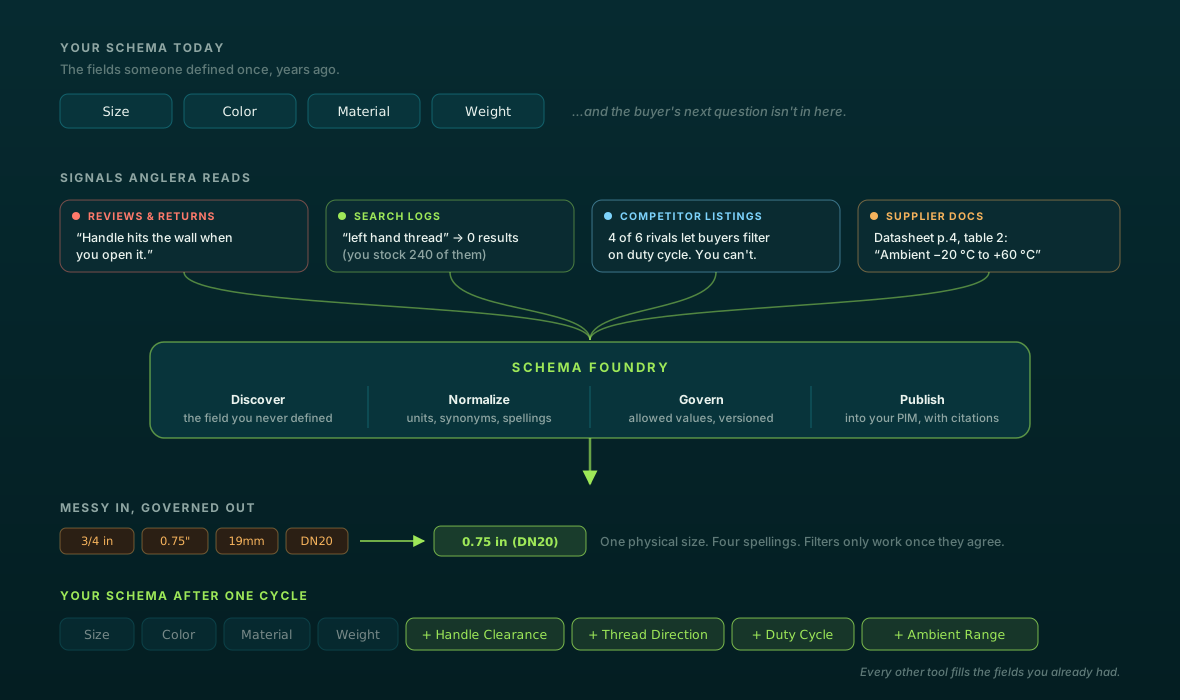
Anglera is the layer that does that work. It connects to your existing source of record — whether that is inriver, another PIM, or an ERP — pulls every SKU, enriches attributes and copy against buyer signals (how your customers actually search, compare, and filter), scores completeness, and writes the improved content back. If Feedonomics is your distribution engine, the feeds it sends to 300+ channels carry richer, buyer-ready data. If inriver is your PIM, the content it governs and distributes is accurate and complete before it ever reaches a syndication endpoint. Whichever platform you pick, Anglera handles the enrichment work both assume has already happened. Implementation is ~30 days with no platform migration required.
Frequently asked questions
What is the main difference between Feedonomics and inriver?
Feedonomics is a managed feed syndication platform — it takes product data you already have, optimizes it for each channel's specifications, and distributes it to 300+ ad channels and marketplaces with specialist support. inriver is a PIM — it is the system of record where product data is consolidated, governed, enriched, and then distributed. Feedonomics moves and optimizes data; inriver stores and governs it. They solve different problems and can be used together.
Can Feedonomics and inriver be used together?
Yes. Some companies use inriver as the master PIM — the governed source of truth for product content — and Feedonomics to handle ad channel and marketplace feed distribution. In that setup, inriver manages data quality, localization, and lifecycle governance, while Feedonomics handles the transformation and distribution logic for each channel destination. The two platforms operate on different parts of the same workflow rather than competing for the same role.
Does inriver replace the need for a feed management tool like Feedonomics?
Partially, for some channels. inriver has built-in syndication and digital shelf analytics, so straightforward distribution to retail partners and digital shelf destinations is handled natively. Where Feedonomics tends to add value is in ad channel distribution breadth — 300+ destinations including Google Shopping, Amazon advertising feeds, and similar — and in the managed-service model where specialists handle feed health and optimization. If your distribution needs are primarily retail channel content rather than ad feed optimization, inriver's native syndication may be sufficient.
How does Anglera work alongside Feedonomics or inriver?
Anglera connects to your source of record — inriver, another PIM, or an ERP — via API. It reads your existing SKUs, enriches every attribute and description against buyer signals (how your customers actually search, compare, and decide), and writes the improved content back to the same system. If Feedonomics is your distribution layer, it picks up richer, buyer-ready data from that source. If inriver is your PIM, the content it governs and distributes is more complete. Anglera enriches upstream of both platforms in roughly 30 days, with no migration required.
Which platform is better for B2B distributors with complex catalogs?
inriver. B2B distributors with deep product hierarchies, supplier onboarding needs, and multi-channel distribution requirements are inriver's design target. Feedonomics is built more for retail and DTC ad channel distribution, where the catalog is often simpler and the primary need is getting products visible across shopping and marketplace channels. A distributor with a complex catalog typically needs a governed PIM before the question of feed distribution becomes relevant.