Feedonomics vs Plytix: Feed Syndication vs. PIM — Which Do You Actually Need?
Feedonomics and Plytix are frequently searched in the same breath, but they are not solving the same problem. Feedonomics is a feed syndication platform: it takes the product data you already have and gets it to 300+ ad channels and marketplaces, managed by specialists. Plytix is a PIM: it gives teams a central place to build, store, manage, and publish product content — with built-in DAM, AI content generation, and feed distribution, all aimed at SMBs. One moves data; the other organizes and creates it.
That distinction matters before you spend time evaluating either. If you need a system of record for product content — a place your team authors, stores, and manages every SKU — Feedonomics is not that. If you already have your content managed and your primary need is reaching the maximum number of ad channels with a managed service, Plytix's syndication reach will not match Feedonomics. Picking the wrong tool means buying a solution to a problem you are not actually having.
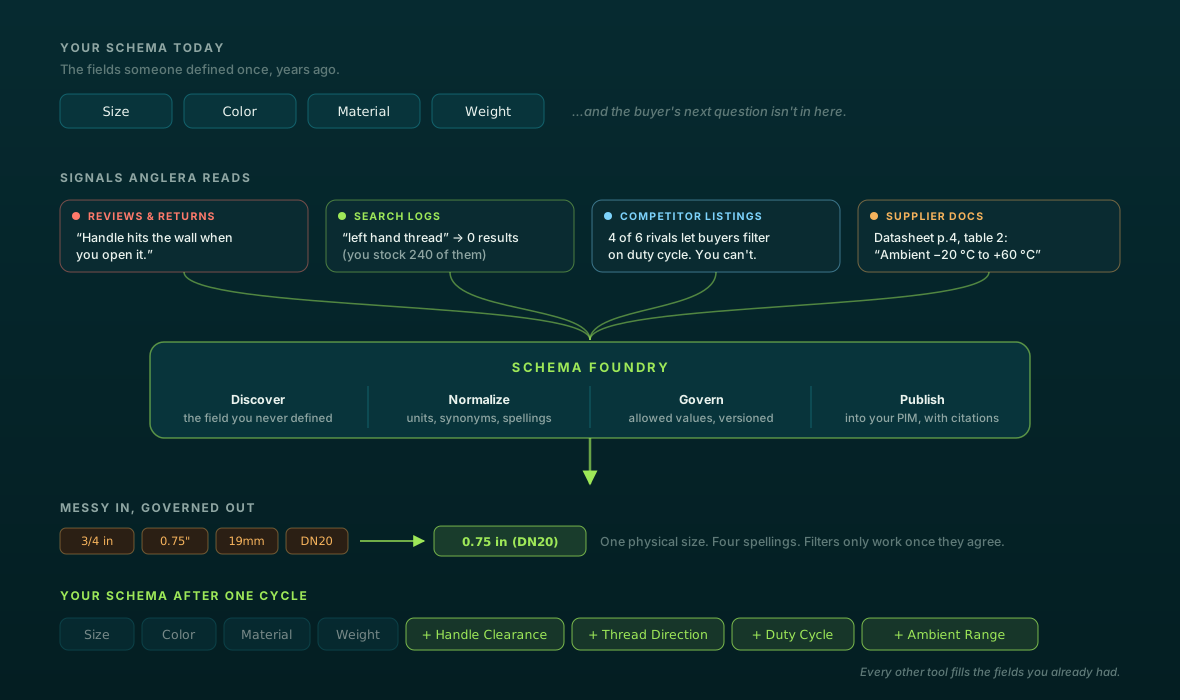
The gap both tools share is the same one that affects most of the PIM and syndication market: neither is built to enrich product data against buyer signals before it is stored or distributed. Feedonomics assumes you have clean, complete content and distributes it. Plytix gives your team AI tools to generate content from what you already have. What neither does automatically is research how buyers actually search, fill missing attributes from external sources, and score every SKU for conversion readiness before any of the above happens.
| Feedonomics | Plytix | Anglera | |
|---|---|---|---|
| Primary job-to-be-done | Distribute existing product data to 300+ ad channels and marketplaces via a managed-service model — feed transformation, optimization, and error resolution handled by specialists | Centralize product content in an all-in-one PIM — store, organize, create, and publish from a single platform with unlimited users | Enrich the product data that either platform then handles — filling attributes, scoring completeness, and writing buyer-signal-optimized content back to the source of truth |
| Channel distribution reach | 300+ destinations including Google Shopping, Amazon, Microsoft Advertising, Walmart, and major global marketplaces — one of the broadest channel networks in feed management | Ecommerce channels and marketplaces via built-in feed syndication; channel add-ons available; fewer destinations than Feedonomics by design, focused on core commerce channels | Not a syndication tool — enriches the product data so that whatever channels Feedonomics or Plytix distributes to, the content arriving there is complete and buyer-ready |
| Content creation and enrichment | Feed transformation and optimization only — maps, reformats, and routes existing data to channel specs; not designed to generate, rewrite, or enrich product content | Built-in AI generates and translates product descriptions from existing data; teams build product content inside the PIM using unlimited user access | Autonomous enrichment driven by buyer signals — attribute extraction, gap-filling, title and description rewriting, and content scoring against how buyers actually search and decide |
| How work gets done | Managed service — dedicated feed specialists handle setup, ongoing optimization, and error resolution on your behalf; no-revenue-share pricing model | Self-serve platform — unlimited users collaborate inside the PIM; AI tools support content generation and translation; your team owns the work | Automated enrichment pipeline runs against your catalog continuously; human review focuses on exceptions and score thresholds, not field-by-field data entry |
| Pricing model | Custom enterprise quote only — varies by SKU count, channel count, and service tier; no public pricing; no revenue share | Freemium entry point available; paid plans start around $733/month; catalog-size-based tiers with add-ons for AI credits and extra distribution channels; unlimited users on all plans | Priced per SKU enriched — layers onto your existing Feedonomics or Plytix investment rather than replacing it |
| Best-fit company size and stage | Mid-market to enterprise retailers and brands with existing product content who need maximum channel reach and want specialists accountable for feed health | Small to mid-sized businesses that do not have a PIM yet and want an affordable, all-in-one content management and publishing platform with minimal IT involvement | Works alongside either — typically deployed by distributors, manufacturers, and mid-market retailers whose catalogs have incomplete or supplier-raw product data regardless of which platform they pick |
| Implementation | Specialist-led onboarding — setup timelines vary by channel count and data complexity; ongoing management is included as part of the service model | SaaS self-onboarding; smaller teams can be up in days; scale depends on catalog complexity and how much content your team still needs to build | ~30 days from kickoff to enriched SKUs written back to whichever system holds your catalog; no platform migration required |
How to choose between Feedonomics and Plytix
Choose Feedonomics if your primary pain is distribution reach, not content management. This means you already have your product content reasonably organized — in a PIM, an ERP, or a structured catalog — and your bottleneck is getting that content to the right ad channels and marketplaces accurately, at scale, without building and maintaining feed rules in-house. Feedonomics' managed-service model and 300+ channel network are purpose-built for that problem, and the no-revenue-share commitment is meaningful for retailers running high-GMV feeds. It is the right call for mid-market and enterprise teams that want specialists accountable for feed quality rather than internal headcount managing rules.
Choose Plytix if you are an SMB that does not have a PIM and needs one. Its all-in-one model — PIM, DAM, AI content generation, and feed syndication under one roof — is the most practical entry point for lean teams that need to centralize and publish product content without stitching together multiple tools. The freemium tier and unlimited-user pricing make it accessible in a way that most enterprise PIMs are not. If you are at a stage where your biggest problem is "we have no single source of truth for our product data," Plytix is a strong starting point.
The honest note on which is a direct competitor: in most buying situations, Feedonomics and Plytix are not competing for the same dollar. A business evaluating both is usually asking two different questions — "how do we manage our product content?" and "how do we get it everywhere?" — and may end up with both. Feedonomics does not replace a PIM; Plytix's syndication reach does not match a dedicated feed management platform. If you are trying to decide between them, clarify which problem is more urgent first.
A few signals that clarify the choice:
- If you have a PIM and need multi-channel distribution, Feedonomics wins on reach and specialist accountability.
- If you have no PIM and limited budget, Plytix's freemium tier gives you a starting point Feedonomics does not offer.
- If your team needs to author and manage product content collaboratively, Plytix's unlimited-user model is a structural advantage.
- If your revenue depends on Google Shopping and Amazon feed performance and you want expert hands managing it, Feedonomics' managed-service model removes that burden from your team.
Whichever you pick, the data still has to get done
Whichever platform you choose, the quality of your underlying product data is what determines downstream results. Feedonomics distributes what your catalog already holds; Plytix gives your team tools to generate and manage content from that same starting point. Neither platform's job is to go research how buyers search your category, identify which attributes are missing across your full SKU catalog, or write structured product content anchored to purchase intent rather than supplier copy.
That is the work Anglera does. It connects to your existing source of truth — your PIM, your ERP, your data warehouse — reads your current SKUs, enriches every attribute and description against buyer signals (what buyers search for, how they compare options, what information drives conversion), scores each SKU for content completeness, and writes the improved data back to the same record. No platform migration. No rip-and-replace.
If you go with Feedonomics: the data Feedonomics distributes to 300+ channels starts from Anglera-enriched records — complete attributes, buyer-signal-optimized titles, no thin descriptions reaching your top ad channels. If you go with Plytix: Anglera fills in what the PIM's AI tools cannot — external attribute sourcing, gap-filling across your full catalog, and completeness scoring before content is published. Either way, implementation is ~30 days and Anglera works alongside the tool you already chose, not instead of it.
Frequently asked questions
Are Feedonomics and Plytix actually direct competitors?
Not really. Feedonomics is a feed syndication platform: it distributes your product data to 300+ ad channels and marketplaces via a managed-service model. Plytix is a PIM: it centralizes, manages, and publishes product content for SMBs. Feedonomics assumes you already have your content managed elsewhere. Plytix includes feed syndication but to fewer channels. A buyer evaluating both is usually asking two separate questions — where to manage product content, and how to distribute it widely — and may end up using tools for both purposes.
Does Feedonomics include a PIM or content management?
No. Feedonomics is a feed management and syndication platform, not a PIM. It reads from your existing catalog and transforms and routes that data to channels — it does not provide a place to author, store, or manage product content. If you need a system of record for product information, you will need a separate PIM alongside Feedonomics.
Is Plytix suitable for enterprise companies, or only SMBs?
Plytix is built and positioned for small to mid-sized businesses. Its unlimited-user model, freemium entry point, and self-serve onboarding are designed for lean teams that need an accessible, all-in-one tool. Enterprise companies with large, complex catalogs, deep localization requirements, or the need for advanced governance and channel connectivity typically outgrow Plytix and move to platforms like Akeneo, Salsify, or inriver.
What does Anglera add that Feedonomics and Plytix do not provide?
Feedonomics distributes your product data; Plytix manages and publishes it. Neither platform automatically researches how buyers in your category search and compare, identifies which attributes are missing or thin across your catalog, or writes enriched product content anchored to purchase intent rather than supplier copy. Anglera does that work upstream of both platforms — connecting to your existing system of record, enriching every SKU against buyer signals, and writing the improved data back before Feedonomics distributes it or Plytix manages it. Implementation is ~30 days with no platform replacement required.
How does Plytix's feed syndication compare to Feedonomics?
Plytix includes built-in feed syndication to major ecommerce channels and marketplaces as part of its all-in-one model, but it is not its primary design focus and covers fewer destinations than Feedonomics' 300+ channel network. Feedonomics' core competency is feed distribution at scale — with a managed-service model, specialist support, and a channel breadth that Plytix's syndication add-ons do not match. If multi-channel reach with expert management is the primary requirement, Feedonomics is the stronger choice on that dimension.