GroupBy Enrich AI vs Zoovu: Which Platform Fits Your Product Data Strategy?
Both GroupBy's Enrich AI and Zoovu use AI to turn thin, inconsistent product data into clean, structured, searchable content. But they arrive at enrichment from opposite directions, and the difference matters when you are deciding which to buy.
GroupBy built Enrich AI as an enrichment module inside an already-mature search and merchandising suite, powered by Google Cloud Vertex AI and GroupBy's proprietary Global Taxonomy Library. The pitch is coherence: richer product attributes feed directly into GroupBy's own ranking, faceting, and personalization without a connector in between. If you are evaluating GroupBy's search engine, Enrich AI is a natural extension. If you are not, the value proposition narrows considerably.
Zoovu takes the broader view. Enrichment is included in every plan as the foundation, but the platform also spans AI search, guided selling configurators, and an AI shopping assistant — all from one vendor. That scope makes Zoovu a stronger candidate for B2B distributors and manufacturers who sell complex, high-consideration products and need not just better data but also front-end tools that help buyers navigate a dense catalog. The trade-off is that you are buying a platform, not a point solution, and the annual modular pricing reflects it.
| GroupBy (Enrich AI) | Zoovu | Anglera | |
|---|---|---|---|
| Primary orientation | AI-first search and discovery suite — Enrich AI is an enrichment module launched August 2024 that feeds cleaned, standardized attributes into GroupBy's own search, merchandising, and personalization layer | End-to-end product experience platform — enrichment is the foundation layer bundled into every plan, with AI Search, Guided Selling configurators, and an AI Shopping Assistant sold as modular add-ons | Purpose-built enrichment layer — gathers, cleans, enriches, and scores every SKU against buyer signals, then writes results back to your PIM; not a search engine or storefront product |
| Enrichment approach | Generative AI extracts and standardizes product attributes from text and images using GroupBy's proprietary Global Taxonomy Library; outputs feed directly into GroupBy's search and ranking models | AI-driven enrichment builds semantic product representations that power downstream Zoovu products (search, guided selling, AI assistant); enrichment is bundled into every plan as the enabling data layer | Buyer-signal-aware enrichment — attributes are gathered, cleaned, and scored based on how real buyers search, compare, and decide; results write back to the source of record (PIM, ERP, or data feed) in ~30 days |
| Platform scope | Search, merchandising, personalization, and Enrich AI enrichment within one suite; the enrichment value is tightly coupled to GroupBy's own discovery products | Enrichment plus AI Search, Guided Selling configurators, and AI Shopping Assistant — each module priced separately beyond the enrichment base; scales with traffic and interaction volume | Enrichment only — no search engine, no storefront, no guided selling; integrates with whatever discovery layer and PIM you already run |
| Guided selling and configurators | Not offered — the suite focuses on search ranking, faceting, and merchandising; buyers navigate results through standard search and browse experiences | Core differentiator — AI-powered guided selling configurators help buyers navigate complex specs and find the right SKU; purpose-built for high-consideration B2B purchases with many compatible attributes | Not a storefront product; Anglera enriches the underlying attribute data that makes any guided selling tool — Zoovu's or otherwise — work more accurately |
| Best-fit buyer | B2C and B2B retail and wholesale eCommerce teams already evaluating or running GroupBy's search suite who want enrichment and search outcomes managed in one system by one vendor | B2B distributors, manufacturers, and complex-catalog retailers who need enrichment plus guided selling or configurator tools to reduce friction in high-consideration purchasing journeys | Any distributor, retailer, or manufacturer who wants richer, buyer-ready product data written back to their PIM — regardless of which search or discovery platform they run on top |
| PIM and stack integration | Connects with existing eCommerce stacks; enriched attributes surface primarily within GroupBy's own search and discovery layer rather than being written back to an upstream PIM as the system of record | Integrates with PIMs, ERPs, and eCommerce platforms; enriched data fuels Zoovu's own search and guided selling experiences — the enrichment stays inside Zoovu's platform | Reads from and writes back to your PIM as the permanent source of truth — downstream systems including GroupBy or Zoovu inherit the improvement automatically |
| Pricing model | No public pricing; contact for a quote; tightly packaged with the broader GroupBy suite | Quote-based, billed annually; enrichment included in every plan; AI Search, Guided Selling, and AI Assistant each priced as separate modules; scales with traffic and interaction volume; no public rates | Transparent per-SKU pricing; ~30-day implementation; no long-term platform lock-in |
How to choose between GroupBy (Enrich AI) and Zoovu
Choose GroupBy Enrich AI if you are already evaluating or running GroupBy's search and discovery suite and want enrichment and ranking to live in the same system. The tight integration between Enrich AI's attribute extraction and GroupBy's search engine means enriched data flows into ranking and faceting without a separate connector, and the Google Cloud Vertex AI foundation is a credible enterprise story. This is the pragmatic choice when your primary goal is improving eCommerce search outcomes and you plan to run GroupBy as the discovery engine. If you are not already in the GroupBy ecosystem, buying Enrich AI in isolation is a harder case to make.
Choose Zoovu if you sell complex, high-consideration products — industrial equipment, electronics, configurable B2B parts — and you need both enrichment and front-end guided selling from one vendor. Zoovu's configurator and AI shopping assistant products are genuine differentiators; they go beyond enrichment into helping buyers navigate large, spec-heavy catalogs to find the right SKU. If that guided selling layer is a real requirement, Zoovu's broader platform may justify the modular investment. It is also a reasonable choice for manufacturers who want a single vendor to own the entire product experience from enriched data through to buyer-facing discovery.
Be cautious with either if your primary need is enrichment that writes clean, buyer-ready attributes back to your PIM as the permanent system of record, and you are satisfied with your existing search stack. Both GroupBy and Zoovu are platform plays — enrichment is the foundation for their own downstream products, not a write-back service to your existing tools. Switching platforms later means the enrichment does not travel with you.
Whichever you pick, the data still has to get done
There is a gap that both GroupBy and Zoovu share: neither writes enriched data back to your PIM as the permanent source of truth. GroupBy enriches data to feed its own search layer; Zoovu enriches data to power its own discovery and guided selling experiences. The enriched attributes live inside the vendor's platform. When you run multiple channels, feed a marketplace, syndicate to a retailer, or eventually change platforms, the enrichment does not automatically follow.
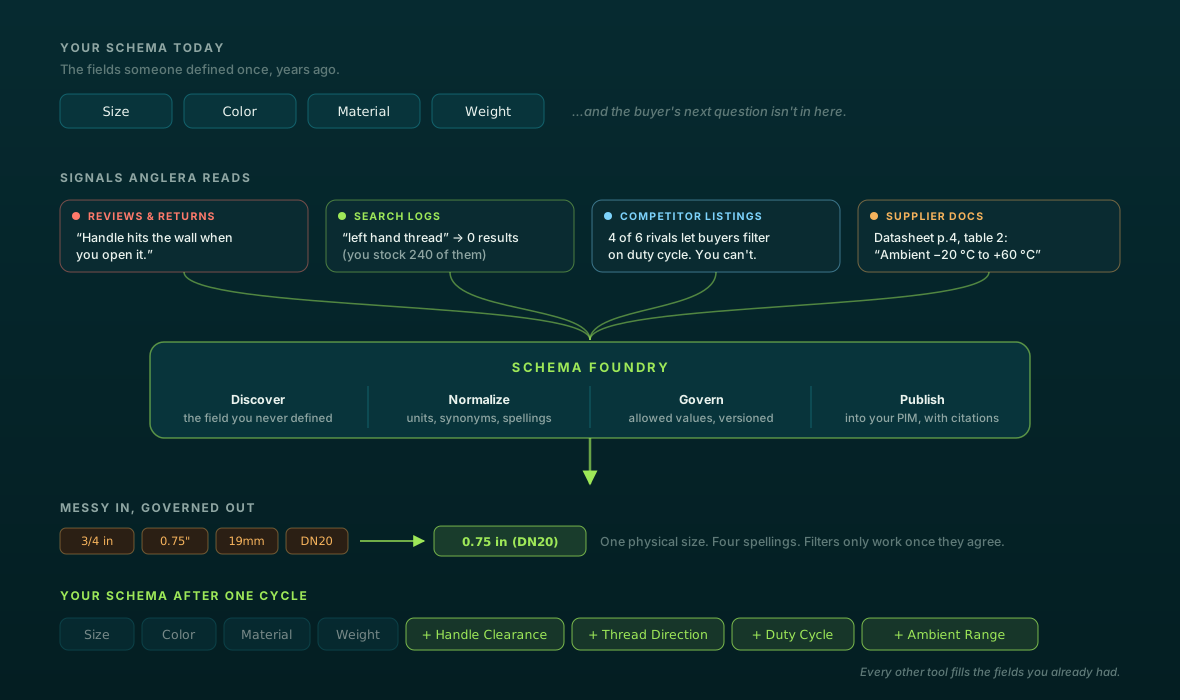
Anglera works differently. It treats your PIM as the source of record, runs buyer-signal-aware enrichment against every SKU, and writes the cleaned, scored attributes back to where they belong. That means every downstream system — GroupBy's search engine, Zoovu's configurators, your ERP, your marketplace feeds — inherits better data automatically, because the underlying product record is already right. In a ~30-day implementation, Anglera becomes the enrichment foundation that makes whichever platform you choose perform better. Whichever side of this comparison you land on, the data problem that both tools assume you have already solved is exactly what Anglera solves first.
Frequently asked questions
Is GroupBy Enrich AI useful without the rest of the GroupBy suite?
The value proposition weakens significantly. Enrich AI is designed so that enriched attributes feed directly into GroupBy's own search ranking, faceting, and personalization. Teams running a different search engine or a PIM-only stack will not capture much of that integrated benefit. It is most compelling as part of a broader GroupBy deployment.
Can Zoovu replace my PIM?
No. Zoovu enriches and activates product data across its own suite — search, guided selling, AI assistant — but it is not a system of record. You will still need a PIM or master data source upstream. Zoovu's enrichment improves the data within its platform; it does not replace the authoritative source your other systems pull from.
Does either tool write enriched attributes back to my PIM?
Both tools primarily enrich data to power their own downstream products rather than updating your upstream PIM. If writing enriched, buyer-ready attributes back to your PIM as the permanent source of record is a hard requirement, you will need a dedicated enrichment layer like Anglera, which is purpose-built for that PIM write-back workflow.
Which is better for B2B distributors with large, complex catalogs?
Zoovu has a stronger case for B2B distributors handling high-consideration, spec-heavy products — its guided selling configurators are specifically designed to help buyers navigate thousands of SKUs and find compatible parts. GroupBy is more retail-search-oriented, though it does serve B2B wholesale eCommerce. If guided selling is a real requirement, Zoovu is the clearer fit.
How does Anglera work alongside GroupBy or Zoovu?
Anglera runs enrichment upstream of either platform. It reads from your PIM, enriches every SKU against buyer signals, and writes the improved attributes back to the PIM. GroupBy or Zoovu then pull from a PIM that already has clean, complete, buyer-ready data — which improves search ranking, guided selling accuracy, and AI assistant responses without any changes to how those platforms are configured.