All comparisons
An alternative to GroupBy (Enrich AI)AI enrichment tools

Anglera vs GroupBy (Enrich AI)

The bottom line

Buy GroupBy if you're buying its search and discovery engine and want enrichment tuned to feed it; buy Anglera if enrichment has to live in your PIM, cite every value to a supplier document, and follow how buyers search.

Both claim to enrich product data. This page is about where that claim stops.

The frame for this comparison

Product data is a practice, not a project.

With an enrichment-AI tool the real question isn't whether the run fills the fields you already model — it's who decides, in month seven, that hinge side needed to be a field at all, when a vendor reformats its spec file and the search log names an attribute nobody has modelled yet.

01

Ground it

Mine every spec from every source.

Every value traced to a document you can open. The catalog is only as honest as what it was built from.

02

Align it

Aim the catalog at the buyer who actually buys.

Grounded data still loses if it answers questions nobody asked. Alignment is what turns specs into conversion.

03

Keep it alive

Product data is a practice, not a project.

Markets move, suppliers reissue, buyers change what they ask for. A catalog that is right in March is wrong by August unless something is watching.
Capability by capability

Where GroupBy (Enrich AI) stops.

Scored against public documentation. Grouped by the three acts — so you can see which ones GroupBy (Enrich AI) leaves on your desk.

01

Ground it

Mine every spec from every source.
Source mining
Where does it get specs from?
GroupBy (Enrich AI)Limited

Mines product text and images; no supplier document mining shown

AngleraYes

PDFs, spec tables, drawings, manuals, images, sites

Schema discovery
Does it find attributes that aren't in your schema yet?
GroupBy (Enrich AI)Limited

Adds attributes from prebuilt Global Taxonomy library, not autonomous discovery

AngleraYes

Proposes fields your schema never had

Governed vocabulary
Does it turn messy free-text into a governed pick list?
GroupBy (Enrich AI)Yes

Global Taxonomy standardizes attribute values; synonyms out of box

AngleraYes

Normalizes and governs allowed values, versioned

Taxonomy & classification
Can it classify every SKU into your hierarchy?
GroupBy (Enrich AI)Yes

Core strength: Global Taxonomy classification plus taxonomy creation, management

AngleraYes

Auto-classifies; channel and marketplace mapping

Citations & provenance
Can you see where any given value came from?
GroupBy (Enrich AI)No

Enrich Viewer reviews values; no per-value source citations found

AngleraYes

Every value cites its source doc and page

02

Align it

Aim the catalog at the buyer who actually buys.
Buyer personas
Is the content written for your buyer, or generically?
GroupBy (Enrich AI)Limited

Attribution aligned to shopper search intent; no persona-split output

AngleraYes

B2B specifier and B2C shopper enriched differently

Review, search & social signals
Does it learn what buyers ask from the live market?
GroupBy (Enrich AI)Yes

Site search queries, null searches, trends refine attribution strategy

AngleraYes

Reviews, search, competitor rails, social — fed back

Copy & SEO
Does it write original, channel-ready copy?
GroupBy (Enrich AI)Limited

Attribution-focused; description generation not clearly documented

AngleraYes

Original copy per persona and channel

Product imagery
Can it produce usable images for SKUs that lack them?
GroupBy (Enrich AI)No

Reads images to extract attributes; does not generate images

AngleraYes

Generates studio-grade imagery for photoless SKUs

03

Keep it alive

Product data is a practice, not a project.
Continuous re-enrichment
What happens when the market moves after go-live?
GroupBy (Enrich AI)Yes

Catalog-as-a-Service maintains enrichment as catalog churns

AngleraYes

Re-enriches on its own after go-live

Quality scoring
Does it score its own output and track catalog health?
GroupBy (Enrich AI)Limited

Automated data quality checks; completeness scorecards not documented

AngleraYes

Scored against your standards; nothing publishes below bar

Write-back
Does enriched data land back in your system of record?
GroupBy (Enrich AI)Limited

PIM/PXM integration cited; primarily feeds GroupBy discovery platform

AngleraYes

Writes back to PIM, ERP, warehouse, commerce

API, MCP & webhooks
Can your own tools and agents drive it headlessly?
GroupBy (Enrich AI)Limited

Headless REST API and SDKs; no public webhooks or MCP

AngleraYes

API, webhooks, and MCP servers

Who does the work
Does it do the work, or help your team do it?
GroupBy (Enrich AI)Limited

GroupBy curators and ML, plus customer review in Enrich Viewer

AngleraYes

Anglera owns the work; review is a guardrail

KeyYesships itLimitedlimited or gatedYour teamyour team still does itNodoesn't do itAnglera differentiator
What “buyer signals” actually means

Six signals sitting in your market right now.

“Buyer signals” is the emptiest phrase in this category, so here is the literal thing. Each of these is an observation from a live market, the gap it exposes, and the field that gets created as a result.

Search signal·Internal site-search logs, weekly zero-result report

"ansi z87.1 anti-fog clear" returns nothing, and so do several near-variants of it — while safety-eyewear SKUs sit in the catalog with "meets ANSI standards" and "fog-resistant lens" buried in marketing copy.

The standard marking and the lens coating exist as prose, not as fields. There is no facet to build, so the query has nothing to match on and the demand stays invisible in fill-rate reporting.

Field createdeye_protection_standard_marking + lens_coatingMarkings: Z87, Z87+, D3, D4, D5 (ANSI/ISEA Z87.1). Coating: anti-fog, anti-scratch, anti-fog + anti-scratch, mirror, uncoated. Marketing phrasing ("fog-resistant", "fog-free") maps in; it does not become a value.
Review signal·Product Q&A and reviews on a commercial reach-in refrigerator PDP

Separate questions asking whether the door swing can be reversed, and a two-star review whose only complaint is that the reversing hinge kit had to be ordered separately.

Door swing decides whether the unit fits a line layout, and buyers are asking a human because the field doesn't exist. Reviews are pricing a spec the catalog never captured — and the same question repeats across every reach-in SKU on the site.

Field createddoor_hinge_side + field_reversible + reversing_kit_includedHinge side: left, right, field-reversible. Reversible and kit-included are strict yes/no — "reversible" with the kit sold separately is two values, not one merged one.
Supplier signal·Quarterly item file from an HVAC vendor, ingested straight into the catalog

Within one vendor's own file, the same filter line arrives as "MERV 13" on some rows, "13 MERV" on others, and "MPR 1900" on the rows that came from the retail packaging SKUs.

Three ratings scales and two word orders describing one efficiency level. The facet splits into buckets that each look thin, so filtering on efficiency hides most of the range from the shopper. Nothing is missing; everything is unnormalised — and it re-breaks on the next quarterly file.

Field createdfiltration_efficiency_mervMERV 1–16 as an integer. MPR and FPR values map to their MERV equivalent at ingest and are retained as source-scale aliases, not as separate facet values. Nominal size parses out to its own field rather than riding along in the description.
Why catalogs rot

The rot isn't in the fields you filled — it's in the fields nobody named

GroupBy names the objective plainly: Enrich AI is built to "deliver highly relevant search results by enhancing product discoverability and reducing search friction," enriching catalog data against its proprietary Global Taxonomy library. The page also documents taxonomy creation and management, humans-in-the-loop curation, and catalog-as-a-service upkeep for products that have churned. Those are real surfaces; the question is what arrives at them. A vendor re-issues a spec sheet and moves the rating out of the item title into a footnote. A buyer adds forty SKUs whose deciding spec — hinge side, standard marking, coil length — isn't a field yet, anywhere. Zero-result logs name an attribute nobody modelled. None of it surfaces as an error: fill rate stays flat while the facet stops matching how people actually buy. Deciding which fields should exist is standing work, and it comes back every quarter.

Messy in, governed out.

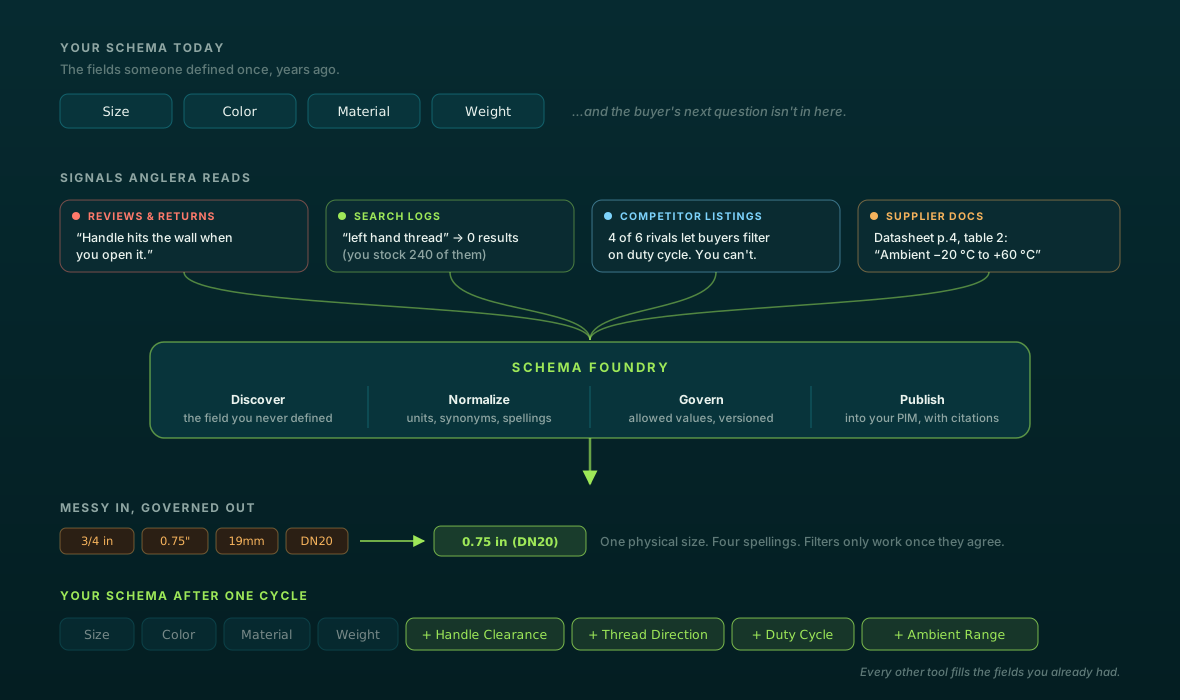
Values are normalized into a governed, versioned set of allowed values — so a filter works, and keeps working after the next import.

Nominal Size
3/4 in0.75"3/4"19mm3/4 inchDN20
0.75 in (DN20)

Six suppliers, six spellings, one physical size. Filters only work once they agree.

Finish
BlkblackBLACK MATTEMatte BlkRAL 9005
Black — Matte

Free text makes a colour filter useless. A governed value makes it a facet.

Material
SS316316 StainlessStainless Steel 316A4 Stainless
Stainless Steel — 316 / A4

Same alloy, four vocabularies, plus a trade name. Buyers search all of them.

And the part nobody else does

We don't just fill the template you handed us.

Filling the fields you defined has an invisible ceiling: a catalog can hit 100% complete and still miss the attribute that loses the sale, because completeness is measured against a schema someone drew years ago. Schema Foundry reads competitor listings, buyer searches, review complaints and your supplier docs, and proposes the fields you never defined — which is where GroupBy (Enrich AI) stops.

How Schema Foundry works
Schema Foundry: signals from reviews, search logs, competitor listings and supplier documents reveal attributes missing from your schema; the Foundry discovers, normalizes and governs them, so your schema ends the cycle with more fields than it started with.

What GroupBy (Enrich AI) does

GroupBy is an AI-first eCommerce search and product discovery platform (powered by Google Cloud Vertex AI) that launched Enrich AI in August 2024 as a catalog enrichment module. It uses generative AI and GroupBy's proprietary Global Taxonomy Library to extract and standardize product attributes from text and images, primarily for B2C and B2B retail and wholesale eCommerce.

GroupBy (Enrich AI) website

When GroupBy (Enrich AI) is the right call

Retail and wholesale eCommerce teams standardizing on GroupBy search who want attributes classified against a maintained Global Taxonomy and refined by their own site-search and null-query data.

We'd rather tell you here than in month three of an implementation.

Capability verdicts reviewed against GroupBy (Enrich AI)'s public documentation on July 14, 2026. Vendors ship quickly — if something here is out of date, tell us and we'll correct it.

See it on your own SKUs.

Bring one category and your supplier files. In 30 minutes you'll see it enriched — complete, structured, and consistent enough to launch on — plus the attributes your schema didn't have yet.

Book a demo