Constructor vs GroupBy Enrich AI: Which Product Discovery Platform Belongs in Your Stack?
Both Constructor and GroupBy Enrich AI exist because the same problem keeps surfacing: search results fail when product data is thin, inconsistent, or missing key attributes. But the two platforms solve it from different starting points. Constructor leads with behavioral clickstream intelligence — it learns from what shoppers actually click and buy, then uses enrichment to sharpen its own index. GroupBy leads with a generative AI module (Enrich AI, launched August 2024) that extracts and standardizes attributes from product text and images, with those cleaner attributes then feeding its search and merchandising suite.
The distinction matters because it shapes where each platform adds value, what catalog conditions it needs to work well, and what work it leaves for you to do upstream. A buyer choosing between these two is really asking: do I want behavioral learning or content-based extraction as the primary enrichment driver?
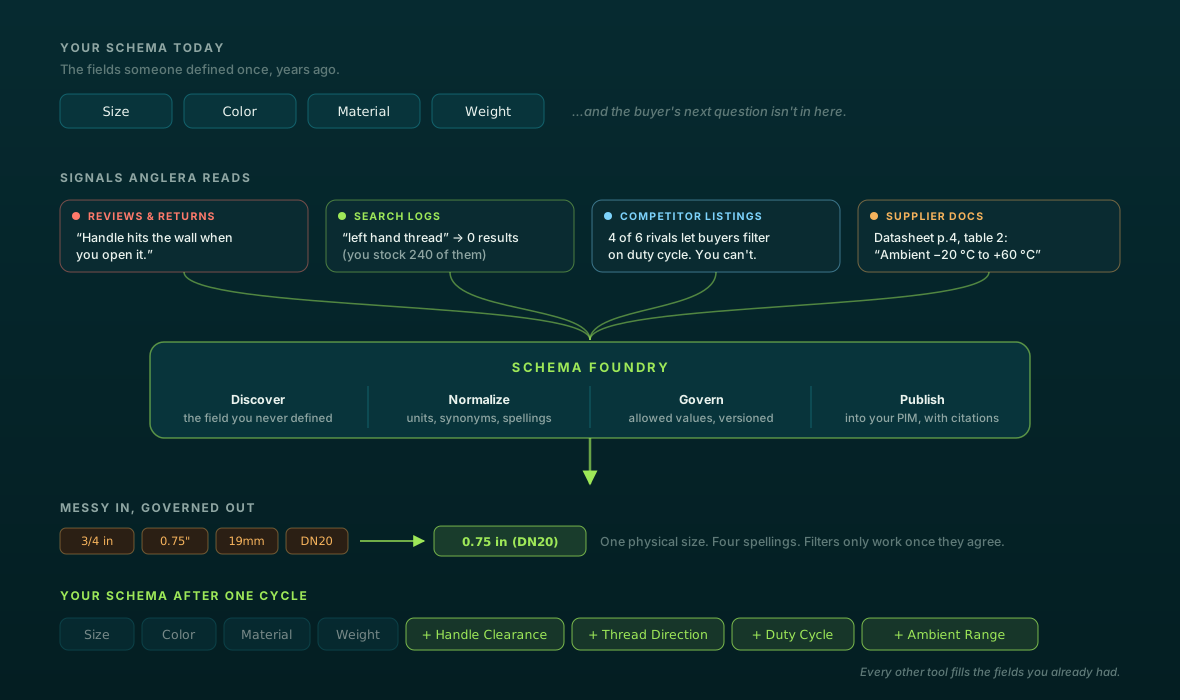
This page compares both honestly across the dimensions a real buyer cares about, then explains where Anglera fits regardless of which you choose — because neither platform solves the upstream problem of getting raw, inconsistent supplier data clean and structured before it enters any search layer.
| Constructor | GroupBy (Enrich AI) | Anglera | |
|---|---|---|---|
| Primary function and enrichment role | AI-powered search and product discovery platform for enterprise ecommerce. Enrichment is a supporting feature that improves the quality of Constructor's own index — it exists to make search better, not to produce portable, PIM-ready attribute data. | AI-first search and discovery suite built on Google Cloud Vertex AI. Enrich AI is a dedicated catalog enrichment module within the suite, using generative AI and GroupBy's proprietary Global Taxonomy Library to extract and standardize attributes from text and images. | Standalone enrichment layer that sits upstream of any search or discovery platform. Gathers raw data from supplier feeds, PDFs, and spec sheets; cleans, tags, and scores every SKU; then writes structured attributes back to the PIM so every downstream system benefits. |
| Enrichment mechanism | Behavioral and inferential. Constructor uses clickstream data — clicks, add-to-carts, conversions — to infer relevance and auto-tag attributes. Thin catalogs with low traffic generate sparse signals, which slows the learning curve. | Content-based and generative. Enrich AI parses product descriptions and images using generative AI, then maps extracted attributes to GroupBy's Global Taxonomy Library to standardize them. Quality depends on the richness of the source text and images available. | Source-data and signal-driven. Anglera pulls from supplier PDFs, spec sheets, and existing feeds, then enriches against buyer demand signals (search trends, category velocity) to ensure attributes reflect what buyers actually look for — not just what suppliers provide. |
| Where enriched data flows | Enriched attributes live inside Constructor's index. They improve search results within the Constructor environment but do not automatically flow back to the PIM, ERP, or other downstream channels without custom integration work. | Enriched attributes stay within the GroupBy ecosystem and feed its search and merchandising tools. Portability to external systems is not a core use case and would require custom work. | Writes directly back to the system of record — the PIM, ERP, or master catalog. Every downstream channel, including Constructor or GroupBy, automatically receives cleaner data without additional integration per channel. |
| Best-fit catalog and buyer profile | B2C enterprise retailers and large marketplaces with meaningful click-and-conversion volume and catalogs that already carry baseline attributes. Revenue-driven teams that want search performance tied to measurable commerce outcomes. | B2C and B2B retail and wholesale ecommerce operators whose products have text descriptions and images that generative AI can parse. Teams looking for enrichment that feeds tightly into the same vendor's search and merchandising layer. | B2B distributors, manufacturers, and industrial retailers with high SKU counts, technical or complex attributes, and supplier data arriving in inconsistent formats. Organizations that need enrichment to write back to the PIM — not stay siloed inside a search platform. |
| Implementation scope and timeline | Full-platform deployment that typically replaces or layers over existing search infrastructure. Enterprise onboarding involves search indexing, behavioral data pipelines, and A/B testing setup — a multi-month commitment. | Enrich AI is a module within the broader GroupBy suite. Deploying the suite is an enterprise-scale engagement. The enrichment module alone requires that GroupBy's broader platform integration is already in place or planned. | Approximately 30-day implementation. Connects to the existing PIM and supplier data sources without replacing any search, merchandising, or commerce platform. No behavioral data pipeline or search reindexing required to get started. |
| Pricing model | Custom enterprise pricing. Estimated average contract value of $150K–$300K per year, scaled by interaction volume. Full-platform commitment — enrichment is not available as a standalone purchase. | Pricing not publicly disclosed. Delivered as part of the GroupBy suite; Enrich AI does not appear to be available as a standalone module outside the broader platform. | Custom pricing based on SKU volume and enrichment scope. Scoped independently of any search or discovery platform — no requirement to change or replace existing commerce tooling. |
How to choose between Constructor and GroupBy (Enrich AI)
Choose Constructor if your primary objective is revenue-driven search performance and you have the clickstream volume to make behavioral learning meaningful. Constructor is the right pick when you want a platform that ties search investment directly to conversion metrics, and when enrichment is something you want the platform to handle internally rather than manage as a separate data discipline. It suits enterprise B2C retailers with established traffic and teams that want a single vendor responsible for search outcomes.
Choose GroupBy Enrich AI if you want generative AI to extract and standardize attributes from your existing product content — descriptions, images, spec text — and you want that enrichment to feed tightly into the same vendor's search and merchandising layer. It is a reasonable choice for retail and wholesale operators who are already evaluating or using GroupBy's broader platform and want enrichment embedded in that workflow rather than managed separately.
Avoid both if your primary problem is upstream: inconsistent supplier data, missing attributes arriving in raw PDFs or non-standard feeds, or catalog data that needs to be clean in the PIM before any search layer sees it. Neither Constructor nor GroupBy Enrich AI is designed to ingest messy multi-supplier data and write structured output back to the source of record. That is a different problem — and it is the one Anglera is built to solve.
Whichever you pick, the data still has to get done
Whichever platform you choose, the enrichment work has to happen somewhere — and both Constructor and GroupBy assume it has already happened.
Constructor's behavioral learning works best when product attributes are already accurate and complete. A SKU with three attributes generates weaker signals than one with fifteen. Feeding a thin catalog into Constructor means the platform spends months learning from noise before it can act on signal. GroupBy's generative extraction is only as good as the source text and images it receives. If supplier-provided descriptions are vague, duplicated, or non-standard — which they typically are in B2B environments — the AI is extracting from a weak foundation.
Anglera handles the layer both platforms assume is already done. It pulls raw data from supplier PDFs, spec sheets, and inconsistent feeds; standardizes and enriches attributes against buyer demand signals; and writes clean, structured data back to the PIM. Once that layer is in place, Constructor indexes higher-quality data from day one and GroupBy Enrich AI starts with a stronger content foundation to extract from. The behavioral learning curve shortens. The generative extraction produces more consistent outputs.
Anglera takes approximately 30 days to implement and connects to existing PIMs without replacing any search, merchandising, or commerce layer. It does not compete with Constructor or GroupBy — it does the upstream work that makes either platform perform better.
Frequently asked questions
Is Constructor or GroupBy Enrich AI primarily an enrichment platform?
Neither. Both are search and product discovery platforms that use enrichment as a means to improve their own indexes. Constructor enriches through behavioral inference; GroupBy Enrich AI extracts attributes using generative AI. If your core need is enrichment that writes back to the PIM and flows to multiple downstream systems, you are looking at a different category of tool.
Can I use Constructor or GroupBy without replacing my existing PIM?
Yes. Both operate as search and discovery layers that sit alongside your PIM rather than replacing it. However, enriched attributes generated within either platform typically remain within that platform's index. Getting those attributes written back to the PIM automatically requires custom integration work that is not part of either platform's standard offering.
Where does Anglera fit if I already use or plan to use Constructor or GroupBy?
Anglera handles the enrichment work that should happen before data enters the search layer. It ingests raw supplier data, enriches and scores every SKU, and writes structured attributes back to your PIM. Constructor and GroupBy then receive cleaner, more complete product data — which improves discovery quality regardless of which platform you choose. Anglera does not replace either; it feeds both.
How do Constructor and GroupBy handle B2B catalogs specifically?
GroupBy explicitly targets B2B retail and wholesale ecommerce alongside B2C, and its Global Taxonomy Library is designed to standardize attributes across those verticals. Constructor's documented strengths are primarily in B2C enterprise retail, though it supports B2B scenarios. Neither platform is purpose-built for the industrial or technical attribute complexity common in distribution — high SKU counts, supplier-specific naming conventions, and data arriving in unstructured formats.
What does implementation actually involve for each platform?
Constructor and GroupBy are both enterprise-scale platforms with multi-month implementation timelines that include search indexing, data pipeline setup, and organizational onboarding. Anglera is scoped differently: approximately 30 days to connect to an existing PIM and begin enriching SKUs. Because Anglera writes back to the PIM rather than replacing any search layer, it does not require a platform migration or search reindexing to deliver value.